




















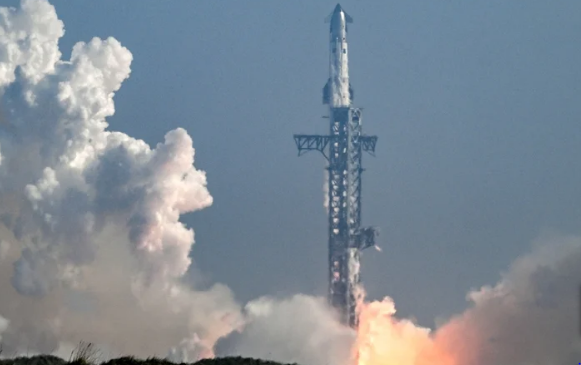
SpaceX’s Starship spacecraft completed a controlled splashdown in the Indian Ocean following a largely successful test flight of its latest upgraded version, marking another milestone in the company’s ambitious push toward deep-space missions and a potential record-breaking initial public offering.
The launch took place shortly after 5:30 p.m. local time, with the towering rocket lifting off smoothly before SpaceX engineers and employees monitoring the livestream reacted with visible excitement as the mission progressed. While the flight experienced several technical issues, the overall test was deemed a success by the company, which has been steadily refining the world’s largest rocket system.
The mission did not include recovery of either the Super Heavy booster or the upper stage. Instead, SpaceX focused on demonstrating new design improvements, with the spacecraft executing a controlled descent into the ocean as planned. The company confirmed the outcome on social media, posting: “Splashdown confirmed!”
During the flight, the third-generation Starship performed a critical maneuver involving an upright flip and engine re-ignition designed to test attitude control systems. One engine failed to operate during a burn sequence, resulting in an imperfect orbital insertion. Despite this, SpaceX spokesperson Dan Huot said the trajectory remained “within bounds” of expected parameters.
The booster stage separated as intended but did not complete its planned return burn, falling uncontrolled into the Gulf of Mexico. Although recovery was not required for this mission, engineers had aimed to test a more precise return profile.
SpaceX CEO Elon Musk praised the team’s efforts on X, describing the flight as “epic” and adding, “You scored a goal for humanity,” while acknowledging that further development is still needed.
The test comes at a critical time for the company, which is preparing for a potential initial public offering that could become one of the largest in history. Regulatory filings have already been submitted, with market observers expecting a possible listing as early as June.
Starship’s latest version stands over 124 metres when fully stacked and represents the most powerful rocket system ever developed. It is central to NASA’s Artemis programme, which aims to return humans to the Moon later this decade, while China advances its own competing lunar ambitions.
Experts noted that while the test demonstrated meaningful progress, significant work remains before Starship is ready for crewed missions or orbital docking operations. NASA officials, including Administrator Jared Isaacman, praised the launch, calling it a “step closer to the Moon and Mars,” underscoring the vehicle’s role in future exploration plans.



















