

















Connect with us

Hi, what are you looking for?

News

The Silent Closures: Britain’s Hospitality Sector Faces Mounting Pressure Amid Rising Costs”

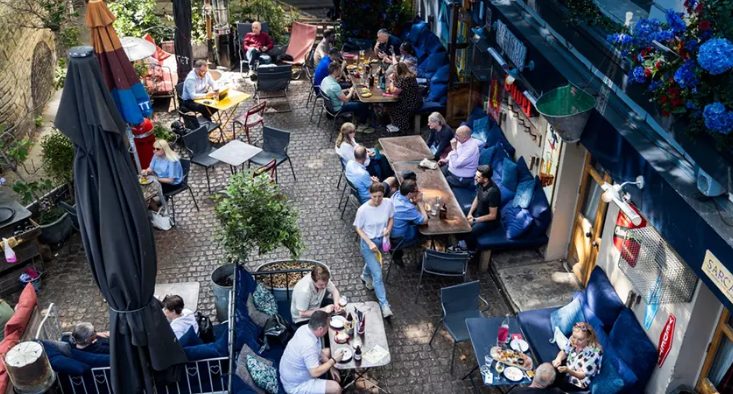
A quiet transformation is unfolding across Britain’s restaurants and pubs, where once-busy dining rooms are increasingly falling silent as rising costs force many businesses to shut their doors.

Across the country, hospitality owners describe a growing financial strain that is pushing independent venues to the brink. In west London, one neighbourhood bistro owner recently confirmed he will close in September, despite steady customer traffic. The former banker-turned-restaurateur said demand is not the issue, but the balance sheets no longer add up.

Industry groups say his case is far from isolated. UKHospitality estimates that roughly one pub or restaurant closed every day last year, while campaigners from Hospitality Rising report rising numbers of chefs leaving the profession and venues being converted into coffee shops or convenience stores.

Business leaders point to a series of policy and cost pressures converging at once. From April 2025, employer National Insurance rose to 15 per cent, while the threshold for payments was lowered to £5,000. At the same time, the National Living Wage increased to £12.21 an hour, and business rates relief was reduced from 75 per cent to 40 per cent. Industry estimates suggest these changes collectively add around £3.4 billion annually to sector costs.

Hospitality groups also criticise the UK’s value-added tax regime, arguing that it leaves British operators at a disadvantage compared with European competitors. Recruitment constraints and limits on overseas labour have added further strain, particularly for kitchens and front-of-house staffing.

Government ministers have defended their economic strategy, urging businesses to adapt through productivity gains and new technologies. Proposals to integrate artificial intelligence into service roles have been floated as part of wider efficiency reforms, although industry figures question how practical such solutions are in customer-facing environments.

Hospitality, however, remains one of the UK’s largest employers, supporting around 3.5 million jobs. Many of those positions are held by younger workers entering the labour market for the first time. Sector advocates argue that restaurants and pubs provide essential training grounds for communication, teamwork, and service skills that extend far beyond the industry itself.

The impact of closures, they say, extends well beyond individual businesses. Supply chains linked to food producers, laundries, transport firms, and local suppliers all feel the effects when a venue shuts down.

As more establishments struggle to stay open, industry voices warn that the broader ecosystem supporting Britain’s high streets is under increasing pressure. While government officials maintain that reforms are aimed at long-term growth, business owners continue to describe a more immediate reality—one in which rising costs are reshaping the landscape of everyday dining and community life across the country.


Business

Fraudsters are increasingly using AI-generated images and videos to trick people into handing over sensitive personal and financial information, according to FraudSMART, the financial crime awareness initiative operated by the Banking and Payments Federation Ireland (BPFI). The organisation has reported a rise in online adverts promoting fake, State-backed investment schemes. These scams often use fabricated images of well-known politicians and business figures to make the offers appear legitimate and encourage users to click on registration links. Niamh Davenport, head of financial crime at BPFI, said scammers are deliberately exploiting recent media coverage of a planned State-backed savings and investment scheme to give their frauds a sense of credibility. “They often claim the scheme is open to everyone, but that places are limited and being ‘snapped up’ fast, in order to pressure people to act quickly,” she said. “They typically promise guaranteed returns or a guaranteed monthly income.” FraudSMART said that while anyone can be targeted, people in their early 50s are particularly vulnerable to investment scams. This age group is often focused on retirement planning, making them more receptive to financial offers that appear secure or high-yield. According to the organisation, most scams follow a similar pattern. Victims are first directed to click a registration link and complete a short online form providing their contact details. They are then contacted by someone posing as a financial adviser, who urges them to make an immediate “security deposit” to secure participation in the scheme. Once a payment is made, the money is quickly moved through multiple accounts, often overseas, making recovery extremely difficult. Davenport warned that scammers are becoming more sophisticated in their use of technology, particularly AI tools that allow them to create realistic but entirely fake promotional content. These materials are designed to mimic legitimate financial advertisements and build trust with potential victims. Recent figures from An Garda Síochána show investment fraud rose by 20% last year, with losses exceeding €20 million. The scale of individual scams varies widely, ranging from smaller crypto-related frauds involving a few hundred euro to large-scale investment schemes where victims lose tens of thousands. FraudSMART is urging the public to remain cautious when encountering online investment advertisements, especially those promising guaranteed returns or requiring urgent action. It also advises consumers to avoid sharing personal information with unverified sources and to be wary of pressure tactics designed to rush financial decisions. Authorities continue to warn that fraudsters are adapting quickly, using advanced digital tools to target victims across multiple platforms.

Trending

Business

Fraudsters are increasingly using AI-generated images and videos to trick people into handing over sensitive personal and financial information, according to FraudSMART, the financial crime awareness initiative operated by the Banking and Payments Federation Ireland (BPFI). The organisation has reported a rise in online adverts promoting fake, State-backed investment schemes. These scams often use fabricated images of well-known politicians and business figures to make the offers appear legitimate and encourage users to click on registration links. Niamh Davenport, head of financial crime at BPFI, said scammers are deliberately exploiting recent media coverage of a planned State-backed savings and investment scheme to give their frauds a sense of credibility. “They often claim the scheme is open to everyone, but that places are limited and being ‘snapped up’ fast, in order to pressure people to act quickly,” she said. “They typically promise guaranteed returns or a guaranteed monthly income.” FraudSMART said that while anyone can be targeted, people in their early 50s are particularly vulnerable to investment scams. This age group is often focused on retirement planning, making them more receptive to financial offers that appear secure or high-yield. According to the organisation, most scams follow a similar pattern. Victims are first directed to click a registration link and complete a short online form providing their contact details. They are then contacted by someone posing as a financial adviser, who urges them to make an immediate “security deposit” to secure participation in the scheme. Once a payment is made, the money is quickly moved through multiple accounts, often overseas, making recovery extremely difficult. Davenport warned that scammers are becoming more sophisticated in their use of technology, particularly AI tools that allow them to create realistic but entirely fake promotional content. These materials are designed to mimic legitimate financial advertisements and build trust with potential victims. Recent figures from An Garda Síochána show investment fraud rose by 20% last year, with losses exceeding €20 million. The scale of individual scams varies widely, ranging from smaller crypto-related frauds involving a few hundred euro to large-scale investment schemes where victims lose tens of thousands. FraudSMART is urging the public to remain cautious when encountering online investment advertisements, especially those promising guaranteed returns or requiring urgent action. It also advises consumers to avoid sharing personal information with unverified sources and to be wary of pressure tactics designed to rush financial decisions. Authorities continue to warn that fraudsters are adapting quickly, using advanced digital tools to target victims across multiple platforms.

You May Also Like

Politics

WASHINGTON — The Pentagon announced on Sunday that the United States will send a Terminal High Altitude Area Defense (THAAD) battery to Israel, alongside...

Health

NEW YORK — Teen smoking in the United States has reached an all-time low in 2024, with significant declines in overall youth tobacco use,...

Politics

WASHINGTON — As the countdown to the November 5 presidential election continues, former President Donald Trump is urging his supporters to aim for a...

Politics

In September, NASA announced that summer 2024 was the hottest on record. Just days later, the U.S. faced the dual impact of Hurricanes Helene...