














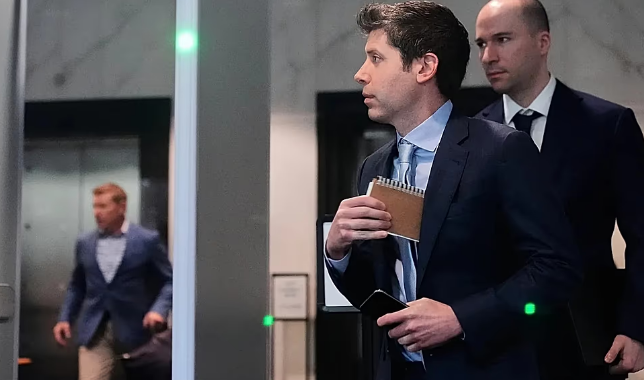
OpenAI chief executive Sam Altman took the witness stand on Tuesday in a closely watched courtroom battle against billionaire entrepreneur Elon Musk, defending both his personal credibility and the company’s transformation into one of the world’s leading artificial intelligence firms.
The trial, now entering its third week, centers on allegations by Musk that OpenAI abandoned its original nonprofit mission after receiving millions of dollars in support from him during the company’s early years. Musk claims he contributed around $38 million to help establish OpenAI as a charity focused on developing artificial intelligence for the public good, only for the organization to later adopt a profit-driven structure.
Under questioning from Musk’s legal team, Altman rejected suggestions that he had misled investors or colleagues during the company’s rise.
“I believe I am an honest and trustworthy businessperson,” Altman told the court, responding to earlier testimony that challenged his leadership style and decision-making.
The case could have major consequences for OpenAI, which has attracted billions of dollars in investment and emerged as a dominant force in the AI industry through the success of ChatGPT and other advanced language models.
During his testimony, Altman described tensions that developed between himself and Musk shortly after OpenAI was founded in 2015. He said there were concerns among company founders about how much control Musk wanted over the organization as discussions took place about leadership and governance.
Altman told the jury that OpenAI’s founders believed artificial general intelligence, often called AGI, should never be controlled by a single individual. He recalled what he described as a troubling conversation in which Musk allegedly suggested that control of the organization could eventually pass to his children.
“That was not something I felt comfortable with,” Altman said.
According to evidence presented during the trial, OpenAI’s founders initially aimed to raise about $100 million to launch the research organization. However, the enormous costs associated with developing advanced AI systems quickly pushed funding needs into the billions.
OpenAI has argued that the scale of investment required made a purely nonprofit structure impossible to sustain. Court documents and earlier company statements claim Musk supported the idea of creating a for-profit arm but later sought majority ownership, board control and the chief executive position.
Altman also testified that Musk eventually distanced himself from OpenAI, leaving the company struggling financially during a critical stage of development.
“I felt like he had abandoned us,” Altman told the court. “It’s been an extremely painful thing for me to see someone I respected so much continue to publicly attack us.”
The trial continues as jurors weigh competing accounts of OpenAI’s origins, leadership disputes and the future direction of one of the most influential technology companies in the world.