















Connect with us

Hi, what are you looking for?

Technology

Altman Defends OpenAI Leadership in Court Clash With Musk

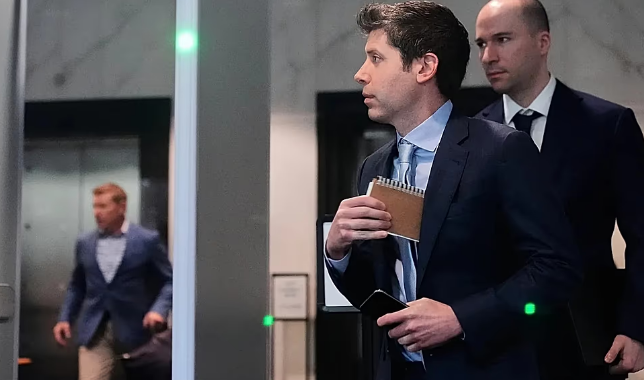
OpenAI chief executive Sam Altman took the witness stand on Tuesday in a closely watched courtroom battle against billionaire entrepreneur Elon Musk, defending both his personal credibility and the company’s transformation into one of the world’s leading artificial intelligence firms.

The trial, now entering its third week, centers on allegations by Musk that OpenAI abandoned its original nonprofit mission after receiving millions of dollars in support from him during the company’s early years. Musk claims he contributed around $38 million to help establish OpenAI as a charity focused on developing artificial intelligence for the public good, only for the organization to later adopt a profit-driven structure.

Under questioning from Musk’s legal team, Altman rejected suggestions that he had misled investors or colleagues during the company’s rise.

“I believe I am an honest and trustworthy businessperson,” Altman told the court, responding to earlier testimony that challenged his leadership style and decision-making.

The case could have major consequences for OpenAI, which has attracted billions of dollars in investment and emerged as a dominant force in the AI industry through the success of ChatGPT and other advanced language models.

During his testimony, Altman described tensions that developed between himself and Musk shortly after OpenAI was founded in 2015. He said there were concerns among company founders about how much control Musk wanted over the organization as discussions took place about leadership and governance.

Altman told the jury that OpenAI’s founders believed artificial general intelligence, often called AGI, should never be controlled by a single individual. He recalled what he described as a troubling conversation in which Musk allegedly suggested that control of the organization could eventually pass to his children.

“That was not something I felt comfortable with,” Altman said.

According to evidence presented during the trial, OpenAI’s founders initially aimed to raise about $100 million to launch the research organization. However, the enormous costs associated with developing advanced AI systems quickly pushed funding needs into the billions.

OpenAI has argued that the scale of investment required made a purely nonprofit structure impossible to sustain. Court documents and earlier company statements claim Musk supported the idea of creating a for-profit arm but later sought majority ownership, board control and the chief executive position.

Altman also testified that Musk eventually distanced himself from OpenAI, leaving the company struggling financially during a critical stage of development.

“I felt like he had abandoned us,” Altman told the court. “It’s been an extremely painful thing for me to see someone I respected so much continue to publicly attack us.”

The trial continues as jurors weigh competing accounts of OpenAI’s origins, leadership disputes and the future direction of one of the most influential technology companies in the world.

Business

Fraudsters are increasingly using AI-generated images and videos to trick people into handing over sensitive personal and financial information, according to FraudSMART, the financial crime awareness initiative operated by the Banking and Payments Federation Ireland (BPFI). The organisation has reported a rise in online adverts promoting fake, State-backed investment schemes. These scams often use fabricated images of well-known politicians and business figures to make the offers appear legitimate and encourage users to click on registration links. Niamh Davenport, head of financial crime at BPFI, said scammers are deliberately exploiting recent media coverage of a planned State-backed savings and investment scheme to give their frauds a sense of credibility. “They often claim the scheme is open to everyone, but that places are limited and being ‘snapped up’ fast, in order to pressure people to act quickly,” she said. “They typically promise guaranteed returns or a guaranteed monthly income.” FraudSMART said that while anyone can be targeted, people in their early 50s are particularly vulnerable to investment scams. This age group is often focused on retirement planning, making them more receptive to financial offers that appear secure or high-yield. According to the organisation, most scams follow a similar pattern. Victims are first directed to click a registration link and complete a short online form providing their contact details. They are then contacted by someone posing as a financial adviser, who urges them to make an immediate “security deposit” to secure participation in the scheme. Once a payment is made, the money is quickly moved through multiple accounts, often overseas, making recovery extremely difficult. Davenport warned that scammers are becoming more sophisticated in their use of technology, particularly AI tools that allow them to create realistic but entirely fake promotional content. These materials are designed to mimic legitimate financial advertisements and build trust with potential victims. Recent figures from An Garda Síochána show investment fraud rose by 20% last year, with losses exceeding €20 million. The scale of individual scams varies widely, ranging from smaller crypto-related frauds involving a few hundred euro to large-scale investment schemes where victims lose tens of thousands. FraudSMART is urging the public to remain cautious when encountering online investment advertisements, especially those promising guaranteed returns or requiring urgent action. It also advises consumers to avoid sharing personal information with unverified sources and to be wary of pressure tactics designed to rush financial decisions. Authorities continue to warn that fraudsters are adapting quickly, using advanced digital tools to target victims across multiple platforms.

Trending

Business

Fraudsters are increasingly using AI-generated images and videos to trick people into handing over sensitive personal and financial information, according to FraudSMART, the financial crime awareness initiative operated by the Banking and Payments Federation Ireland (BPFI). The organisation has reported a rise in online adverts promoting fake, State-backed investment schemes. These scams often use fabricated images of well-known politicians and business figures to make the offers appear legitimate and encourage users to click on registration links. Niamh Davenport, head of financial crime at BPFI, said scammers are deliberately exploiting recent media coverage of a planned State-backed savings and investment scheme to give their frauds a sense of credibility. “They often claim the scheme is open to everyone, but that places are limited and being ‘snapped up’ fast, in order to pressure people to act quickly,” she said. “They typically promise guaranteed returns or a guaranteed monthly income.” FraudSMART said that while anyone can be targeted, people in their early 50s are particularly vulnerable to investment scams. This age group is often focused on retirement planning, making them more receptive to financial offers that appear secure or high-yield. According to the organisation, most scams follow a similar pattern. Victims are first directed to click a registration link and complete a short online form providing their contact details. They are then contacted by someone posing as a financial adviser, who urges them to make an immediate “security deposit” to secure participation in the scheme. Once a payment is made, the money is quickly moved through multiple accounts, often overseas, making recovery extremely difficult. Davenport warned that scammers are becoming more sophisticated in their use of technology, particularly AI tools that allow them to create realistic but entirely fake promotional content. These materials are designed to mimic legitimate financial advertisements and build trust with potential victims. Recent figures from An Garda Síochána show investment fraud rose by 20% last year, with losses exceeding €20 million. The scale of individual scams varies widely, ranging from smaller crypto-related frauds involving a few hundred euro to large-scale investment schemes where victims lose tens of thousands. FraudSMART is urging the public to remain cautious when encountering online investment advertisements, especially those promising guaranteed returns or requiring urgent action. It also advises consumers to avoid sharing personal information with unverified sources and to be wary of pressure tactics designed to rush financial decisions. Authorities continue to warn that fraudsters are adapting quickly, using advanced digital tools to target victims across multiple platforms.

You May Also Like

Politics

WASHINGTON — The Pentagon announced on Sunday that the United States will send a Terminal High Altitude Area Defense (THAAD) battery to Israel, alongside...

Health

NEW YORK — Teen smoking in the United States has reached an all-time low in 2024, with significant declines in overall youth tobacco use,...

Politics

WASHINGTON — As the countdown to the November 5 presidential election continues, former President Donald Trump is urging his supporters to aim for a...

Politics

In September, NASA announced that summer 2024 was the hottest on record. Just days later, the U.S. faced the dual impact of Hurricanes Helene...