
















Connect with us

Hi, what are you looking for?

Politics

Zelensky’s Diplomatic Struggles Amid Ongoing War

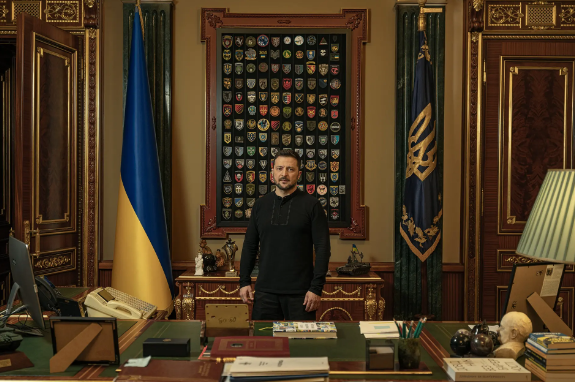
Ukrainian President Volodymyr Zelensky continues to navigate complex diplomatic challenges nearly six years into his presidency, as the war with Russia grinds on. His office, adorned with opulent gold leaf and chandeliers, stands in stark contrast to the grim realities of his wartime leadership. With his focus on Ukraine’s survival, renovations remain an afterthought.

A small private space behind his desk reflects his wartime mindset. Among personal decorations, paintings depict a Russian warship sinking, Ukrainian troops advancing on Russian soil, and a dramatic image of the Kremlin in flames—symbols of the victory he relentlessly pursues.

Tense Exchange with Trump

On February 28, Zelensky’s diplomatic efforts faced a setback during a meeting with former U.S. President Donald Trump and Vice President J.D. Vance. In widely circulated footage, Trump accused Zelensky of being ungrateful and warned that Ukraine was risking a broader conflict. “You don’t hold the cards,” Trump reportedly told him.

Zelensky, who had prepared symbolic gifts to ease tensions, instead presented photographs depicting Ukrainian prisoners of war subjected to Russian captivity. The move, intended to highlight the war’s brutal toll, appeared to exacerbate tensions. Vance dismissed Ukraine’s efforts as “propaganda tours,” underscoring skepticism among some U.S. officials about Kyiv’s diplomatic approach.

Honoring Ukraine’s Resistance

Days later, Zelensky visited Moshchun, a village that played a crucial role in stopping Russia’s advance toward Kyiv in 2022. At a memorial ceremony, he honored fallen defenders in a battlefield now lined with flags bearing the phrase “Ukraine or Death.”

The event underscored the challenge of keeping global attention on Ukraine’s war efforts as the conflict stretches on. While the battlefields of yesterday become memorials, Zelensky faces an uphill battle to sustain international engagement.

Ongoing Russian Attacks and Global Support

As Ukraine marked the anniversary of the battle, Russian forces launched another wave of drone strikes, targeting Odesa and causing widespread power outages. Among those narrowly escaping the attack was Czech President Petr Pavel, a vocal supporter of Ukraine. His train departed Odesa just minutes before the bombardment began.

During a visit to Finland, Zelensky observed the country’s extensive underground shelters designed to protect civilians from potential Russian threats. Impressed by their preparedness, he signed an agreement to develop similar structures in Ukraine.

Uncertain Future Amid Waning Support

Despite Zelensky’s diplomatic outreach, international backing for Ukraine appears to be fading. A peace summit in Switzerland last year outlined Ukraine’s Peace Formula, demanding a full Russian withdrawal and accountability for war crimes. However, leaders like Pavel acknowledge that achieving these objectives in the short term remains unlikely, raising concerns of a protracted conflict akin to Korea or Cold War-era Germany.

Recent negotiations between Zelensky and Trump centered on leveraging Ukraine’s mineral wealth to secure U.S. aid. Although an agreement was tentatively reached, tensions during their meeting prevented its finalization. Trump subsequently froze military assistance to Ukraine, further straining its battlefield capabilities.

Zelensky remains defiant despite these setbacks. “Morale depends on whether your partners stand beside you,” he said. However, as Ukraine struggles to maintain global support, the road ahead remains increasingly uncertain.


Business

Fraudsters are increasingly using AI-generated images and videos to trick people into handing over sensitive personal and financial information, according to FraudSMART, the financial crime awareness initiative operated by the Banking and Payments Federation Ireland (BPFI). The organisation has reported a rise in online adverts promoting fake, State-backed investment schemes. These scams often use fabricated images of well-known politicians and business figures to make the offers appear legitimate and encourage users to click on registration links. Niamh Davenport, head of financial crime at BPFI, said scammers are deliberately exploiting recent media coverage of a planned State-backed savings and investment scheme to give their frauds a sense of credibility. “They often claim the scheme is open to everyone, but that places are limited and being ‘snapped up’ fast, in order to pressure people to act quickly,” she said. “They typically promise guaranteed returns or a guaranteed monthly income.” FraudSMART said that while anyone can be targeted, people in their early 50s are particularly vulnerable to investment scams. This age group is often focused on retirement planning, making them more receptive to financial offers that appear secure or high-yield. According to the organisation, most scams follow a similar pattern. Victims are first directed to click a registration link and complete a short online form providing their contact details. They are then contacted by someone posing as a financial adviser, who urges them to make an immediate “security deposit” to secure participation in the scheme. Once a payment is made, the money is quickly moved through multiple accounts, often overseas, making recovery extremely difficult. Davenport warned that scammers are becoming more sophisticated in their use of technology, particularly AI tools that allow them to create realistic but entirely fake promotional content. These materials are designed to mimic legitimate financial advertisements and build trust with potential victims. Recent figures from An Garda Síochána show investment fraud rose by 20% last year, with losses exceeding €20 million. The scale of individual scams varies widely, ranging from smaller crypto-related frauds involving a few hundred euro to large-scale investment schemes where victims lose tens of thousands. FraudSMART is urging the public to remain cautious when encountering online investment advertisements, especially those promising guaranteed returns or requiring urgent action. It also advises consumers to avoid sharing personal information with unverified sources and to be wary of pressure tactics designed to rush financial decisions. Authorities continue to warn that fraudsters are adapting quickly, using advanced digital tools to target victims across multiple platforms.

Trending

Business

Fraudsters are increasingly using AI-generated images and videos to trick people into handing over sensitive personal and financial information, according to FraudSMART, the financial crime awareness initiative operated by the Banking and Payments Federation Ireland (BPFI). The organisation has reported a rise in online adverts promoting fake, State-backed investment schemes. These scams often use fabricated images of well-known politicians and business figures to make the offers appear legitimate and encourage users to click on registration links. Niamh Davenport, head of financial crime at BPFI, said scammers are deliberately exploiting recent media coverage of a planned State-backed savings and investment scheme to give their frauds a sense of credibility. “They often claim the scheme is open to everyone, but that places are limited and being ‘snapped up’ fast, in order to pressure people to act quickly,” she said. “They typically promise guaranteed returns or a guaranteed monthly income.” FraudSMART said that while anyone can be targeted, people in their early 50s are particularly vulnerable to investment scams. This age group is often focused on retirement planning, making them more receptive to financial offers that appear secure or high-yield. According to the organisation, most scams follow a similar pattern. Victims are first directed to click a registration link and complete a short online form providing their contact details. They are then contacted by someone posing as a financial adviser, who urges them to make an immediate “security deposit” to secure participation in the scheme. Once a payment is made, the money is quickly moved through multiple accounts, often overseas, making recovery extremely difficult. Davenport warned that scammers are becoming more sophisticated in their use of technology, particularly AI tools that allow them to create realistic but entirely fake promotional content. These materials are designed to mimic legitimate financial advertisements and build trust with potential victims. Recent figures from An Garda Síochána show investment fraud rose by 20% last year, with losses exceeding €20 million. The scale of individual scams varies widely, ranging from smaller crypto-related frauds involving a few hundred euro to large-scale investment schemes where victims lose tens of thousands. FraudSMART is urging the public to remain cautious when encountering online investment advertisements, especially those promising guaranteed returns or requiring urgent action. It also advises consumers to avoid sharing personal information with unverified sources and to be wary of pressure tactics designed to rush financial decisions. Authorities continue to warn that fraudsters are adapting quickly, using advanced digital tools to target victims across multiple platforms.

You May Also Like

Politics

WASHINGTON — The Pentagon announced on Sunday that the United States will send a Terminal High Altitude Area Defense (THAAD) battery to Israel, alongside...

Health

NEW YORK — Teen smoking in the United States has reached an all-time low in 2024, with significant declines in overall youth tobacco use,...

Politics

WASHINGTON — As the countdown to the November 5 presidential election continues, former President Donald Trump is urging his supporters to aim for a...

Politics

In September, NASA announced that summer 2024 was the hottest on record. Just days later, the U.S. faced the dual impact of Hurricanes Helene...