















Connect with us

Hi, what are you looking for?

Politics

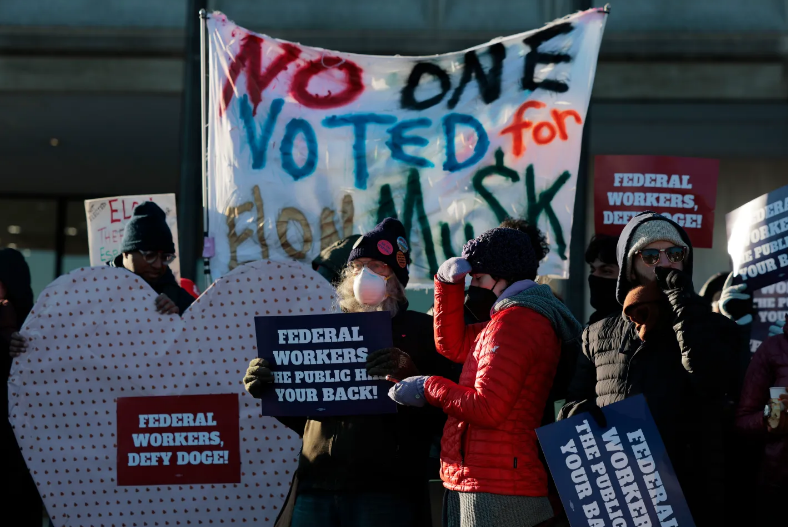
Mass Federal Layoffs Spark Outrage, Legal Challenges

Thousands of federal employees across the country are reeling from a wave of abrupt layoffs initiated by the Trump Administration, targeting probationary workers with less than two years of service. The cuts, which began last Thursday, have sent shockwaves through government agencies, prompting widespread condemnation and setting the stage for legal battles.

A U.S. Department of Agriculture (USDA) worker in Phoenix was stunned when he received his termination letter, citing “performance issues.” The worker, who had been on the job for just six weeks, says no one had raised any concerns before the dismissal. “There’s no way to tie me to a specific performance issue,” he told TIME, speaking anonymously.

He is one of thousands affected by the sweeping layoffs, which have hit multiple agencies, including the Department of Veterans Affairs (VA), the Internal Revenue Service (IRS), and the Department of Health and Human Services (HHS). The VA alone let go of more than 1,000 employees in a single day, with officials claiming the move would save $98 million per year.

A Radical Overhaul

The layoffs are part of a broader effort led by the Trump Administration and the newly created Department of Government Efficiency (DOGE), an initiative overseen by billionaire Elon Musk. The goal: streamline government operations and cut costs. Musk has publicly advocated for eliminating entire agencies, likening them to “weeds” that need to be removed.

Government unions and legal experts argue that many of these firings may be unlawful. The American Federation of Government Employees (AFGE) has vowed to challenge the layoffs in court, with President Everett Kelley calling the terminations “a violation of workers’ rights” and an attempt to “gut the federal government.”

The Office of Personnel Management (OPM)—now led by Musk allies—has justified the cuts by claiming probationary employees must prove their value to the government before their appointments are finalized.

Fallout and Employee Backlash

The layoffs have left federal employees shaken and scrambling. Some workers received pre-recorded termination messages, while others had their government access revoked instantly.

A senior IRS agent in New York who was hired in July expects to be fired soon. “I feel like the administration is demonizing federal workers,” he said.

An HR manager at the VA’s health administration, with more than two decades of experience, called the mass firings “the worst I’ve ever seen.” He revealed that even agency leaders were blindsided, learning about the terminations at the same time as the employees.

A lifelong Republican, he now regrets supporting Trump. “I voted for him three times. Never again,” he said, vowing to vote Democrat in the next election.

Buyouts and Skepticism

The layoffs follow a controversial buyout program, which offered federal employees a chance to leave their jobs voluntarily while continuing to receive pay through September. The White House claims 77,000 workers took the offer, but others declined, fearing the deal lacked proper funding.

“It’s a joke,” said a probationary IRS agent. “Nobody trusted it.”

Jordain Solis, a 27-year-old fuel compliance officer at the IRS, accepted the buyout, saying he no longer felt valued. “I didn’t want to work for a country that doesn’t respect public servants.”

A Government in Turmoil

The legal and political fallout from these cuts is just beginning. Many agencies are uncertain about the future, and federal workers are on edge. “Even senior leadership doesn’t know what’s happening,” one dismissed USDA worker said.

For now, the Trump Administration appears determined to push forward, despite growing legal challenges and bipartisan concerns that the cuts could cripple government functions.

A soon-to-be-fired IRS agent put it bluntly: “It’s funny—we have smart businessmen running this, but the last thing you do in business is cut your revenue stream. The IRS is the revenue stream. Cutting us doesn’t make any sense.”


Business

Fraudsters are increasingly using AI-generated images and videos to trick people into handing over sensitive personal and financial information, according to FraudSMART, the financial crime awareness initiative operated by the Banking and Payments Federation Ireland (BPFI). The organisation has reported a rise in online adverts promoting fake, State-backed investment schemes. These scams often use fabricated images of well-known politicians and business figures to make the offers appear legitimate and encourage users to click on registration links. Niamh Davenport, head of financial crime at BPFI, said scammers are deliberately exploiting recent media coverage of a planned State-backed savings and investment scheme to give their frauds a sense of credibility. “They often claim the scheme is open to everyone, but that places are limited and being ‘snapped up’ fast, in order to pressure people to act quickly,” she said. “They typically promise guaranteed returns or a guaranteed monthly income.” FraudSMART said that while anyone can be targeted, people in their early 50s are particularly vulnerable to investment scams. This age group is often focused on retirement planning, making them more receptive to financial offers that appear secure or high-yield. According to the organisation, most scams follow a similar pattern. Victims are first directed to click a registration link and complete a short online form providing their contact details. They are then contacted by someone posing as a financial adviser, who urges them to make an immediate “security deposit” to secure participation in the scheme. Once a payment is made, the money is quickly moved through multiple accounts, often overseas, making recovery extremely difficult. Davenport warned that scammers are becoming more sophisticated in their use of technology, particularly AI tools that allow them to create realistic but entirely fake promotional content. These materials are designed to mimic legitimate financial advertisements and build trust with potential victims. Recent figures from An Garda Síochána show investment fraud rose by 20% last year, with losses exceeding €20 million. The scale of individual scams varies widely, ranging from smaller crypto-related frauds involving a few hundred euro to large-scale investment schemes where victims lose tens of thousands. FraudSMART is urging the public to remain cautious when encountering online investment advertisements, especially those promising guaranteed returns or requiring urgent action. It also advises consumers to avoid sharing personal information with unverified sources and to be wary of pressure tactics designed to rush financial decisions. Authorities continue to warn that fraudsters are adapting quickly, using advanced digital tools to target victims across multiple platforms.

Trending

Business

Fraudsters are increasingly using AI-generated images and videos to trick people into handing over sensitive personal and financial information, according to FraudSMART, the financial crime awareness initiative operated by the Banking and Payments Federation Ireland (BPFI). The organisation has reported a rise in online adverts promoting fake, State-backed investment schemes. These scams often use fabricated images of well-known politicians and business figures to make the offers appear legitimate and encourage users to click on registration links. Niamh Davenport, head of financial crime at BPFI, said scammers are deliberately exploiting recent media coverage of a planned State-backed savings and investment scheme to give their frauds a sense of credibility. “They often claim the scheme is open to everyone, but that places are limited and being ‘snapped up’ fast, in order to pressure people to act quickly,” she said. “They typically promise guaranteed returns or a guaranteed monthly income.” FraudSMART said that while anyone can be targeted, people in their early 50s are particularly vulnerable to investment scams. This age group is often focused on retirement planning, making them more receptive to financial offers that appear secure or high-yield. According to the organisation, most scams follow a similar pattern. Victims are first directed to click a registration link and complete a short online form providing their contact details. They are then contacted by someone posing as a financial adviser, who urges them to make an immediate “security deposit” to secure participation in the scheme. Once a payment is made, the money is quickly moved through multiple accounts, often overseas, making recovery extremely difficult. Davenport warned that scammers are becoming more sophisticated in their use of technology, particularly AI tools that allow them to create realistic but entirely fake promotional content. These materials are designed to mimic legitimate financial advertisements and build trust with potential victims. Recent figures from An Garda Síochána show investment fraud rose by 20% last year, with losses exceeding €20 million. The scale of individual scams varies widely, ranging from smaller crypto-related frauds involving a few hundred euro to large-scale investment schemes where victims lose tens of thousands. FraudSMART is urging the public to remain cautious when encountering online investment advertisements, especially those promising guaranteed returns or requiring urgent action. It also advises consumers to avoid sharing personal information with unverified sources and to be wary of pressure tactics designed to rush financial decisions. Authorities continue to warn that fraudsters are adapting quickly, using advanced digital tools to target victims across multiple platforms.

You May Also Like

Politics

WASHINGTON — The Pentagon announced on Sunday that the United States will send a Terminal High Altitude Area Defense (THAAD) battery to Israel, alongside...

Health

NEW YORK — Teen smoking in the United States has reached an all-time low in 2024, with significant declines in overall youth tobacco use,...

Politics

WASHINGTON — As the countdown to the November 5 presidential election continues, former President Donald Trump is urging his supporters to aim for a...

Politics

In September, NASA announced that summer 2024 was the hottest on record. Just days later, the U.S. faced the dual impact of Hurricanes Helene...