
















Connect with us

Hi, what are you looking for?

Politics

Zelensky Heads to White House With European Leaders as Peace Deal Debate Intensifies

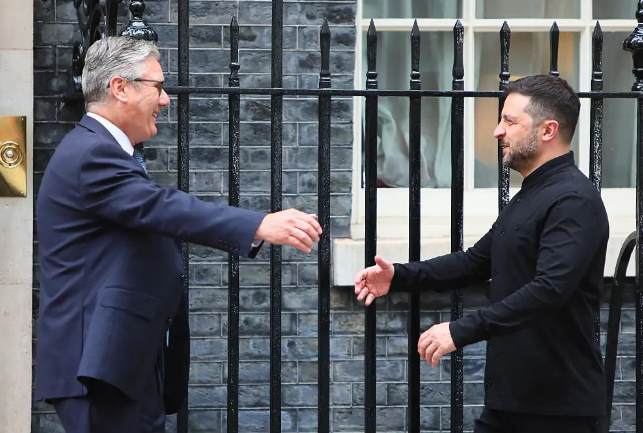
Ukrainian President Volodymyr Zelensky will return to the White House on Monday for the first time since a heated clash with President Donald Trump earlier this year that strained relations between Kyiv and Washington. This time, however, he will not come alone.

In a show of solidarity, several European leaders will join him, including German Chancellor Friedrich Merz, French President Emmanuel Macron, British Prime Minister Keir Starmer, Italian Prime Minister Giorgia Meloni, Finnish President Alexander Stubb, and European Commission President Ursula von der Leyen. NATO Secretary-General Mark Rutte is also expected to take part.

The joint appearance, described by Macron as a “coalition of the willing,” signals Europe’s determination to back Kyiv against mounting pressure for a settlement that could force Ukraine into concessions. “If we show weakness today in front of Russia, we are laying the ground for future conflicts,” Macron said on Sunday.

The high-level visit comes at a critical moment. Russia continues to press forward in Donetsk, while Trump recently emerged from talks with Russian President Vladimir Putin voicing support for a final peace deal rather than the ceasefire favored by Kyiv and its European partners.

Zelensky, speaking ahead of the summit, insisted any negotiations must begin with halting the fighting. “It’s impossible to do this under the pressure of weapons,” he said. “A ceasefire must come first.” European capitals echoed his stance, with Poland’s foreign ministry declaring, “You cannot negotiate peace under falling bombs.”

Security guarantees remain another flashpoint. Earlier disputes between Trump and Zelensky centered on Washington’s push for a ceasefire without firm protections for Ukraine. While U.S. officials have since floated the idea of “Article 5-like” assurances—referencing NATO’s collective defense principle—details remain vague.

Senator Marco Rubio suggested on Sunday that territorial changes could be part of the deal, saying, “There’ll be some swapping of territories to the betterment of both.” Reports in Reuters and the Financial Times indicated Russia has offered to freeze front lines if Ukraine ceded the eastern regions of Donetsk and Luhansk, while withdrawing from smaller areas in Sumy and Kharkiv.

Zelensky, however, dismissed the idea of ceding land, citing Ukraine’s constitution. “The answer to Ukraine’s territorial question is already in the Constitution of Ukraine,” he said. “No one will step back from this, nor will anyone be able to.”

The outcome of Monday’s meeting could shape the next stage of the war. For Kyiv, the visit is about ensuring continued support from Washington while reinforcing the united stance of Europe. For Trump, it is an opportunity to push for a deal that could mark a turning point in the conflict—though potentially at Ukraine’s expense.


Business

Fraudsters are increasingly using AI-generated images and videos to trick people into handing over sensitive personal and financial information, according to FraudSMART, the financial crime awareness initiative operated by the Banking and Payments Federation Ireland (BPFI). The organisation has reported a rise in online adverts promoting fake, State-backed investment schemes. These scams often use fabricated images of well-known politicians and business figures to make the offers appear legitimate and encourage users to click on registration links. Niamh Davenport, head of financial crime at BPFI, said scammers are deliberately exploiting recent media coverage of a planned State-backed savings and investment scheme to give their frauds a sense of credibility. “They often claim the scheme is open to everyone, but that places are limited and being ‘snapped up’ fast, in order to pressure people to act quickly,” she said. “They typically promise guaranteed returns or a guaranteed monthly income.” FraudSMART said that while anyone can be targeted, people in their early 50s are particularly vulnerable to investment scams. This age group is often focused on retirement planning, making them more receptive to financial offers that appear secure or high-yield. According to the organisation, most scams follow a similar pattern. Victims are first directed to click a registration link and complete a short online form providing their contact details. They are then contacted by someone posing as a financial adviser, who urges them to make an immediate “security deposit” to secure participation in the scheme. Once a payment is made, the money is quickly moved through multiple accounts, often overseas, making recovery extremely difficult. Davenport warned that scammers are becoming more sophisticated in their use of technology, particularly AI tools that allow them to create realistic but entirely fake promotional content. These materials are designed to mimic legitimate financial advertisements and build trust with potential victims. Recent figures from An Garda Síochána show investment fraud rose by 20% last year, with losses exceeding €20 million. The scale of individual scams varies widely, ranging from smaller crypto-related frauds involving a few hundred euro to large-scale investment schemes where victims lose tens of thousands. FraudSMART is urging the public to remain cautious when encountering online investment advertisements, especially those promising guaranteed returns or requiring urgent action. It also advises consumers to avoid sharing personal information with unverified sources and to be wary of pressure tactics designed to rush financial decisions. Authorities continue to warn that fraudsters are adapting quickly, using advanced digital tools to target victims across multiple platforms.

Trending

Business

Fraudsters are increasingly using AI-generated images and videos to trick people into handing over sensitive personal and financial information, according to FraudSMART, the financial crime awareness initiative operated by the Banking and Payments Federation Ireland (BPFI). The organisation has reported a rise in online adverts promoting fake, State-backed investment schemes. These scams often use fabricated images of well-known politicians and business figures to make the offers appear legitimate and encourage users to click on registration links. Niamh Davenport, head of financial crime at BPFI, said scammers are deliberately exploiting recent media coverage of a planned State-backed savings and investment scheme to give their frauds a sense of credibility. “They often claim the scheme is open to everyone, but that places are limited and being ‘snapped up’ fast, in order to pressure people to act quickly,” she said. “They typically promise guaranteed returns or a guaranteed monthly income.” FraudSMART said that while anyone can be targeted, people in their early 50s are particularly vulnerable to investment scams. This age group is often focused on retirement planning, making them more receptive to financial offers that appear secure or high-yield. According to the organisation, most scams follow a similar pattern. Victims are first directed to click a registration link and complete a short online form providing their contact details. They are then contacted by someone posing as a financial adviser, who urges them to make an immediate “security deposit” to secure participation in the scheme. Once a payment is made, the money is quickly moved through multiple accounts, often overseas, making recovery extremely difficult. Davenport warned that scammers are becoming more sophisticated in their use of technology, particularly AI tools that allow them to create realistic but entirely fake promotional content. These materials are designed to mimic legitimate financial advertisements and build trust with potential victims. Recent figures from An Garda Síochána show investment fraud rose by 20% last year, with losses exceeding €20 million. The scale of individual scams varies widely, ranging from smaller crypto-related frauds involving a few hundred euro to large-scale investment schemes where victims lose tens of thousands. FraudSMART is urging the public to remain cautious when encountering online investment advertisements, especially those promising guaranteed returns or requiring urgent action. It also advises consumers to avoid sharing personal information with unverified sources and to be wary of pressure tactics designed to rush financial decisions. Authorities continue to warn that fraudsters are adapting quickly, using advanced digital tools to target victims across multiple platforms.

You May Also Like

Politics

WASHINGTON — The Pentagon announced on Sunday that the United States will send a Terminal High Altitude Area Defense (THAAD) battery to Israel, alongside...

Health

NEW YORK — Teen smoking in the United States has reached an all-time low in 2024, with significant declines in overall youth tobacco use,...

Politics

WASHINGTON — As the countdown to the November 5 presidential election continues, former President Donald Trump is urging his supporters to aim for a...

Politics

In September, NASA announced that summer 2024 was the hottest on record. Just days later, the U.S. faced the dual impact of Hurricanes Helene...