















Connect with us

Hi, what are you looking for?

Politics

US Denies War With Iran as Fallout from Nuclear Strikes Sparks Domestic and Global Tensions

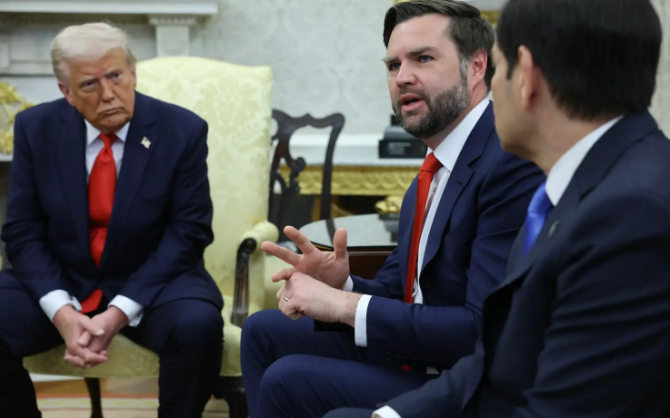
U.S. Vice President J.D. Vance has insisted that America is “not at war with Iran,” despite a dramatic escalation over the weekend in which U.S. forces joined Israel in launching strikes on three of Iran’s nuclear sites. The strikes, described by President Donald Trump as a “very successful attack,” have drawn fierce criticism both at home and abroad.

“We’re not at war with Iran, we’re at war with Iran’s nuclear program,” Vance said in an interview on NBC’s Meet the Press on Sunday. He repeated the position throughout the day, even as Tehran warned of severe consequences and called for an emergency UN Security Council meeting.

Iran’s UN ambassador, Amir Saeid Iravani, urged global condemnation, calling the strikes “heinous crimes” and demanding those responsible be held accountable.

President Trump, flanked by Vance, Secretary of State Marco Rubio, and Defense Secretary Pete Hegseth in a televised address Saturday night, warned Iran that any retaliation would prompt a swift and powerful U.S. response. “We will strike with speed and precision,” he declared.

The strikes have raised alarms across the U.S. security establishment. A National Terrorism Advisory issued by the Department of Homeland Security on Sunday described a “heightened threat environment,” citing risks of cyberattacks by Iranian-linked groups and possible retaliatory violence on U.S. soil. The bulletin noted Iran’s history of targeting American officials, referencing the 2020 assassination of Iranian General Qasem Soleimani by a U.S. drone strike ordered during Trump’s first term.

“There is concern Iran may seek revenge, either digitally or through physical plots,” the advisory stated. It also warned of threats against Jewish and pro-Israel targets within the U.S.

In Washington, the strikes have ignited a political firestorm. Several Republicans, including Senators Lindsey Graham and Marsha Blackburn, praised the action. “Peace can only be achieved through strength,” Blackburn said.

But opposition has surged on both sides of the aisle. Independent Senator Bernie Sanders denounced the strikes as “grossly unconstitutional,” arguing that Trump bypassed congressional authority. “Only Congress can declare war,” he told a rally in Oklahoma, where chants of “no more war” echoed.

Representative Alexandria Ocasio-Cortez and other progressive lawmakers went further, calling for Trump’s impeachment. “This is absolutely and clearly grounds for removal,” Ocasio-Cortez said.

House Democratic Leader Hakeem Jeffries condemned the move, accusing Trump of escalating tensions while putting U.S. troops in danger. Senate Minority Leader Chuck Schumer demanded an immediate congressional briefing.

Republican Congressman Thomas Massie also questioned the legality of the strikes. “This military action was not constitutional,” he posted on social media, prompting Trump to lash out on his Truth Social platform, calling Massie “disrespectful to our great military.”

As global leaders urge restraint, eyes now turn to Tehran for its next move. Trump has warned that any response would be “a terrible mistake,” but Iran’s leadership has yet to signal whether it intends to retaliate directly or through proxies.


Business

Fraudsters are increasingly using AI-generated images and videos to trick people into handing over sensitive personal and financial information, according to FraudSMART, the financial crime awareness initiative operated by the Banking and Payments Federation Ireland (BPFI). The organisation has reported a rise in online adverts promoting fake, State-backed investment schemes. These scams often use fabricated images of well-known politicians and business figures to make the offers appear legitimate and encourage users to click on registration links. Niamh Davenport, head of financial crime at BPFI, said scammers are deliberately exploiting recent media coverage of a planned State-backed savings and investment scheme to give their frauds a sense of credibility. “They often claim the scheme is open to everyone, but that places are limited and being ‘snapped up’ fast, in order to pressure people to act quickly,” she said. “They typically promise guaranteed returns or a guaranteed monthly income.” FraudSMART said that while anyone can be targeted, people in their early 50s are particularly vulnerable to investment scams. This age group is often focused on retirement planning, making them more receptive to financial offers that appear secure or high-yield. According to the organisation, most scams follow a similar pattern. Victims are first directed to click a registration link and complete a short online form providing their contact details. They are then contacted by someone posing as a financial adviser, who urges them to make an immediate “security deposit” to secure participation in the scheme. Once a payment is made, the money is quickly moved through multiple accounts, often overseas, making recovery extremely difficult. Davenport warned that scammers are becoming more sophisticated in their use of technology, particularly AI tools that allow them to create realistic but entirely fake promotional content. These materials are designed to mimic legitimate financial advertisements and build trust with potential victims. Recent figures from An Garda Síochána show investment fraud rose by 20% last year, with losses exceeding €20 million. The scale of individual scams varies widely, ranging from smaller crypto-related frauds involving a few hundred euro to large-scale investment schemes where victims lose tens of thousands. FraudSMART is urging the public to remain cautious when encountering online investment advertisements, especially those promising guaranteed returns or requiring urgent action. It also advises consumers to avoid sharing personal information with unverified sources and to be wary of pressure tactics designed to rush financial decisions. Authorities continue to warn that fraudsters are adapting quickly, using advanced digital tools to target victims across multiple platforms.

Trending

Business

Fraudsters are increasingly using AI-generated images and videos to trick people into handing over sensitive personal and financial information, according to FraudSMART, the financial crime awareness initiative operated by the Banking and Payments Federation Ireland (BPFI). The organisation has reported a rise in online adverts promoting fake, State-backed investment schemes. These scams often use fabricated images of well-known politicians and business figures to make the offers appear legitimate and encourage users to click on registration links. Niamh Davenport, head of financial crime at BPFI, said scammers are deliberately exploiting recent media coverage of a planned State-backed savings and investment scheme to give their frauds a sense of credibility. “They often claim the scheme is open to everyone, but that places are limited and being ‘snapped up’ fast, in order to pressure people to act quickly,” she said. “They typically promise guaranteed returns or a guaranteed monthly income.” FraudSMART said that while anyone can be targeted, people in their early 50s are particularly vulnerable to investment scams. This age group is often focused on retirement planning, making them more receptive to financial offers that appear secure or high-yield. According to the organisation, most scams follow a similar pattern. Victims are first directed to click a registration link and complete a short online form providing their contact details. They are then contacted by someone posing as a financial adviser, who urges them to make an immediate “security deposit” to secure participation in the scheme. Once a payment is made, the money is quickly moved through multiple accounts, often overseas, making recovery extremely difficult. Davenport warned that scammers are becoming more sophisticated in their use of technology, particularly AI tools that allow them to create realistic but entirely fake promotional content. These materials are designed to mimic legitimate financial advertisements and build trust with potential victims. Recent figures from An Garda Síochána show investment fraud rose by 20% last year, with losses exceeding €20 million. The scale of individual scams varies widely, ranging from smaller crypto-related frauds involving a few hundred euro to large-scale investment schemes where victims lose tens of thousands. FraudSMART is urging the public to remain cautious when encountering online investment advertisements, especially those promising guaranteed returns or requiring urgent action. It also advises consumers to avoid sharing personal information with unverified sources and to be wary of pressure tactics designed to rush financial decisions. Authorities continue to warn that fraudsters are adapting quickly, using advanced digital tools to target victims across multiple platforms.

You May Also Like

Politics

WASHINGTON — The Pentagon announced on Sunday that the United States will send a Terminal High Altitude Area Defense (THAAD) battery to Israel, alongside...

Health

NEW YORK — Teen smoking in the United States has reached an all-time low in 2024, with significant declines in overall youth tobacco use,...

Politics

WASHINGTON — As the countdown to the November 5 presidential election continues, former President Donald Trump is urging his supporters to aim for a...

Politics

In September, NASA announced that summer 2024 was the hottest on record. Just days later, the U.S. faced the dual impact of Hurricanes Helene...