
















Connect with us

Hi, what are you looking for?

Politics

Two National Guard Members Critically Wounded in Targeted Shooting Near White House

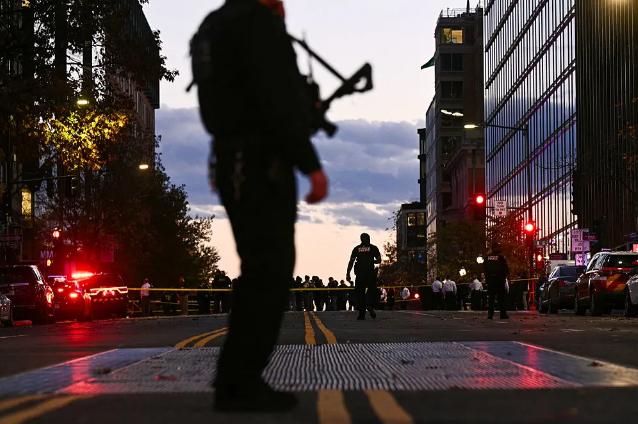
Two West Virginia National Guard servicemembers are in critical condition after being shot near the White House on Wednesday in what officials have described as a targeted attack.

The incident occurred at around 2:15 p.m. during high-visibility patrols by National Guard members, Metropolitan Police Department Executive Assistant Chief Jeffery Carroll said. The suspect, identified as 29-year-old Afghan national Rahmanullah Lakanwal, appeared to act alone and was taken into custody following an exchange of gunfire. Officials said it remains unclear whether the suspect was shot by one of the guards or another responding officer. Lakanwal and the injured guards were transported to local hospitals, with the suspect’s injuries not believed to be life-threatening.

President Donald Trump called the attack “monstrous” and an “act of terror” in a video statement from Florida, while ordering an additional 500 National Guard members to Washington, D.C. Defense Secretary Pete Hegseth said the deployment would help secure the capital. Trump described the shooter as an Afghan national brought to the U.S. under President Joe Biden’s administration and used the attack to push his anti-immigration platform.

The two Guardsmen, a man and a woman, have not been publicly identified. West Virginia Governor Patrick Morrisey condemned the attack as “an act of unspeakable violence” but later clarified that reports of the victims’ deaths were incorrect, citing conflicting information. Army Secretary Dan Driscoll said he visited the servicemembers in hospital and expressed sympathy for the victims and their families.

Authorities believe Lakanwal used a handgun recovered at the scene. Law enforcement is investigating how he obtained the weapon, noting restrictions on firearm sales to non-citizens. Lakanwal arrived in the U.S. in 2021 and was granted asylum. He previously served in the Afghan army alongside U.S. Special Forces and lived in Bellingham, Washington, with his wife and five children.

The FBI is treating the shooting as a potential act of international terrorism. Homeland Security Secretary Kristi Noem confirmed that all Afghan immigration requests are paused pending a review of vetting and security protocols.

The attack has sparked politically charged responses, with Trump and several Republican lawmakers calling for stricter immigration controls and deportations, while advocacy groups urged caution against demonizing the Afghan community. AfghanEvac, a nonprofit supporting resettled Afghans, condemned any attempts to use the incident to target Afghan families, emphasizing that the suspect’s actions should not reflect on the wider community.

The investigation remains ongoing, with law enforcement continuing to gather details on the motive and circumstances of the shooting.


Business

Fraudsters are increasingly using AI-generated images and videos to trick people into handing over sensitive personal and financial information, according to FraudSMART, the financial crime awareness initiative operated by the Banking and Payments Federation Ireland (BPFI). The organisation has reported a rise in online adverts promoting fake, State-backed investment schemes. These scams often use fabricated images of well-known politicians and business figures to make the offers appear legitimate and encourage users to click on registration links. Niamh Davenport, head of financial crime at BPFI, said scammers are deliberately exploiting recent media coverage of a planned State-backed savings and investment scheme to give their frauds a sense of credibility. “They often claim the scheme is open to everyone, but that places are limited and being ‘snapped up’ fast, in order to pressure people to act quickly,” she said. “They typically promise guaranteed returns or a guaranteed monthly income.” FraudSMART said that while anyone can be targeted, people in their early 50s are particularly vulnerable to investment scams. This age group is often focused on retirement planning, making them more receptive to financial offers that appear secure or high-yield. According to the organisation, most scams follow a similar pattern. Victims are first directed to click a registration link and complete a short online form providing their contact details. They are then contacted by someone posing as a financial adviser, who urges them to make an immediate “security deposit” to secure participation in the scheme. Once a payment is made, the money is quickly moved through multiple accounts, often overseas, making recovery extremely difficult. Davenport warned that scammers are becoming more sophisticated in their use of technology, particularly AI tools that allow them to create realistic but entirely fake promotional content. These materials are designed to mimic legitimate financial advertisements and build trust with potential victims. Recent figures from An Garda Síochána show investment fraud rose by 20% last year, with losses exceeding €20 million. The scale of individual scams varies widely, ranging from smaller crypto-related frauds involving a few hundred euro to large-scale investment schemes where victims lose tens of thousands. FraudSMART is urging the public to remain cautious when encountering online investment advertisements, especially those promising guaranteed returns or requiring urgent action. It also advises consumers to avoid sharing personal information with unverified sources and to be wary of pressure tactics designed to rush financial decisions. Authorities continue to warn that fraudsters are adapting quickly, using advanced digital tools to target victims across multiple platforms.

Trending

Business

Fraudsters are increasingly using AI-generated images and videos to trick people into handing over sensitive personal and financial information, according to FraudSMART, the financial crime awareness initiative operated by the Banking and Payments Federation Ireland (BPFI). The organisation has reported a rise in online adverts promoting fake, State-backed investment schemes. These scams often use fabricated images of well-known politicians and business figures to make the offers appear legitimate and encourage users to click on registration links. Niamh Davenport, head of financial crime at BPFI, said scammers are deliberately exploiting recent media coverage of a planned State-backed savings and investment scheme to give their frauds a sense of credibility. “They often claim the scheme is open to everyone, but that places are limited and being ‘snapped up’ fast, in order to pressure people to act quickly,” she said. “They typically promise guaranteed returns or a guaranteed monthly income.” FraudSMART said that while anyone can be targeted, people in their early 50s are particularly vulnerable to investment scams. This age group is often focused on retirement planning, making them more receptive to financial offers that appear secure or high-yield. According to the organisation, most scams follow a similar pattern. Victims are first directed to click a registration link and complete a short online form providing their contact details. They are then contacted by someone posing as a financial adviser, who urges them to make an immediate “security deposit” to secure participation in the scheme. Once a payment is made, the money is quickly moved through multiple accounts, often overseas, making recovery extremely difficult. Davenport warned that scammers are becoming more sophisticated in their use of technology, particularly AI tools that allow them to create realistic but entirely fake promotional content. These materials are designed to mimic legitimate financial advertisements and build trust with potential victims. Recent figures from An Garda Síochána show investment fraud rose by 20% last year, with losses exceeding €20 million. The scale of individual scams varies widely, ranging from smaller crypto-related frauds involving a few hundred euro to large-scale investment schemes where victims lose tens of thousands. FraudSMART is urging the public to remain cautious when encountering online investment advertisements, especially those promising guaranteed returns or requiring urgent action. It also advises consumers to avoid sharing personal information with unverified sources and to be wary of pressure tactics designed to rush financial decisions. Authorities continue to warn that fraudsters are adapting quickly, using advanced digital tools to target victims across multiple platforms.

You May Also Like

Politics

WASHINGTON — The Pentagon announced on Sunday that the United States will send a Terminal High Altitude Area Defense (THAAD) battery to Israel, alongside...

Health

NEW YORK — Teen smoking in the United States has reached an all-time low in 2024, with significant declines in overall youth tobacco use,...

Politics

WASHINGTON — As the countdown to the November 5 presidential election continues, former President Donald Trump is urging his supporters to aim for a...

Politics

In September, NASA announced that summer 2024 was the hottest on record. Just days later, the U.S. faced the dual impact of Hurricanes Helene...