














Connect with us

Hi, what are you looking for?

Politics

Trump’s Foreign Aid Freeze Sparks Global Concerns

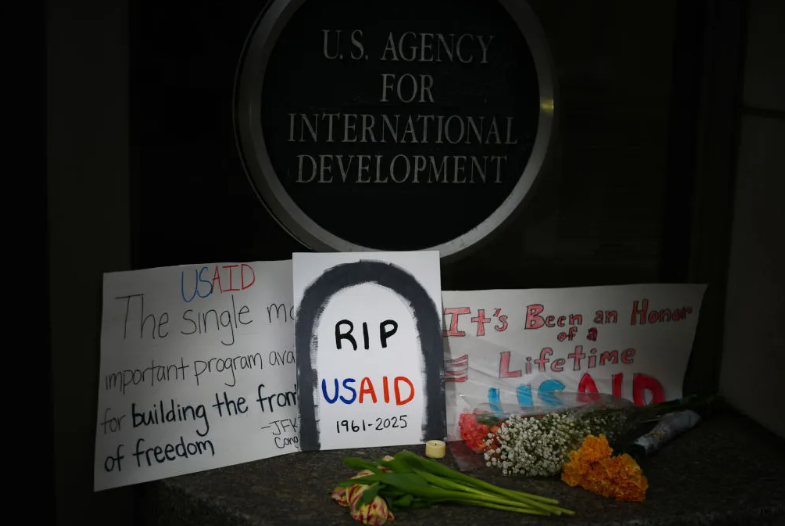
President Donald Trump’s abrupt decision to freeze nearly $72 billion in U.S. foreign aid has sent shockwaves through the international community, raising concerns about America’s global influence and the stability of democratic initiatives worldwide. The move, widely seen as a dramatic shift in U.S. policy, threatens to undermine decades of efforts to promote democracy, fight corruption, and provide humanitarian assistance.

The decision has drawn criticism from both sides of the aisle, with many warning that it creates a power vacuum that adversaries such as China, Russia, and Iran are likely to exploit. The U.S. Agency for International Development (USAID), established by President John F. Kennedy, and the National Endowment for Democracy (NED), founded under Ronald Reagan, have long played crucial roles in advancing human rights and supporting civil society groups across the globe. With nearly 40% of global aid stemming from the U.S., the sudden funding freeze could have far-reaching consequences.

In the former Soviet bloc, the effects of the funding cut have been immediate. Independent news outlets such as Meduza, which provides coverage critical of the Kremlin, now face an uncertain future, a development welcomed by Moscow. In Ukraine, anti-corruption organizations supported by USAID are struggling to continue their work, while in Southeast Asia, efforts to combat human trafficking are at risk. Additionally, programs such as China Labor Watch, which investigates labor abuses in China, are left in limbo. Even the widely praised President’s Emergency Plan for AIDS Relief (PEPFAR), introduced under President George W. Bush, is now in jeopardy, endangering millions of lives across Africa.

Critics argue that the freeze represents a dangerous retreat from America’s historical commitment to democracy and human rights. The move starkly contrasts with past U.S. policies, such as the shelter provided to Hungarian Cardinal József Mindszenty by the American embassy during the Cold War. Observers warn that such a withdrawal from global democratic support could embolden authoritarian regimes and weaken international alliances.

With the federal government scaling back its role, experts suggest that the responsibility to support democratic values now falls on cities, states, private citizens, and civil society groups. Activists have called for increased engagement from diaspora communities and nonprofit organizations to sustain democracy-building efforts worldwide.

Other democratic nations are also being urged to step in. Analysts recommend that the European Endowment for Democracy expand its reach globally, while the U.K. leverages its Britain Reconnected strategy to support press freedom and human rights. Meanwhile, countries like Canada, Brazil, and South Africa are being encouraged to take on greater roles in safeguarding democracy and counteracting authoritarian influence.

As the Trump administration remains firm on its foreign aid freeze, the international community faces a crucial test: whether it can fill the void left by the U.S. retreat or risk the erosion of democratic gains made over the past six decades.


 

Business

Fraudsters are increasingly using AI-generated images and videos to trick people into handing over sensitive personal and financial information, according to FraudSMART, the financial crime awareness initiative operated by the Banking and Payments Federation Ireland (BPFI). The organisation has reported a rise in online adverts promoting fake, State-backed investment schemes. These scams often use fabricated images of well-known politicians and business figures to make the offers appear legitimate and encourage users to click on registration links. Niamh Davenport, head of financial crime at BPFI, said scammers are deliberately exploiting recent media coverage of a planned State-backed savings and investment scheme to give their frauds a sense of credibility. “They often claim the scheme is open to everyone, but that places are limited and being ‘snapped up’ fast, in order to pressure people to act quickly,” she said. “They typically promise guaranteed returns or a guaranteed monthly income.” FraudSMART said that while anyone can be targeted, people in their early 50s are particularly vulnerable to investment scams. This age group is often focused on retirement planning, making them more receptive to financial offers that appear secure or high-yield. According to the organisation, most scams follow a similar pattern. Victims are first directed to click a registration link and complete a short online form providing their contact details. They are then contacted by someone posing as a financial adviser, who urges them to make an immediate “security deposit” to secure participation in the scheme. Once a payment is made, the money is quickly moved through multiple accounts, often overseas, making recovery extremely difficult. Davenport warned that scammers are becoming more sophisticated in their use of technology, particularly AI tools that allow them to create realistic but entirely fake promotional content. These materials are designed to mimic legitimate financial advertisements and build trust with potential victims. Recent figures from An Garda Síochána show investment fraud rose by 20% last year, with losses exceeding €20 million. The scale of individual scams varies widely, ranging from smaller crypto-related frauds involving a few hundred euro to large-scale investment schemes where victims lose tens of thousands. FraudSMART is urging the public to remain cautious when encountering online investment advertisements, especially those promising guaranteed returns or requiring urgent action. It also advises consumers to avoid sharing personal information with unverified sources and to be wary of pressure tactics designed to rush financial decisions. Authorities continue to warn that fraudsters are adapting quickly, using advanced digital tools to target victims across multiple platforms.

Trending

Business

Fraudsters are increasingly using AI-generated images and videos to trick people into handing over sensitive personal and financial information, according to FraudSMART, the financial crime awareness initiative operated by the Banking and Payments Federation Ireland (BPFI). The organisation has reported a rise in online adverts promoting fake, State-backed investment schemes. These scams often use fabricated images of well-known politicians and business figures to make the offers appear legitimate and encourage users to click on registration links. Niamh Davenport, head of financial crime at BPFI, said scammers are deliberately exploiting recent media coverage of a planned State-backed savings and investment scheme to give their frauds a sense of credibility. “They often claim the scheme is open to everyone, but that places are limited and being ‘snapped up’ fast, in order to pressure people to act quickly,” she said. “They typically promise guaranteed returns or a guaranteed monthly income.” FraudSMART said that while anyone can be targeted, people in their early 50s are particularly vulnerable to investment scams. This age group is often focused on retirement planning, making them more receptive to financial offers that appear secure or high-yield. According to the organisation, most scams follow a similar pattern. Victims are first directed to click a registration link and complete a short online form providing their contact details. They are then contacted by someone posing as a financial adviser, who urges them to make an immediate “security deposit” to secure participation in the scheme. Once a payment is made, the money is quickly moved through multiple accounts, often overseas, making recovery extremely difficult. Davenport warned that scammers are becoming more sophisticated in their use of technology, particularly AI tools that allow them to create realistic but entirely fake promotional content. These materials are designed to mimic legitimate financial advertisements and build trust with potential victims. Recent figures from An Garda Síochána show investment fraud rose by 20% last year, with losses exceeding €20 million. The scale of individual scams varies widely, ranging from smaller crypto-related frauds involving a few hundred euro to large-scale investment schemes where victims lose tens of thousands. FraudSMART is urging the public to remain cautious when encountering online investment advertisements, especially those promising guaranteed returns or requiring urgent action. It also advises consumers to avoid sharing personal information with unverified sources and to be wary of pressure tactics designed to rush financial decisions. Authorities continue to warn that fraudsters are adapting quickly, using advanced digital tools to target victims across multiple platforms.

You May Also Like

Politics

WASHINGTON — The Pentagon announced on Sunday that the United States will send a Terminal High Altitude Area Defense (THAAD) battery to Israel, alongside...

Health

NEW YORK — Teen smoking in the United States has reached an all-time low in 2024, with significant declines in overall youth tobacco use,...

Politics

WASHINGTON — As the countdown to the November 5 presidential election continues, former President Donald Trump is urging his supporters to aim for a...

Politics

In September, NASA announced that summer 2024 was the hottest on record. Just days later, the U.S. faced the dual impact of Hurricanes Helene...