















Connect with us

Hi, what are you looking for?

Politics

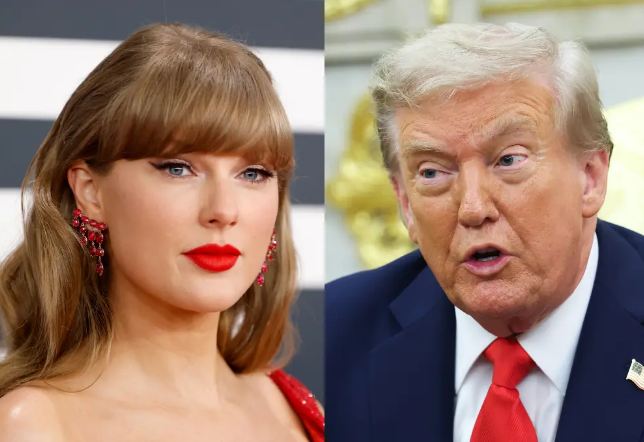
Trump Weighs In on Taylor Swift and Travis Kelce Engagement, Rekindling Long History of Commentary

The engagement of pop icon Taylor Swift and Kansas City Chiefs tight end Travis Kelce has dominated headlines this week—and even prompted a reaction from former U.S. President Donald Trump.

Despite his past criticism of Swift, Trump offered warm wishes to the couple during a Cabinet meeting at the White House on Tuesday, just hours after their announcement. “I wish them a lot of luck,” he told reporters. “I think he’s a great player, I think he’s a great guy, and I think that she’s a terrific person, so I wish them a lot of luck.”

Trump’s response comes after years of shifting remarks about Swift, ranging from praise for her music and character to sharp criticism following her entry into politics.

His first widely known comment about Swift dates back to 2009, when rapper Kanye West interrupted her acceptance speech at the MTV Video Music Awards. Trump called the outburst “disgusting” and urged a boycott of West, saying the rapper was merely seeking attention.

In the early 2010s, Trump appeared to admire the singer. In August 2012, he tweeted thanks to Swift for what he described as a “beautiful picture” and called her “fantastic.” Later that year, he celebrated her co-hosting of the Grammy nominations special, declaring, “Taylor is terrific!”

By 2015, his admiration had not faded. In an interview with Yahoo! Politics, Trump again described Swift as “terrific.” At the time, a video posted by his wife Melania even showed him driving while listening to Swift’s music.

The tone changed in October 2018, when Swift publicly endorsed Democratic candidates in Tennessee. Trump, then in the middle of his presidency, told reporters that he liked her music “about 25% less” after her announcement, while reaffirming his support for Republican candidate Marsha Blackburn.

In more recent years, Trump’s comments have swung between dismissive and conciliatory. In 2023, when reports surfaced of Swift’s romance with Kelce, Trump told The Daily Caller, “I wish the best for both of them. I hope they enjoy their life, maybe together, maybe not—most likely not.” Around the same time, he accused Swift of being “woke” and claimed she was “no longer hot” after she endorsed his opponent Kamala Harris in the presidential election.

Now, with Swift and Kelce officially engaged, Trump appears to have taken a more measured approach, praising both and wishing them well. The remarks underscore a long and unusual history of the former president inserting himself into cultural moments involving Swift—often reflecting the political climate of the time.


Business

Fraudsters are increasingly using AI-generated images and videos to trick people into handing over sensitive personal and financial information, according to FraudSMART, the financial crime awareness initiative operated by the Banking and Payments Federation Ireland (BPFI). The organisation has reported a rise in online adverts promoting fake, State-backed investment schemes. These scams often use fabricated images of well-known politicians and business figures to make the offers appear legitimate and encourage users to click on registration links. Niamh Davenport, head of financial crime at BPFI, said scammers are deliberately exploiting recent media coverage of a planned State-backed savings and investment scheme to give their frauds a sense of credibility. “They often claim the scheme is open to everyone, but that places are limited and being ‘snapped up’ fast, in order to pressure people to act quickly,” she said. “They typically promise guaranteed returns or a guaranteed monthly income.” FraudSMART said that while anyone can be targeted, people in their early 50s are particularly vulnerable to investment scams. This age group is often focused on retirement planning, making them more receptive to financial offers that appear secure or high-yield. According to the organisation, most scams follow a similar pattern. Victims are first directed to click a registration link and complete a short online form providing their contact details. They are then contacted by someone posing as a financial adviser, who urges them to make an immediate “security deposit” to secure participation in the scheme. Once a payment is made, the money is quickly moved through multiple accounts, often overseas, making recovery extremely difficult. Davenport warned that scammers are becoming more sophisticated in their use of technology, particularly AI tools that allow them to create realistic but entirely fake promotional content. These materials are designed to mimic legitimate financial advertisements and build trust with potential victims. Recent figures from An Garda Síochána show investment fraud rose by 20% last year, with losses exceeding €20 million. The scale of individual scams varies widely, ranging from smaller crypto-related frauds involving a few hundred euro to large-scale investment schemes where victims lose tens of thousands. FraudSMART is urging the public to remain cautious when encountering online investment advertisements, especially those promising guaranteed returns or requiring urgent action. It also advises consumers to avoid sharing personal information with unverified sources and to be wary of pressure tactics designed to rush financial decisions. Authorities continue to warn that fraudsters are adapting quickly, using advanced digital tools to target victims across multiple platforms.

Trending

Business

Fraudsters are increasingly using AI-generated images and videos to trick people into handing over sensitive personal and financial information, according to FraudSMART, the financial crime awareness initiative operated by the Banking and Payments Federation Ireland (BPFI). The organisation has reported a rise in online adverts promoting fake, State-backed investment schemes. These scams often use fabricated images of well-known politicians and business figures to make the offers appear legitimate and encourage users to click on registration links. Niamh Davenport, head of financial crime at BPFI, said scammers are deliberately exploiting recent media coverage of a planned State-backed savings and investment scheme to give their frauds a sense of credibility. “They often claim the scheme is open to everyone, but that places are limited and being ‘snapped up’ fast, in order to pressure people to act quickly,” she said. “They typically promise guaranteed returns or a guaranteed monthly income.” FraudSMART said that while anyone can be targeted, people in their early 50s are particularly vulnerable to investment scams. This age group is often focused on retirement planning, making them more receptive to financial offers that appear secure or high-yield. According to the organisation, most scams follow a similar pattern. Victims are first directed to click a registration link and complete a short online form providing their contact details. They are then contacted by someone posing as a financial adviser, who urges them to make an immediate “security deposit” to secure participation in the scheme. Once a payment is made, the money is quickly moved through multiple accounts, often overseas, making recovery extremely difficult. Davenport warned that scammers are becoming more sophisticated in their use of technology, particularly AI tools that allow them to create realistic but entirely fake promotional content. These materials are designed to mimic legitimate financial advertisements and build trust with potential victims. Recent figures from An Garda Síochána show investment fraud rose by 20% last year, with losses exceeding €20 million. The scale of individual scams varies widely, ranging from smaller crypto-related frauds involving a few hundred euro to large-scale investment schemes where victims lose tens of thousands. FraudSMART is urging the public to remain cautious when encountering online investment advertisements, especially those promising guaranteed returns or requiring urgent action. It also advises consumers to avoid sharing personal information with unverified sources and to be wary of pressure tactics designed to rush financial decisions. Authorities continue to warn that fraudsters are adapting quickly, using advanced digital tools to target victims across multiple platforms.

You May Also Like

Politics

WASHINGTON — The Pentagon announced on Sunday that the United States will send a Terminal High Altitude Area Defense (THAAD) battery to Israel, alongside...

Health

NEW YORK — Teen smoking in the United States has reached an all-time low in 2024, with significant declines in overall youth tobacco use,...

Politics

WASHINGTON — As the countdown to the November 5 presidential election continues, former President Donald Trump is urging his supporters to aim for a...

Politics

In September, NASA announced that summer 2024 was the hottest on record. Just days later, the U.S. faced the dual impact of Hurricanes Helene...