












Connect with us

Hi, what are you looking for?

Politics

Trump to Appear on U.S. Currency as Name and Image Spread Across Federal Programs

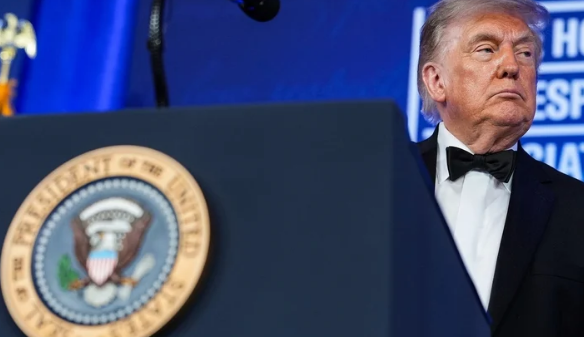
President Donald Trump is taking his well-known penchant for branding into new territory, as the Treasury Department announced that his signature will appear on future U.S. currency. The move, timed to celebrate the 250th anniversary of American independence, will mark the first time a sitting president’s signature is featured on paper money, alongside Treasury Secretary Scott Bessent’s signature.

“Under President Trump’s leadership, we are on a path toward unprecedented economic growth, lasting dollar dominance, and fiscal strength and stability,” Bessent said. “There is no more powerful way to recognize the historic achievements of our great country and President Donald J. Trump than U.S dollar bills bearing his name.”

Trump’s efforts to place his name on government properties and programs have been widespread. Earlier plans included a $1 commemorative coin featuring his image for the Semiquincentennial, and a 24-karat gold coin approved by the Commission of Fine Arts, which depicts a stern Trump leaning over a desk. U.S. Treasurer Brandon Beach described the design as “emblematic for the front of such coins” as the nation approaches its 250th birthday.

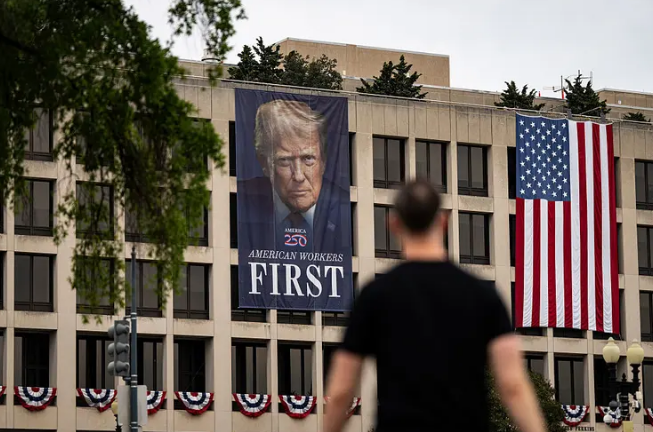
Federal buildings in Washington, D.C., have also been updated to feature Trump’s likeness. Large banners appeared on the Department of Justice, Labor, and Agriculture buildings, sometimes alongside images of Presidents Abraham Lincoln and Theodore Roosevelt, highlighting slogans such as “American Workers First” and “Growing America Since 1862.”

Trump launched a government website called TrumpRx.gov to help Americans access discounted prescription drugs. He has also announced plans for “Trump class” battleships, calling them part of a “golden fleet,” with construction expected to begin in the early 2030s. Navy Secretary John Phelan described the ships as “the largest, deadliest and most versatile and best-looking warship anywhere on the world’s oceans.”

In other high-profile moves, Trump’s name has been added to the John F. Kennedy Center for the Performing Arts and the United States Institute of Peace, drawing legal challenges. Democratic Representative Joyce Beatty of Ohio filed a motion asking a federal court to reverse the Kennedy Center renaming, arguing that the venue was designated as a memorial exclusively to Kennedy.

Trump’s branding extends to national programs and financial initiatives. The Department of the Interior announced that the 2026 “America the Beautiful” national park pass will feature Trump’s face alongside George Washington instead of traditional nature imagery. The “One Big Beautiful Bill” law authorizes so-called Trump Accounts, federal investment accounts seeded with $1,000 for babies born between 2025 and 2029.

Other initiatives include the Trump Gold Card program, allowing wealthy foreigners to gain extended U.S. residency privileges, and stimulus checks issued during Trump’s first term, which bore his name. These moves underscore a trend of personal branding that has permeated multiple corners of the federal government during his presidency.

Trump’s signature on U.S. currency will be another addition to a long list of efforts to stamp his identity on American institutions, reinforcing a legacy of high-profile personal branding within government programs, buildings, and financial instruments.


Business

Fraudsters are increasingly using AI-generated images and videos to trick people into handing over sensitive personal and financial information, according to FraudSMART, the financial crime awareness initiative operated by the Banking and Payments Federation Ireland (BPFI). The organisation has reported a rise in online adverts promoting fake, State-backed investment schemes. These scams often use fabricated images of well-known politicians and business figures to make the offers appear legitimate and encourage users to click on registration links. Niamh Davenport, head of financial crime at BPFI, said scammers are deliberately exploiting recent media coverage of a planned State-backed savings and investment scheme to give their frauds a sense of credibility. “They often claim the scheme is open to everyone, but that places are limited and being ‘snapped up’ fast, in order to pressure people to act quickly,” she said. “They typically promise guaranteed returns or a guaranteed monthly income.” FraudSMART said that while anyone can be targeted, people in their early 50s are particularly vulnerable to investment scams. This age group is often focused on retirement planning, making them more receptive to financial offers that appear secure or high-yield. According to the organisation, most scams follow a similar pattern. Victims are first directed to click a registration link and complete a short online form providing their contact details. They are then contacted by someone posing as a financial adviser, who urges them to make an immediate “security deposit” to secure participation in the scheme. Once a payment is made, the money is quickly moved through multiple accounts, often overseas, making recovery extremely difficult. Davenport warned that scammers are becoming more sophisticated in their use of technology, particularly AI tools that allow them to create realistic but entirely fake promotional content. These materials are designed to mimic legitimate financial advertisements and build trust with potential victims. Recent figures from An Garda Síochána show investment fraud rose by 20% last year, with losses exceeding €20 million. The scale of individual scams varies widely, ranging from smaller crypto-related frauds involving a few hundred euro to large-scale investment schemes where victims lose tens of thousands. FraudSMART is urging the public to remain cautious when encountering online investment advertisements, especially those promising guaranteed returns or requiring urgent action. It also advises consumers to avoid sharing personal information with unverified sources and to be wary of pressure tactics designed to rush financial decisions. Authorities continue to warn that fraudsters are adapting quickly, using advanced digital tools to target victims across multiple platforms.

Trending

Business

Fraudsters are increasingly using AI-generated images and videos to trick people into handing over sensitive personal and financial information, according to FraudSMART, the financial crime awareness initiative operated by the Banking and Payments Federation Ireland (BPFI). The organisation has reported a rise in online adverts promoting fake, State-backed investment schemes. These scams often use fabricated images of well-known politicians and business figures to make the offers appear legitimate and encourage users to click on registration links. Niamh Davenport, head of financial crime at BPFI, said scammers are deliberately exploiting recent media coverage of a planned State-backed savings and investment scheme to give their frauds a sense of credibility. “They often claim the scheme is open to everyone, but that places are limited and being ‘snapped up’ fast, in order to pressure people to act quickly,” she said. “They typically promise guaranteed returns or a guaranteed monthly income.” FraudSMART said that while anyone can be targeted, people in their early 50s are particularly vulnerable to investment scams. This age group is often focused on retirement planning, making them more receptive to financial offers that appear secure or high-yield. According to the organisation, most scams follow a similar pattern. Victims are first directed to click a registration link and complete a short online form providing their contact details. They are then contacted by someone posing as a financial adviser, who urges them to make an immediate “security deposit” to secure participation in the scheme. Once a payment is made, the money is quickly moved through multiple accounts, often overseas, making recovery extremely difficult. Davenport warned that scammers are becoming more sophisticated in their use of technology, particularly AI tools that allow them to create realistic but entirely fake promotional content. These materials are designed to mimic legitimate financial advertisements and build trust with potential victims. Recent figures from An Garda Síochána show investment fraud rose by 20% last year, with losses exceeding €20 million. The scale of individual scams varies widely, ranging from smaller crypto-related frauds involving a few hundred euro to large-scale investment schemes where victims lose tens of thousands. FraudSMART is urging the public to remain cautious when encountering online investment advertisements, especially those promising guaranteed returns or requiring urgent action. It also advises consumers to avoid sharing personal information with unverified sources and to be wary of pressure tactics designed to rush financial decisions. Authorities continue to warn that fraudsters are adapting quickly, using advanced digital tools to target victims across multiple platforms.

You May Also Like

Politics

WASHINGTON — The Pentagon announced on Sunday that the United States will send a Terminal High Altitude Area Defense (THAAD) battery to Israel, alongside...

Health

NEW YORK — Teen smoking in the United States has reached an all-time low in 2024, with significant declines in overall youth tobacco use,...

Politics

WASHINGTON — As the countdown to the November 5 presidential election continues, former President Donald Trump is urging his supporters to aim for a...

Politics

In September, NASA announced that summer 2024 was the hottest on record. Just days later, the U.S. faced the dual impact of Hurricanes Helene...