











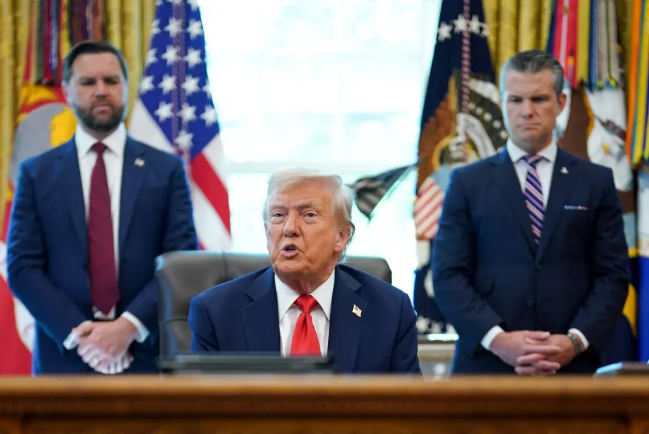
President Donald Trump on Monday suggested that some Americans might support the idea of a dictator, though he insisted he does not see himself as one. His remarks came as he signed a series of executive orders at the White House, including a directive creating a specialized National Guard unit tasked with maintaining public safety in Washington, D.C.
“They say: ‘We don’t need him. Freedom, freedom, he’s a dictator, he’s a dictator,’” Trump told reporters in the Oval Office. “A lot of people are saying, ‘Maybe we like a dictator.’ I don’t like a dictator. I’m not a dictator. I’m a man with great common sense and a smart person.”
The comments follow weeks of criticism over Trump’s decision to deploy National Guard troops to the capital and his threats to extend such deployments to other Democratic-led cities. While crime rates have declined in several of those cities, Trump has continued to frame the initiative as a necessary crackdown on lawlessness.
“When I see what’s happening to our cities and then you send in troops, instead of being praised, they’re saying you’re trying to take over the Republic,” Trump said of his critics. “These people are sick.”
The President’s statements echo earlier remarks that drew scrutiny during his campaign. In December 2023, Trump told Fox News he would not be a dictator “except for Day 1,” a comment that sparked alarm among opponents. He later said in a 2024 interview with TIME magazine that his statement was made “sarcastically,” but added that he believed “a lot of people like it.”
Concerns about Trump’s governing style have persisted throughout his presidency. Critics point to his repeated suggestions that he could remain in office beyond constitutional limits, his frequent clashes with the judiciary, and his use of federal powers in ways that opponents say undermine democratic norms.
Public opinion research underscores the unease. A poll conducted earlier this year by the Public Religion Research Institute found that a majority of Americans view Trump as a “dangerous dictator whose power should be limited before he destroys American democracy.”
Despite such warnings, Trump has continued to embrace strongman rhetoric while dismissing accusations of authoritarianism as partisan attacks. Supporters argue that his willingness to take forceful action reflects leadership at a time of unrest, while opponents see his approach as a threat to the nation’s democratic institutions.
As the political debate intensifies, Trump’s latest comments are likely to renew focus on how far he is willing to push the boundaries of presidential authority ahead of the 2026 midterm elections.