













Connect with us

Hi, what are you looking for?

Politics

Trump Orders Troop Deployment to Portland, Escalating Clash With Local Leaders

President Donald Trump announced on Saturday that he had ordered U.S. troops to be sent to Portland, Oregon, to “protect” the city and federal facilities, authorizing the Pentagon to use “full force, if necessary.”

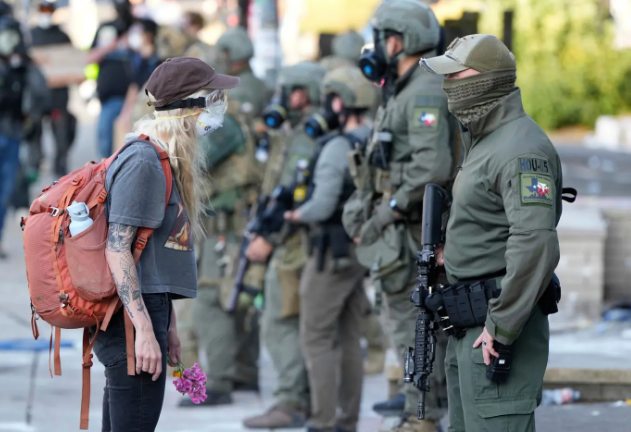
The move follows Trump’s designation of Antifa as a domestic terror group earlier this week and comes amid growing tensions over left-wing protests outside Immigration and Customs Enforcement (ICE) offices in Portland. The announcement also marks the latest in a series of unprecedented deployments of federal forces to U.S. cities during Trump’s second term.

In a post on Truth Social, Trump said he was acting at the request of Homeland Security Secretary Kristi Noem. He directed Defense Secretary Pete Hegseth “to provide all necessary Troops to protect War ravaged Portland, and any of our ICE Facilities under siege from attack by Antifa, and other domestic terrorists.”

Portland’s mayor, Keith Wilson, condemned the order as unnecessary and provocative. “The number of necessary troops is zero, in Portland and any other American city,” he said. “Our nation has a long memory for acts of oppression, and the president will not find lawlessness or violence here unless he plans to perpetrate it.”

The White House has pointed to what it calls “Antifa violence” in Portland, citing incidents in which protesters allegedly attacked federal officers during demonstrations in June. The Department of Homeland Security claimed that activists had targeted ICE officers with lasers and smoke grenades and accused groups of publishing personal information about federal agents.

But state and local officials rejected the characterization of Portland as unsafe. Oregon Governor Tina Kotek said her administration had not been consulted about the deployment and insisted there was “no national security threat in Portland.” Senator Ron Wyden (D-Ore.) accused Trump of staging an “authoritarian takeover” of his hometown, warning the president was trying to provoke violence for political gain.

The announcement revives memories of 2020, when Trump deployed federal agents to Portland during nationwide protests over racial justice and police violence. At the time, critics, including then-Governor Kate Brown, argued that the federal presence inflamed tensions rather than restoring calm.

Trump has increasingly used the military and federal forces to confront domestic unrest during his second term. Earlier this year, he dispatched troops to Los Angeles and Washington, D.C., in response to protests, decisions that fueled legal challenges and drew accusations of overreach.

Local leaders in Portland have made clear they do not want federal intervention. Mayor Wilson said city police had successfully managed protests at ICE facilities and defended the city’s ability to protect both free expression and public safety.

Despite opposition from state and city officials, Trump’s order signals that Portland will once again be a focal point in the administration’s crackdown on dissent, setting up a confrontation between federal authority and local resistance.


Business

Fraudsters are increasingly using AI-generated images and videos to trick people into handing over sensitive personal and financial information, according to FraudSMART, the financial crime awareness initiative operated by the Banking and Payments Federation Ireland (BPFI). The organisation has reported a rise in online adverts promoting fake, State-backed investment schemes. These scams often use fabricated images of well-known politicians and business figures to make the offers appear legitimate and encourage users to click on registration links. Niamh Davenport, head of financial crime at BPFI, said scammers are deliberately exploiting recent media coverage of a planned State-backed savings and investment scheme to give their frauds a sense of credibility. “They often claim the scheme is open to everyone, but that places are limited and being ‘snapped up’ fast, in order to pressure people to act quickly,” she said. “They typically promise guaranteed returns or a guaranteed monthly income.” FraudSMART said that while anyone can be targeted, people in their early 50s are particularly vulnerable to investment scams. This age group is often focused on retirement planning, making them more receptive to financial offers that appear secure or high-yield. According to the organisation, most scams follow a similar pattern. Victims are first directed to click a registration link and complete a short online form providing their contact details. They are then contacted by someone posing as a financial adviser, who urges them to make an immediate “security deposit” to secure participation in the scheme. Once a payment is made, the money is quickly moved through multiple accounts, often overseas, making recovery extremely difficult. Davenport warned that scammers are becoming more sophisticated in their use of technology, particularly AI tools that allow them to create realistic but entirely fake promotional content. These materials are designed to mimic legitimate financial advertisements and build trust with potential victims. Recent figures from An Garda Síochána show investment fraud rose by 20% last year, with losses exceeding €20 million. The scale of individual scams varies widely, ranging from smaller crypto-related frauds involving a few hundred euro to large-scale investment schemes where victims lose tens of thousands. FraudSMART is urging the public to remain cautious when encountering online investment advertisements, especially those promising guaranteed returns or requiring urgent action. It also advises consumers to avoid sharing personal information with unverified sources and to be wary of pressure tactics designed to rush financial decisions. Authorities continue to warn that fraudsters are adapting quickly, using advanced digital tools to target victims across multiple platforms.

Trending

Business

Fraudsters are increasingly using AI-generated images and videos to trick people into handing over sensitive personal and financial information, according to FraudSMART, the financial crime awareness initiative operated by the Banking and Payments Federation Ireland (BPFI). The organisation has reported a rise in online adverts promoting fake, State-backed investment schemes. These scams often use fabricated images of well-known politicians and business figures to make the offers appear legitimate and encourage users to click on registration links. Niamh Davenport, head of financial crime at BPFI, said scammers are deliberately exploiting recent media coverage of a planned State-backed savings and investment scheme to give their frauds a sense of credibility. “They often claim the scheme is open to everyone, but that places are limited and being ‘snapped up’ fast, in order to pressure people to act quickly,” she said. “They typically promise guaranteed returns or a guaranteed monthly income.” FraudSMART said that while anyone can be targeted, people in their early 50s are particularly vulnerable to investment scams. This age group is often focused on retirement planning, making them more receptive to financial offers that appear secure or high-yield. According to the organisation, most scams follow a similar pattern. Victims are first directed to click a registration link and complete a short online form providing their contact details. They are then contacted by someone posing as a financial adviser, who urges them to make an immediate “security deposit” to secure participation in the scheme. Once a payment is made, the money is quickly moved through multiple accounts, often overseas, making recovery extremely difficult. Davenport warned that scammers are becoming more sophisticated in their use of technology, particularly AI tools that allow them to create realistic but entirely fake promotional content. These materials are designed to mimic legitimate financial advertisements and build trust with potential victims. Recent figures from An Garda Síochána show investment fraud rose by 20% last year, with losses exceeding €20 million. The scale of individual scams varies widely, ranging from smaller crypto-related frauds involving a few hundred euro to large-scale investment schemes where victims lose tens of thousands. FraudSMART is urging the public to remain cautious when encountering online investment advertisements, especially those promising guaranteed returns or requiring urgent action. It also advises consumers to avoid sharing personal information with unverified sources and to be wary of pressure tactics designed to rush financial decisions. Authorities continue to warn that fraudsters are adapting quickly, using advanced digital tools to target victims across multiple platforms.

You May Also Like

Politics

WASHINGTON — The Pentagon announced on Sunday that the United States will send a Terminal High Altitude Area Defense (THAAD) battery to Israel, alongside...

Health

NEW YORK — Teen smoking in the United States has reached an all-time low in 2024, with significant declines in overall youth tobacco use,...

Politics

WASHINGTON — As the countdown to the November 5 presidential election continues, former President Donald Trump is urging his supporters to aim for a...

Politics

In September, NASA announced that summer 2024 was the hottest on record. Just days later, the U.S. faced the dual impact of Hurricanes Helene...