















Connect with us

Hi, what are you looking for?

Politics

Trump Launches Religious Liberty Commission Amid Push to Elevate Christian Influence in Government

Former President Donald Trump marked the National Day of Prayer by signing an executive order establishing a new presidential commission aimed at protecting and promoting religious liberty across the United States.

The Religious Liberty Commission, as outlined in the executive order, will investigate perceived threats to religious freedom and recommend policies to bolster protections for faith communities. The White House says the initiative is part of a broader effort to “restore and safeguard religious liberty for all Americans.”

While the order itself does not name specific religions, the accompanying fact sheet and recent White House actions make clear the initiative is heavily focused on Christianity. This comes on the heels of Trump’s earlier formation of a “Task Force to Eradicate Anti-Christian Bias” and the launch of a White House Faith Office.

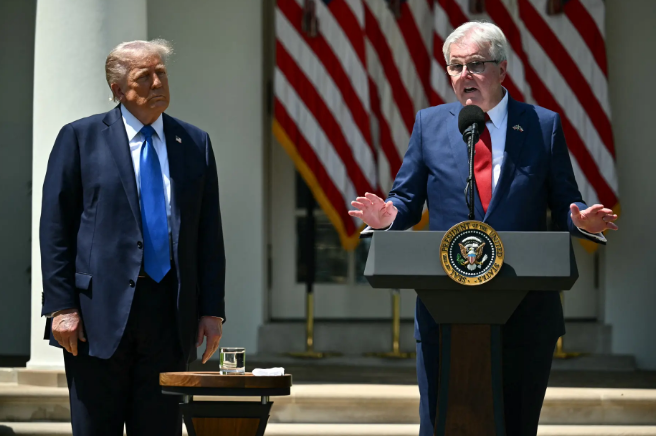
Speaking in the Rose Garden, Trump suggested that his administration is actively working to reintegrate religion into public life. “Separation [of church and state]? Is that a good thing or a bad thing? I’m not sure… We’re bringing religion back to our country. It’s a big deal,” he said.

The Religious Liberty Commission will be tasked with preparing a comprehensive report identifying threats to religious expression. According to the order, recent government policies have “threatened America’s unique and beautiful tradition of religious liberty,” citing concerns such as restrictions on faith-based school attendance and potential funding penalties for religious nonprofits.

The Commission is set to expire on July 4, 2026coinciding with the nation’s 250th anniversary—unless extended by the administration.

Political and Religious Implications

Critics argue that the initiative is more symbolic than substantive, intended primarily to appeal to Trump’s evangelical base. Melissa Deckman, CEO of the Public Religion Research Institute (PRRI), says the effort reflects concerns among White evangelicals, 66% of whom believe that Christians face discrimination equal to or greater than other groups. PRRI data also shows that 78% of Americans oppose creating a federal task force to combat anti-Christian bias.

This commission and task force are rewards to Christian nationalist groups who see their cultural loss of dominance as persecution,” said Deckman.

Andrew Thompson, a political science professor at the University of Pennsylvania, warned the order could signal deeper efforts to embed Christian fundamentalism in public policy. “Don’t miss the forest for the trees,” Thompson said. “This is about power and executive overreach more broadly.”

Leadership and Direction

The Commission will be chaired by Dan Patrick, the Lieutenant Governor of Texas. A vocal Christian conservative, Patrick has backed legislation requiring the display of the Ten Commandments in public school classrooms and has described the U.S. as a “Christian nation.”

At the Rose Garden event, Patrick stated, “We are a nation birthed by prayer, founded on the Judeo-Christian ethic… but that is no longer the case. The last Administration attacked people of faith for four years.”

The Religious Liberty Commission marks a significant escalation in the Trump administration’s focus on religious identity in government, with critics and supporters alike watching closely to see how it may shape national policy moving forward.


Business

Fraudsters are increasingly using AI-generated images and videos to trick people into handing over sensitive personal and financial information, according to FraudSMART, the financial crime awareness initiative operated by the Banking and Payments Federation Ireland (BPFI). The organisation has reported a rise in online adverts promoting fake, State-backed investment schemes. These scams often use fabricated images of well-known politicians and business figures to make the offers appear legitimate and encourage users to click on registration links. Niamh Davenport, head of financial crime at BPFI, said scammers are deliberately exploiting recent media coverage of a planned State-backed savings and investment scheme to give their frauds a sense of credibility. “They often claim the scheme is open to everyone, but that places are limited and being ‘snapped up’ fast, in order to pressure people to act quickly,” she said. “They typically promise guaranteed returns or a guaranteed monthly income.” FraudSMART said that while anyone can be targeted, people in their early 50s are particularly vulnerable to investment scams. This age group is often focused on retirement planning, making them more receptive to financial offers that appear secure or high-yield. According to the organisation, most scams follow a similar pattern. Victims are first directed to click a registration link and complete a short online form providing their contact details. They are then contacted by someone posing as a financial adviser, who urges them to make an immediate “security deposit” to secure participation in the scheme. Once a payment is made, the money is quickly moved through multiple accounts, often overseas, making recovery extremely difficult. Davenport warned that scammers are becoming more sophisticated in their use of technology, particularly AI tools that allow them to create realistic but entirely fake promotional content. These materials are designed to mimic legitimate financial advertisements and build trust with potential victims. Recent figures from An Garda Síochána show investment fraud rose by 20% last year, with losses exceeding €20 million. The scale of individual scams varies widely, ranging from smaller crypto-related frauds involving a few hundred euro to large-scale investment schemes where victims lose tens of thousands. FraudSMART is urging the public to remain cautious when encountering online investment advertisements, especially those promising guaranteed returns or requiring urgent action. It also advises consumers to avoid sharing personal information with unverified sources and to be wary of pressure tactics designed to rush financial decisions. Authorities continue to warn that fraudsters are adapting quickly, using advanced digital tools to target victims across multiple platforms.

Trending

Business

Fraudsters are increasingly using AI-generated images and videos to trick people into handing over sensitive personal and financial information, according to FraudSMART, the financial crime awareness initiative operated by the Banking and Payments Federation Ireland (BPFI). The organisation has reported a rise in online adverts promoting fake, State-backed investment schemes. These scams often use fabricated images of well-known politicians and business figures to make the offers appear legitimate and encourage users to click on registration links. Niamh Davenport, head of financial crime at BPFI, said scammers are deliberately exploiting recent media coverage of a planned State-backed savings and investment scheme to give their frauds a sense of credibility. “They often claim the scheme is open to everyone, but that places are limited and being ‘snapped up’ fast, in order to pressure people to act quickly,” she said. “They typically promise guaranteed returns or a guaranteed monthly income.” FraudSMART said that while anyone can be targeted, people in their early 50s are particularly vulnerable to investment scams. This age group is often focused on retirement planning, making them more receptive to financial offers that appear secure or high-yield. According to the organisation, most scams follow a similar pattern. Victims are first directed to click a registration link and complete a short online form providing their contact details. They are then contacted by someone posing as a financial adviser, who urges them to make an immediate “security deposit” to secure participation in the scheme. Once a payment is made, the money is quickly moved through multiple accounts, often overseas, making recovery extremely difficult. Davenport warned that scammers are becoming more sophisticated in their use of technology, particularly AI tools that allow them to create realistic but entirely fake promotional content. These materials are designed to mimic legitimate financial advertisements and build trust with potential victims. Recent figures from An Garda Síochána show investment fraud rose by 20% last year, with losses exceeding €20 million. The scale of individual scams varies widely, ranging from smaller crypto-related frauds involving a few hundred euro to large-scale investment schemes where victims lose tens of thousands. FraudSMART is urging the public to remain cautious when encountering online investment advertisements, especially those promising guaranteed returns or requiring urgent action. It also advises consumers to avoid sharing personal information with unverified sources and to be wary of pressure tactics designed to rush financial decisions. Authorities continue to warn that fraudsters are adapting quickly, using advanced digital tools to target victims across multiple platforms.

You May Also Like

Politics

WASHINGTON — The Pentagon announced on Sunday that the United States will send a Terminal High Altitude Area Defense (THAAD) battery to Israel, alongside...

Health

NEW YORK — Teen smoking in the United States has reached an all-time low in 2024, with significant declines in overall youth tobacco use,...

Politics

WASHINGTON — As the countdown to the November 5 presidential election continues, former President Donald Trump is urging his supporters to aim for a...

Politics

In September, NASA announced that summer 2024 was the hottest on record. Just days later, the U.S. faced the dual impact of Hurricanes Helene...