

















Connect with us

Hi, what are you looking for?

Politics

Trump Hints at Regime Change in Iran Amid Escalating Tensions Over Nuclear Strikes

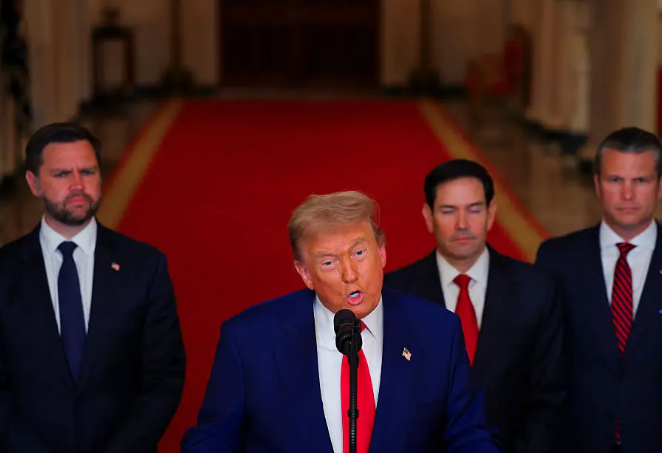
President Donald Trump has reignited speculation about U.S. intentions in Iran following his latest Truth Social post in which he appeared to endorse regime change, just days after ordering strikes on three of Iran’s nuclear facilities.

“It’s not politically correct to use the term ‘Regime Change,’” Trump wrote on Sunday. “But if the current Iranian Regime is unable to MAKE IRAN GREAT AGAIN, why wouldn’t there be a Regime change???” He concluded the post with a reworked slogan: “MIGA!!!” — a nod to his “Make America Great Again” mantra.

The provocative remarks came as members of Trump’s own administration continued to insist that toppling the Iranian government is not the objective of recent military action. “This mission was not and has not been about regime change,” said Defense Secretary Pete Hegseth during a Sunday press conference. He described the operation as a “precision” effort to neutralize Iran’s nuclear capabilities and protect U.S. troops and allies in the region.

Vice President J.D. Vance also downplayed regime change concerns in multiple media appearances. “We do not want to protract this or build this out any more than it’s already been built out,” Vance said on NBC’s Meet the Press, framing the strike as targeting Iran’s nuclear program—not the state itself.

Despite that message, the president’s public statements have sowed confusion about the administration’s end goals. Just last week, Trump posted about Iran’s Supreme Leader Ayatollah Ali Khamenei being an “easy target,” though he claimed the U.S. would spare him “for now.”

Tensions remain high as Iran promises retaliation for the strikes, which came just weeks after a failed round of negotiations between Tehran and Washington. Iran’s Foreign Minister Abbas Araghchi accused the U.S. and Israel of “blowing up diplomacy,” while warning that continued aggression would draw consequences.

Secretary of State Marco Rubio defended the administration’s approach, saying on Fox News that while he personally disapproves of the regime, “We’re not into the regime change business here. We’re into the safety and security of the United States business.”

Rubio added that if Iran pursues nuclear weapons, it would “put the regime at risk,” suggesting serious consequences could follow. “I think it would be the end of the regime if they tried to do that,” he warned.

Meanwhile, Ayatollah Khamenei, now 86, is reportedly taking refuge in a secure underground facility and has identified potential successors, according to The New York Times.

With threats escalating on both sides, Trump has issued a stark warning: “ANY RETALIATION BY IRAN AGAINST THE UNITED STATES OF AMERICA WILL BE MET WITH FORCE FAR GREATER THAN WHAT WAS WITNESSED TONIGHT.”

As calls for de-escalation grow internationally, uncertainty remains over whether U.S. policy is focused solely on deterrence—or a more dramatic reshaping of the Iranian regime itself.


Business

Fraudsters are increasingly using AI-generated images and videos to trick people into handing over sensitive personal and financial information, according to FraudSMART, the financial crime awareness initiative operated by the Banking and Payments Federation Ireland (BPFI). The organisation has reported a rise in online adverts promoting fake, State-backed investment schemes. These scams often use fabricated images of well-known politicians and business figures to make the offers appear legitimate and encourage users to click on registration links. Niamh Davenport, head of financial crime at BPFI, said scammers are deliberately exploiting recent media coverage of a planned State-backed savings and investment scheme to give their frauds a sense of credibility. “They often claim the scheme is open to everyone, but that places are limited and being ‘snapped up’ fast, in order to pressure people to act quickly,” she said. “They typically promise guaranteed returns or a guaranteed monthly income.” FraudSMART said that while anyone can be targeted, people in their early 50s are particularly vulnerable to investment scams. This age group is often focused on retirement planning, making them more receptive to financial offers that appear secure or high-yield. According to the organisation, most scams follow a similar pattern. Victims are first directed to click a registration link and complete a short online form providing their contact details. They are then contacted by someone posing as a financial adviser, who urges them to make an immediate “security deposit” to secure participation in the scheme. Once a payment is made, the money is quickly moved through multiple accounts, often overseas, making recovery extremely difficult. Davenport warned that scammers are becoming more sophisticated in their use of technology, particularly AI tools that allow them to create realistic but entirely fake promotional content. These materials are designed to mimic legitimate financial advertisements and build trust with potential victims. Recent figures from An Garda Síochána show investment fraud rose by 20% last year, with losses exceeding €20 million. The scale of individual scams varies widely, ranging from smaller crypto-related frauds involving a few hundred euro to large-scale investment schemes where victims lose tens of thousands. FraudSMART is urging the public to remain cautious when encountering online investment advertisements, especially those promising guaranteed returns or requiring urgent action. It also advises consumers to avoid sharing personal information with unverified sources and to be wary of pressure tactics designed to rush financial decisions. Authorities continue to warn that fraudsters are adapting quickly, using advanced digital tools to target victims across multiple platforms.

Trending

Business

Fraudsters are increasingly using AI-generated images and videos to trick people into handing over sensitive personal and financial information, according to FraudSMART, the financial crime awareness initiative operated by the Banking and Payments Federation Ireland (BPFI). The organisation has reported a rise in online adverts promoting fake, State-backed investment schemes. These scams often use fabricated images of well-known politicians and business figures to make the offers appear legitimate and encourage users to click on registration links. Niamh Davenport, head of financial crime at BPFI, said scammers are deliberately exploiting recent media coverage of a planned State-backed savings and investment scheme to give their frauds a sense of credibility. “They often claim the scheme is open to everyone, but that places are limited and being ‘snapped up’ fast, in order to pressure people to act quickly,” she said. “They typically promise guaranteed returns or a guaranteed monthly income.” FraudSMART said that while anyone can be targeted, people in their early 50s are particularly vulnerable to investment scams. This age group is often focused on retirement planning, making them more receptive to financial offers that appear secure or high-yield. According to the organisation, most scams follow a similar pattern. Victims are first directed to click a registration link and complete a short online form providing their contact details. They are then contacted by someone posing as a financial adviser, who urges them to make an immediate “security deposit” to secure participation in the scheme. Once a payment is made, the money is quickly moved through multiple accounts, often overseas, making recovery extremely difficult. Davenport warned that scammers are becoming more sophisticated in their use of technology, particularly AI tools that allow them to create realistic but entirely fake promotional content. These materials are designed to mimic legitimate financial advertisements and build trust with potential victims. Recent figures from An Garda Síochána show investment fraud rose by 20% last year, with losses exceeding €20 million. The scale of individual scams varies widely, ranging from smaller crypto-related frauds involving a few hundred euro to large-scale investment schemes where victims lose tens of thousands. FraudSMART is urging the public to remain cautious when encountering online investment advertisements, especially those promising guaranteed returns or requiring urgent action. It also advises consumers to avoid sharing personal information with unverified sources and to be wary of pressure tactics designed to rush financial decisions. Authorities continue to warn that fraudsters are adapting quickly, using advanced digital tools to target victims across multiple platforms.

You May Also Like

Politics

WASHINGTON — The Pentagon announced on Sunday that the United States will send a Terminal High Altitude Area Defense (THAAD) battery to Israel, alongside...

Health

NEW YORK — Teen smoking in the United States has reached an all-time low in 2024, with significant declines in overall youth tobacco use,...

Politics

WASHINGTON — As the countdown to the November 5 presidential election continues, former President Donald Trump is urging his supporters to aim for a...

Politics

In September, NASA announced that summer 2024 was the hottest on record. Just days later, the U.S. faced the dual impact of Hurricanes Helene...