















Connect with us

Hi, what are you looking for?

Politics

Trump Faces Mounting Scrutiny Over Economic Woes as Recession Fears Grow

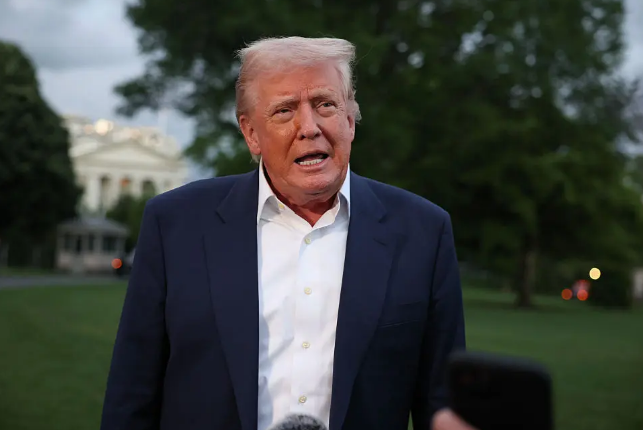
Former President Donald Trump is facing growing public and political scrutiny over the state of the U.S. economy, as market volatility, declining consumer confidence, and looming recession fears converge during his second term in office.

Though Trump has long portrayed himself as a shrewd businessman capable of steering the nation’s economy, recent data suggests that public patience is wearing thin. According to a new NPR-PBS-Marist poll, 60% of Americans now attribute the current economic challenges to Trump’s policies—an unusually high figure for a sitting president. For comparison, just 14% of voters blamed President Barack Obama for the state of the economy during the Great Recession at a similar point in his first term.

The markets have reacted sharply in recent weeks. On Monday, the Dow Jones Industrial Average opened nearly 6% lower than on Trump’s first full day in office, following a series of erratic policy shifts. A global tariff regime, escalating trade tensions with China, and hints of abrupt reversals have rattled investors and added uncertainty to an already fragile economic landscape.

Last week, the Commerce Department reported that the U.S. economy shrank in the first quarter of the year—a period before Trump’s most recent tariff threats took effect. Despite the timing, Trump declined to accept any responsibility, instead blaming his predecessor, Joe Biden. “This is Biden,” Trump said during a Cabinet meeting. “You can even say the next quarter is sort of Biden.”

In public appearances, Trump has attempted to distinguish between what he calls “good” and “bad” parts of the economy, laying the blame for any downturn on Biden-era policies or Federal Reserve Chair Jerome Powell. But as consumer confidence continues to fall—now reportedly lower than during the 2008 financial crisis—voters appear increasingly unconvinced.

On NBC’s Meet the Press last Friday, Trump was pressed on whether he would accept a recession as a necessary consequence of long-term economic reform. He avoided a direct answer, instead calling the current situation a “transition period” and insisting that “we’re going to do fantastically.” When asked if a recession was coming, he responded, “Anything can happen.”

Economists say recessions rarely arrive without warning, often emerging from declining consumer sentiment and uncertainty—two factors now dominating the national mood. With consumers accounting for roughly 70% of economic activity, their caution could have outsized effects.

Trump’s presidency has always leaned heavily on performance and perception. But as financial pressure mounts and Americans begin to tighten their belts, the reality behind the rhetoric is becoming harder to ignore. Having reclaimed the White House, Trump now finds himself fully accountable for the economic storm many voters believe he helped create.
Business

Fraudsters are increasingly using AI-generated images and videos to trick people into handing over sensitive personal and financial information, according to FraudSMART, the financial crime awareness initiative operated by the Banking and Payments Federation Ireland (BPFI). The organisation has reported a rise in online adverts promoting fake, State-backed investment schemes. These scams often use fabricated images of well-known politicians and business figures to make the offers appear legitimate and encourage users to click on registration links. Niamh Davenport, head of financial crime at BPFI, said scammers are deliberately exploiting recent media coverage of a planned State-backed savings and investment scheme to give their frauds a sense of credibility. “They often claim the scheme is open to everyone, but that places are limited and being ‘snapped up’ fast, in order to pressure people to act quickly,” she said. “They typically promise guaranteed returns or a guaranteed monthly income.” FraudSMART said that while anyone can be targeted, people in their early 50s are particularly vulnerable to investment scams. This age group is often focused on retirement planning, making them more receptive to financial offers that appear secure or high-yield. According to the organisation, most scams follow a similar pattern. Victims are first directed to click a registration link and complete a short online form providing their contact details. They are then contacted by someone posing as a financial adviser, who urges them to make an immediate “security deposit” to secure participation in the scheme. Once a payment is made, the money is quickly moved through multiple accounts, often overseas, making recovery extremely difficult. Davenport warned that scammers are becoming more sophisticated in their use of technology, particularly AI tools that allow them to create realistic but entirely fake promotional content. These materials are designed to mimic legitimate financial advertisements and build trust with potential victims. Recent figures from An Garda Síochána show investment fraud rose by 20% last year, with losses exceeding €20 million. The scale of individual scams varies widely, ranging from smaller crypto-related frauds involving a few hundred euro to large-scale investment schemes where victims lose tens of thousands. FraudSMART is urging the public to remain cautious when encountering online investment advertisements, especially those promising guaranteed returns or requiring urgent action. It also advises consumers to avoid sharing personal information with unverified sources and to be wary of pressure tactics designed to rush financial decisions. Authorities continue to warn that fraudsters are adapting quickly, using advanced digital tools to target victims across multiple platforms.

Trending

Business

Fraudsters are increasingly using AI-generated images and videos to trick people into handing over sensitive personal and financial information, according to FraudSMART, the financial crime awareness initiative operated by the Banking and Payments Federation Ireland (BPFI). The organisation has reported a rise in online adverts promoting fake, State-backed investment schemes. These scams often use fabricated images of well-known politicians and business figures to make the offers appear legitimate and encourage users to click on registration links. Niamh Davenport, head of financial crime at BPFI, said scammers are deliberately exploiting recent media coverage of a planned State-backed savings and investment scheme to give their frauds a sense of credibility. “They often claim the scheme is open to everyone, but that places are limited and being ‘snapped up’ fast, in order to pressure people to act quickly,” she said. “They typically promise guaranteed returns or a guaranteed monthly income.” FraudSMART said that while anyone can be targeted, people in their early 50s are particularly vulnerable to investment scams. This age group is often focused on retirement planning, making them more receptive to financial offers that appear secure or high-yield. According to the organisation, most scams follow a similar pattern. Victims are first directed to click a registration link and complete a short online form providing their contact details. They are then contacted by someone posing as a financial adviser, who urges them to make an immediate “security deposit” to secure participation in the scheme. Once a payment is made, the money is quickly moved through multiple accounts, often overseas, making recovery extremely difficult. Davenport warned that scammers are becoming more sophisticated in their use of technology, particularly AI tools that allow them to create realistic but entirely fake promotional content. These materials are designed to mimic legitimate financial advertisements and build trust with potential victims. Recent figures from An Garda Síochána show investment fraud rose by 20% last year, with losses exceeding €20 million. The scale of individual scams varies widely, ranging from smaller crypto-related frauds involving a few hundred euro to large-scale investment schemes where victims lose tens of thousands. FraudSMART is urging the public to remain cautious when encountering online investment advertisements, especially those promising guaranteed returns or requiring urgent action. It also advises consumers to avoid sharing personal information with unverified sources and to be wary of pressure tactics designed to rush financial decisions. Authorities continue to warn that fraudsters are adapting quickly, using advanced digital tools to target victims across multiple platforms.

You May Also Like

Politics

WASHINGTON — The Pentagon announced on Sunday that the United States will send a Terminal High Altitude Area Defense (THAAD) battery to Israel, alongside...

Health

NEW YORK — Teen smoking in the United States has reached an all-time low in 2024, with significant declines in overall youth tobacco use,...

Politics

WASHINGTON — As the countdown to the November 5 presidential election continues, former President Donald Trump is urging his supporters to aim for a...

Politics

In September, NASA announced that summer 2024 was the hottest on record. Just days later, the U.S. faced the dual impact of Hurricanes Helene...