


















Connect with us

Hi, what are you looking for?

Politics

Trump Expected to Rebrand Department of Defense as “Department of War”

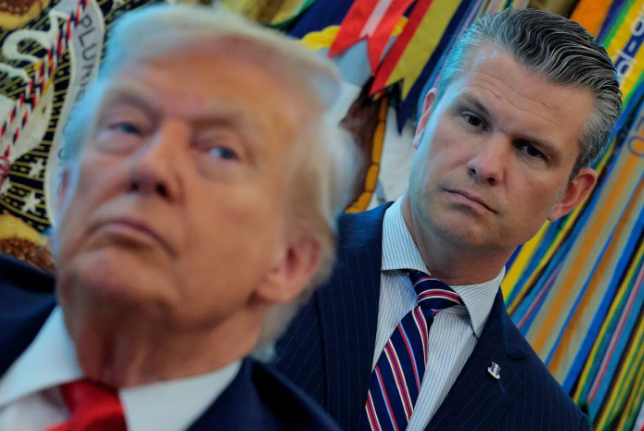
Defense Secretary Pete Hegseth has hinted that a major rebranding of the U.S. military’s top institution is imminent, as President Donald Trump prepares to sign an executive order that would allow the Department of Defense to be referred to once again as the “Department of War.”

Speaking to reporters while departing Joint Base Andrews in Maryland on Thursday, Hegseth thanked them for “traveling with the War Department.” Later, he appeared to confirm the change on social media, reposting a news report about the move with the caption “Department of War.”

According to a White House fact sheet seen by Reuters, Trump’s order would authorize Hegseth to use the title “Secretary of War” in official correspondence and public communications. Other senior officials would also be able to adopt corresponding titles such as “Deputy Secretary of War.”

While a permanent name change would require an act of Congress, Republicans currently hold narrow majorities in both chambers, making approval more likely. Trump has argued repeatedly that the current title sounds too passive. “We want defense, but we want offense too,” he said in the Oval Office on August 25. “As Department of War we won everything, we won everything—and I think we’re going to have to go back to that.”

The United States originally operated a Department of War from its founding until the mid-20th century, when it was reorganized under the National Security Act Amendments of 1949 into what became the Department of Defense. The renaming reflected a shift toward a broader, more unified military structure that included the Army, Navy, and newly created Air Force.

If finalized, the reversion to the old name would represent one of the most symbolic rebranding efforts of Trump’s second term. It follows other controversial renaming decisions, including his proclamation earlier this year rechristening the “Gulf of Mexico” as the “Gulf of America.” In June, Trump also ordered the restoration of names honoring Confederate generals at seven U.S. Army bases, reversing changes enacted under the Biden administration.

Critics say that renaming the Department of Defense could come with an enormous price tag, requiring changes to official emblems, uniforms, signage, websites, and email systems across the vast federal bureaucracy. The White House has not provided a cost estimate, though officials privately acknowledge the expenses could be significant.

Supporters of the move, however, argue that it sends a stronger message of strength to both allies and adversaries. Hegseth, a former Army officer and Fox News host, has emphasized his commitment to restoring what he calls a “warrior ethos” at the Pentagon.

Whether Congress will ultimately approve a statutory renaming remains uncertain, but Trump’s executive order—expected Friday—would immediately allow the administration to use “Department of War” as an alternative title in official settings.


Business

Fraudsters are increasingly using AI-generated images and videos to trick people into handing over sensitive personal and financial information, according to FraudSMART, the financial crime awareness initiative operated by the Banking and Payments Federation Ireland (BPFI). The organisation has reported a rise in online adverts promoting fake, State-backed investment schemes. These scams often use fabricated images of well-known politicians and business figures to make the offers appear legitimate and encourage users to click on registration links. Niamh Davenport, head of financial crime at BPFI, said scammers are deliberately exploiting recent media coverage of a planned State-backed savings and investment scheme to give their frauds a sense of credibility. “They often claim the scheme is open to everyone, but that places are limited and being ‘snapped up’ fast, in order to pressure people to act quickly,” she said. “They typically promise guaranteed returns or a guaranteed monthly income.” FraudSMART said that while anyone can be targeted, people in their early 50s are particularly vulnerable to investment scams. This age group is often focused on retirement planning, making them more receptive to financial offers that appear secure or high-yield. According to the organisation, most scams follow a similar pattern. Victims are first directed to click a registration link and complete a short online form providing their contact details. They are then contacted by someone posing as a financial adviser, who urges them to make an immediate “security deposit” to secure participation in the scheme. Once a payment is made, the money is quickly moved through multiple accounts, often overseas, making recovery extremely difficult. Davenport warned that scammers are becoming more sophisticated in their use of technology, particularly AI tools that allow them to create realistic but entirely fake promotional content. These materials are designed to mimic legitimate financial advertisements and build trust with potential victims. Recent figures from An Garda Síochána show investment fraud rose by 20% last year, with losses exceeding €20 million. The scale of individual scams varies widely, ranging from smaller crypto-related frauds involving a few hundred euro to large-scale investment schemes where victims lose tens of thousands. FraudSMART is urging the public to remain cautious when encountering online investment advertisements, especially those promising guaranteed returns or requiring urgent action. It also advises consumers to avoid sharing personal information with unverified sources and to be wary of pressure tactics designed to rush financial decisions. Authorities continue to warn that fraudsters are adapting quickly, using advanced digital tools to target victims across multiple platforms.

Trending

Business

Fraudsters are increasingly using AI-generated images and videos to trick people into handing over sensitive personal and financial information, according to FraudSMART, the financial crime awareness initiative operated by the Banking and Payments Federation Ireland (BPFI). The organisation has reported a rise in online adverts promoting fake, State-backed investment schemes. These scams often use fabricated images of well-known politicians and business figures to make the offers appear legitimate and encourage users to click on registration links. Niamh Davenport, head of financial crime at BPFI, said scammers are deliberately exploiting recent media coverage of a planned State-backed savings and investment scheme to give their frauds a sense of credibility. “They often claim the scheme is open to everyone, but that places are limited and being ‘snapped up’ fast, in order to pressure people to act quickly,” she said. “They typically promise guaranteed returns or a guaranteed monthly income.” FraudSMART said that while anyone can be targeted, people in their early 50s are particularly vulnerable to investment scams. This age group is often focused on retirement planning, making them more receptive to financial offers that appear secure or high-yield. According to the organisation, most scams follow a similar pattern. Victims are first directed to click a registration link and complete a short online form providing their contact details. They are then contacted by someone posing as a financial adviser, who urges them to make an immediate “security deposit” to secure participation in the scheme. Once a payment is made, the money is quickly moved through multiple accounts, often overseas, making recovery extremely difficult. Davenport warned that scammers are becoming more sophisticated in their use of technology, particularly AI tools that allow them to create realistic but entirely fake promotional content. These materials are designed to mimic legitimate financial advertisements and build trust with potential victims. Recent figures from An Garda Síochána show investment fraud rose by 20% last year, with losses exceeding €20 million. The scale of individual scams varies widely, ranging from smaller crypto-related frauds involving a few hundred euro to large-scale investment schemes where victims lose tens of thousands. FraudSMART is urging the public to remain cautious when encountering online investment advertisements, especially those promising guaranteed returns or requiring urgent action. It also advises consumers to avoid sharing personal information with unverified sources and to be wary of pressure tactics designed to rush financial decisions. Authorities continue to warn that fraudsters are adapting quickly, using advanced digital tools to target victims across multiple platforms.

You May Also Like

Politics

WASHINGTON — The Pentagon announced on Sunday that the United States will send a Terminal High Altitude Area Defense (THAAD) battery to Israel, alongside...

Health

NEW YORK — Teen smoking in the United States has reached an all-time low in 2024, with significant declines in overall youth tobacco use,...

Politics

WASHINGTON — As the countdown to the November 5 presidential election continues, former President Donald Trump is urging his supporters to aim for a...

Politics

In September, NASA announced that summer 2024 was the hottest on record. Just days later, the U.S. faced the dual impact of Hurricanes Helene...
















