












Connect with us

Hi, what are you looking for?

Politics

Senator Raphael Warnock Rallies Support for Kamala Harris Among Black Voters

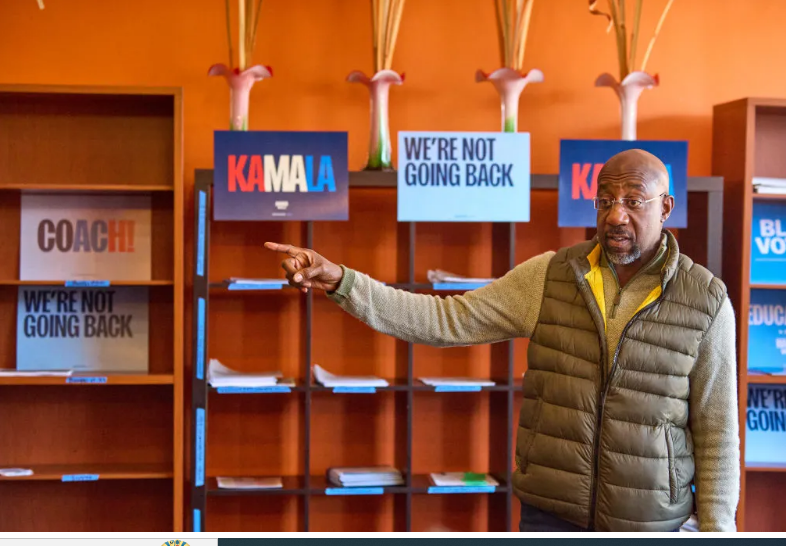
Senator Raphael Warnock of Georgia recently visited Detroit’s Avenue of Fashion, delivering a passionate message to a predominantly Black audience about the importance of voter turnout in the upcoming election. Arriving in an SUV clad in blue jeans and an olive vest, Warnock is among a cadre of high-profile advocates aiming to mobilize Black male voters, a demographic the campaign believes is crucial for Vice President Kamala Harris’s success.

At a makeshift Democratic field office, Warnock emphasized the critical need for participation at the polls, stating, “We cannot afford to stay home. There’s no such thing as not voting. If you do anything other than vote for Kamala Harris, then you are putting that man closer to the White House.” His call to action resonates as he fears that a lack of enthusiasm could cost Harris the election—not necessarily through direct support for Donald Trump but through voter apathy.

Earlier in the day, Warnock addressed students at a local magnet school, stressing the significance of voter engagement as he embarks on a campaign blitz leading up to Election Day. “I don’t believe that there are going to be huge swaths of Black men voting for Donald Trump,” he remarked, underscoring the diversity of opinions within the Black community.

With low-propensity voters—those registered but less likely to vote—at the forefront of their strategy, Harris’s campaign is intensifying its outreach efforts. Campaign advisers believe that core supporters have already cast their ballots, leaving low-propensity voters as the primary target. This includes door-to-door canvassing, digital advertisements tailored to specific demographics, and phone outreach. Just last Saturday, Harris’s campaign reported volunteers knocked on 2,000 doors in Pennsylvania alone.

Harris’s outreach efforts are particularly concentrated in key cities within traditionally white states like Michigan, Wisconsin, and Pennsylvania, where Black voters are seen as pivotal. While these voters make up only a small percentage of the overall electorate, their turnout could decisively influence the election outcome.

The stakes are even higher in Southern states, such as Georgia and North Carolina, where the Black electorate comprises roughly 30% and 25%, respectively. Although not considered must-win states, these are essential components of a broader Democratic strategy.

In response to concerns about Black male voter turnout, Harris has launched initiatives aimed specifically at this group, including an “Opportunity Agenda for Black Men” and community engagement events like “Cuts and Conversations” at local barbershops. Additionally, celebrities such as Beyoncé, Usher, and Magic Johnson have joined her campaign efforts to galvanize support.

While the campaign’s messaging has received praise for its direct approach, there are lingering doubts about its effectiveness. Harris’s polling shows approximately 73% support among Black voters, but concerns remain about the potential for voter apathy to affect turnout.

As Election Day approaches, the urgency of the campaign is palpable. Warnock concludes, “The real threat that we face, the real thing that we’ve got to address is apathy.” With the campaign focusing intensely on engaging Black voters, especially men, both Harris and her allies are racing against time to secure their support.

Business

Fraudsters are increasingly using AI-generated images and videos to trick people into handing over sensitive personal and financial information, according to FraudSMART, the financial crime awareness initiative operated by the Banking and Payments Federation Ireland (BPFI). The organisation has reported a rise in online adverts promoting fake, State-backed investment schemes. These scams often use fabricated images of well-known politicians and business figures to make the offers appear legitimate and encourage users to click on registration links. Niamh Davenport, head of financial crime at BPFI, said scammers are deliberately exploiting recent media coverage of a planned State-backed savings and investment scheme to give their frauds a sense of credibility. “They often claim the scheme is open to everyone, but that places are limited and being ‘snapped up’ fast, in order to pressure people to act quickly,” she said. “They typically promise guaranteed returns or a guaranteed monthly income.” FraudSMART said that while anyone can be targeted, people in their early 50s are particularly vulnerable to investment scams. This age group is often focused on retirement planning, making them more receptive to financial offers that appear secure or high-yield. According to the organisation, most scams follow a similar pattern. Victims are first directed to click a registration link and complete a short online form providing their contact details. They are then contacted by someone posing as a financial adviser, who urges them to make an immediate “security deposit” to secure participation in the scheme. Once a payment is made, the money is quickly moved through multiple accounts, often overseas, making recovery extremely difficult. Davenport warned that scammers are becoming more sophisticated in their use of technology, particularly AI tools that allow them to create realistic but entirely fake promotional content. These materials are designed to mimic legitimate financial advertisements and build trust with potential victims. Recent figures from An Garda Síochána show investment fraud rose by 20% last year, with losses exceeding €20 million. The scale of individual scams varies widely, ranging from smaller crypto-related frauds involving a few hundred euro to large-scale investment schemes where victims lose tens of thousands. FraudSMART is urging the public to remain cautious when encountering online investment advertisements, especially those promising guaranteed returns or requiring urgent action. It also advises consumers to avoid sharing personal information with unverified sources and to be wary of pressure tactics designed to rush financial decisions. Authorities continue to warn that fraudsters are adapting quickly, using advanced digital tools to target victims across multiple platforms.

Trending

Business

Fraudsters are increasingly using AI-generated images and videos to trick people into handing over sensitive personal and financial information, according to FraudSMART, the financial crime awareness initiative operated by the Banking and Payments Federation Ireland (BPFI). The organisation has reported a rise in online adverts promoting fake, State-backed investment schemes. These scams often use fabricated images of well-known politicians and business figures to make the offers appear legitimate and encourage users to click on registration links. Niamh Davenport, head of financial crime at BPFI, said scammers are deliberately exploiting recent media coverage of a planned State-backed savings and investment scheme to give their frauds a sense of credibility. “They often claim the scheme is open to everyone, but that places are limited and being ‘snapped up’ fast, in order to pressure people to act quickly,” she said. “They typically promise guaranteed returns or a guaranteed monthly income.” FraudSMART said that while anyone can be targeted, people in their early 50s are particularly vulnerable to investment scams. This age group is often focused on retirement planning, making them more receptive to financial offers that appear secure or high-yield. According to the organisation, most scams follow a similar pattern. Victims are first directed to click a registration link and complete a short online form providing their contact details. They are then contacted by someone posing as a financial adviser, who urges them to make an immediate “security deposit” to secure participation in the scheme. Once a payment is made, the money is quickly moved through multiple accounts, often overseas, making recovery extremely difficult. Davenport warned that scammers are becoming more sophisticated in their use of technology, particularly AI tools that allow them to create realistic but entirely fake promotional content. These materials are designed to mimic legitimate financial advertisements and build trust with potential victims. Recent figures from An Garda Síochána show investment fraud rose by 20% last year, with losses exceeding €20 million. The scale of individual scams varies widely, ranging from smaller crypto-related frauds involving a few hundred euro to large-scale investment schemes where victims lose tens of thousands. FraudSMART is urging the public to remain cautious when encountering online investment advertisements, especially those promising guaranteed returns or requiring urgent action. It also advises consumers to avoid sharing personal information with unverified sources and to be wary of pressure tactics designed to rush financial decisions. Authorities continue to warn that fraudsters are adapting quickly, using advanced digital tools to target victims across multiple platforms.

You May Also Like

Politics

WASHINGTON — The Pentagon announced on Sunday that the United States will send a Terminal High Altitude Area Defense (THAAD) battery to Israel, alongside...

Health

NEW YORK — Teen smoking in the United States has reached an all-time low in 2024, with significant declines in overall youth tobacco use,...

Politics

WASHINGTON — As the countdown to the November 5 presidential election continues, former President Donald Trump is urging his supporters to aim for a...

Politics

In September, NASA announced that summer 2024 was the hottest on record. Just days later, the U.S. faced the dual impact of Hurricanes Helene...