













Connect with us

Hi, what are you looking for?

Politics

Senate Republicans Prepare for Leadership Transition Amidst Uncertainty

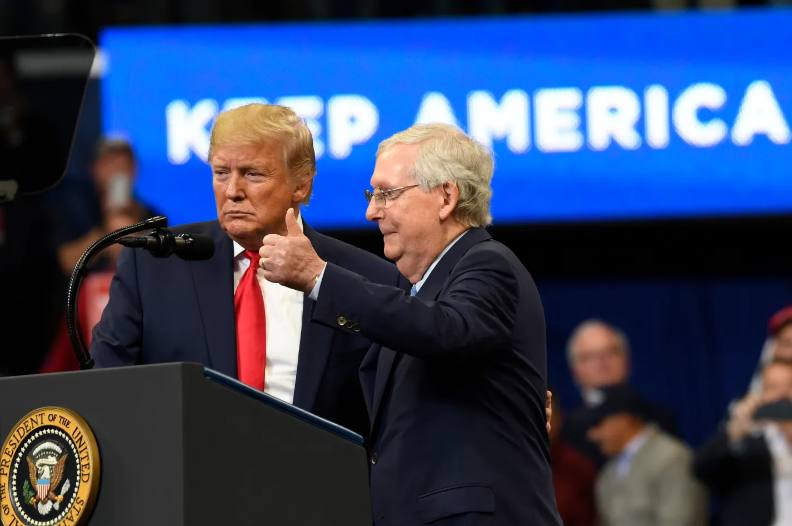
As Senate Republicans gear up to select a new leader to succeed Mitch McConnell, who is stepping down after nearly two decades, the race is heating up ahead of a critical ballot on November 13. Current Senate Minority Whip John Thune of South Dakota and former Whip John Cornyn of Texas are the frontrunners, but many GOP senators remain tight-lipped about their endorsements, with the outcome hanging in the balance following the upcoming presidential election.

The leadership election comes at a pivotal moment for the party. The winner will have significant influence over the GOP’s direction and may assume the role of Senate majority leader if Republicans secure enough seats in the imminent election. While Thune and Cornyn have both garnered a reputation as traditional conservatives, they are vying to distance themselves from McConnell’s leadership style and advocate for a more open approach.

“I’m trying to find differentiation because they’re both great guys,” said Senator Thom Tillis of North Carolina, acknowledging the challenge his colleagues face in making a choice. Both candidates have expressed their support for Donald Trump in the current presidential race, despite having previously clashed with him, particularly after the January 6 Capitol riots. Recent interactions with Trump have intensified, as both senators attended campaign events and communicated frequently with the former president.

The potential for Trump to endorse a candidate could play a decisive role in the leadership race. Some senators, including Oklahoma’s Markwayne Mullin, have advised Trump to refrain from getting involved, suggesting that he understands the importance of maintaining a good relationship with the future Senate leader. Conversely, Tillis cautioned that an endorsement could complicate dynamics within the closely-knit Senate.

Scott has emerged as a wildcard in the leadership race, especially as he campaigns for reelection in Florida. His longstanding ties to Trump may bolster his candidacy, positioning him as a contender that could disrupt the Thune-Cornyn showdown. The presence of Scott and the possibility of another candidate entering the fray adds further unpredictability to the outcome.

In addition to their leadership aspirations, both Thune and Cornyn have actively campaigned and fundraised for fellow Republican candidates nationwide. Thune has made over two dozen campaign appearances and raised more than $31 million for Senate races this cycle, while Cornyn has a robust fundraising track record, claiming over $400 million raised during his two decades in the Senate.

On policy, Thune and Cornyn share similar positions, generally aligning with their conference while occasionally collaborating with Democrats. Cornyn has a history of bipartisan efforts, including work on gun legislation, while Thune has engaged in cross-party negotiations during his tenure on the Senate Commerce Committee.

As the leadership race unfolds, the dynamics within the Republican caucus, particularly the influence of more conservative members who have challenged McConnell in recent years, will be crucial. Some senators, including Missouri’s Josh Hawley, are looking for assurances on how the new leader would engage with Trump if he returns to the presidency.

Both Thune and Cornyn have indicated an openness to reforming the leader’s role to address the concerns of their colleagues, although they are cautious not to undermine the authority of the position. As the Republican Party braces for the upcoming election and leadership change, the decisions made in the coming weeks could shape its trajectory for years to come.


Business

Fraudsters are increasingly using AI-generated images and videos to trick people into handing over sensitive personal and financial information, according to FraudSMART, the financial crime awareness initiative operated by the Banking and Payments Federation Ireland (BPFI). The organisation has reported a rise in online adverts promoting fake, State-backed investment schemes. These scams often use fabricated images of well-known politicians and business figures to make the offers appear legitimate and encourage users to click on registration links. Niamh Davenport, head of financial crime at BPFI, said scammers are deliberately exploiting recent media coverage of a planned State-backed savings and investment scheme to give their frauds a sense of credibility. “They often claim the scheme is open to everyone, but that places are limited and being ‘snapped up’ fast, in order to pressure people to act quickly,” she said. “They typically promise guaranteed returns or a guaranteed monthly income.” FraudSMART said that while anyone can be targeted, people in their early 50s are particularly vulnerable to investment scams. This age group is often focused on retirement planning, making them more receptive to financial offers that appear secure or high-yield. According to the organisation, most scams follow a similar pattern. Victims are first directed to click a registration link and complete a short online form providing their contact details. They are then contacted by someone posing as a financial adviser, who urges them to make an immediate “security deposit” to secure participation in the scheme. Once a payment is made, the money is quickly moved through multiple accounts, often overseas, making recovery extremely difficult. Davenport warned that scammers are becoming more sophisticated in their use of technology, particularly AI tools that allow them to create realistic but entirely fake promotional content. These materials are designed to mimic legitimate financial advertisements and build trust with potential victims. Recent figures from An Garda Síochána show investment fraud rose by 20% last year, with losses exceeding €20 million. The scale of individual scams varies widely, ranging from smaller crypto-related frauds involving a few hundred euro to large-scale investment schemes where victims lose tens of thousands. FraudSMART is urging the public to remain cautious when encountering online investment advertisements, especially those promising guaranteed returns or requiring urgent action. It also advises consumers to avoid sharing personal information with unverified sources and to be wary of pressure tactics designed to rush financial decisions. Authorities continue to warn that fraudsters are adapting quickly, using advanced digital tools to target victims across multiple platforms.

Trending

Business

Fraudsters are increasingly using AI-generated images and videos to trick people into handing over sensitive personal and financial information, according to FraudSMART, the financial crime awareness initiative operated by the Banking and Payments Federation Ireland (BPFI). The organisation has reported a rise in online adverts promoting fake, State-backed investment schemes. These scams often use fabricated images of well-known politicians and business figures to make the offers appear legitimate and encourage users to click on registration links. Niamh Davenport, head of financial crime at BPFI, said scammers are deliberately exploiting recent media coverage of a planned State-backed savings and investment scheme to give their frauds a sense of credibility. “They often claim the scheme is open to everyone, but that places are limited and being ‘snapped up’ fast, in order to pressure people to act quickly,” she said. “They typically promise guaranteed returns or a guaranteed monthly income.” FraudSMART said that while anyone can be targeted, people in their early 50s are particularly vulnerable to investment scams. This age group is often focused on retirement planning, making them more receptive to financial offers that appear secure or high-yield. According to the organisation, most scams follow a similar pattern. Victims are first directed to click a registration link and complete a short online form providing their contact details. They are then contacted by someone posing as a financial adviser, who urges them to make an immediate “security deposit” to secure participation in the scheme. Once a payment is made, the money is quickly moved through multiple accounts, often overseas, making recovery extremely difficult. Davenport warned that scammers are becoming more sophisticated in their use of technology, particularly AI tools that allow them to create realistic but entirely fake promotional content. These materials are designed to mimic legitimate financial advertisements and build trust with potential victims. Recent figures from An Garda Síochána show investment fraud rose by 20% last year, with losses exceeding €20 million. The scale of individual scams varies widely, ranging from smaller crypto-related frauds involving a few hundred euro to large-scale investment schemes where victims lose tens of thousands. FraudSMART is urging the public to remain cautious when encountering online investment advertisements, especially those promising guaranteed returns or requiring urgent action. It also advises consumers to avoid sharing personal information with unverified sources and to be wary of pressure tactics designed to rush financial decisions. Authorities continue to warn that fraudsters are adapting quickly, using advanced digital tools to target victims across multiple platforms.

You May Also Like

Politics

WASHINGTON — The Pentagon announced on Sunday that the United States will send a Terminal High Altitude Area Defense (THAAD) battery to Israel, alongside...

Health

NEW YORK — Teen smoking in the United States has reached an all-time low in 2024, with significant declines in overall youth tobacco use,...

Politics

WASHINGTON — As the countdown to the November 5 presidential election continues, former President Donald Trump is urging his supporters to aim for a...

Politics

In September, NASA announced that summer 2024 was the hottest on record. Just days later, the U.S. faced the dual impact of Hurricanes Helene...