














Connect with us

Hi, what are you looking for?

Politics

New York Officials Move to Re-Raise Pride Flag at Stonewall National Monument

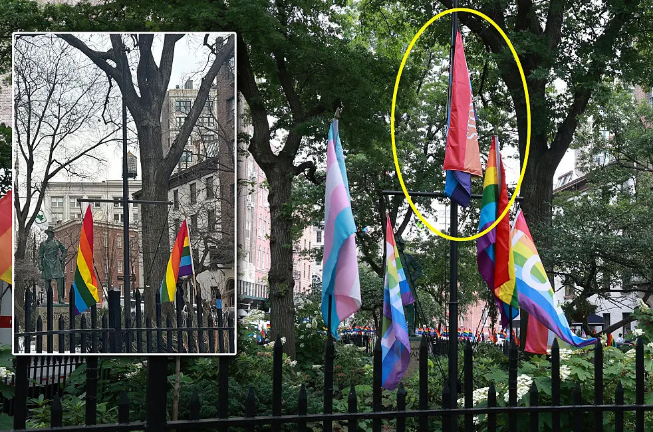
New York officials plan to re-raise a rainbow Pride flag at the Stonewall National Monument in Manhattan after the Trump Administration recently removed it from the site, known for sparking the modern LGBTQ+ rights movement.

Manhattan Borough President Brad Hoylman-Sigal, an openly gay Democrat, posted a video on social media Tuesday evening showing the empty flagpole and declaring, “Our community is not going to stand by idly as the Trump Administration tries to erase our history.” Hoylman-Sigal said he and other city officials would reinstall the flag at 4 p.m. Thursday.

New York City Mayor Zohran Mamdani, also a Democrat, expressed outrage over the removal, posting that “New York is the birthplace of the modern LGBTQ+ rights movement, and no act of erasure will ever change, or silence, that history.” He added that the city has a duty not only to honor the legacy of Stonewall but to live up to it.

City Council Speaker Julie Menin and other council members wrote to the acting director of the National Park Service (NPS), expressing “extreme concern” over the flag’s removal from what they described as “sacred ground in the history of civil rights” and demanding its immediate return. Governor Kathy Hochul criticized the Trump Administration for previously minimizing transgender and queer history on the monument’s federal website and then removing the Pride flag. “I will not let this Administration rollback the rights we fought so hard for,” she said.

Other Democratic lawmakers joined the condemnation. Senate Minority Leader Chuck Schumer called the removal “deeply outrageous” and demanded it be reversed, while Representative Jerry Nadler, who lobbied for federal recognition of Stonewall before its 2016 designation as a national monument, called the move another example of the Trump Administration’s effort to erase the LGBTQ+ community. Nadler vowed to fight for the flag’s reinstatement.

Demonstrators protested Tuesday evening outside the park. Stacy Lentz, co-owner of the Stonewall Inn, which became a symbol of LGBTQ+ resistance after the 1969 police raid, said removing the flag “is an attempt to erase a part of the American struggle and the American story that LGBTQ folks did to make sure that we have equality.” Pride flags at the Stonewall Inn itself remain in place.

The Department of the Interior said that under federal guidance, only the U.S. flag and other congressionally or departmentally authorized flags are flown on National Park Service flagpoles, though exemptions exist for flags that provide historical context. When asked about the city’s plans to re-raise the flag, the department responded that local officials should focus on city services instead of flag disputes.

The Stonewall changes reflect broader Trump Administration efforts to alter national parks and limit diversity and inclusion programs. During Trump’s first term, the federal government denied a nearby flagpole was on federal land, leaving the city to raise its own Pride flag. In 2022, under the Biden Administration, a new federal flagpole was installed, and the Pride flag was officially raised.


Business

Fraudsters are increasingly using AI-generated images and videos to trick people into handing over sensitive personal and financial information, according to FraudSMART, the financial crime awareness initiative operated by the Banking and Payments Federation Ireland (BPFI). The organisation has reported a rise in online adverts promoting fake, State-backed investment schemes. These scams often use fabricated images of well-known politicians and business figures to make the offers appear legitimate and encourage users to click on registration links. Niamh Davenport, head of financial crime at BPFI, said scammers are deliberately exploiting recent media coverage of a planned State-backed savings and investment scheme to give their frauds a sense of credibility. “They often claim the scheme is open to everyone, but that places are limited and being ‘snapped up’ fast, in order to pressure people to act quickly,” she said. “They typically promise guaranteed returns or a guaranteed monthly income.” FraudSMART said that while anyone can be targeted, people in their early 50s are particularly vulnerable to investment scams. This age group is often focused on retirement planning, making them more receptive to financial offers that appear secure or high-yield. According to the organisation, most scams follow a similar pattern. Victims are first directed to click a registration link and complete a short online form providing their contact details. They are then contacted by someone posing as a financial adviser, who urges them to make an immediate “security deposit” to secure participation in the scheme. Once a payment is made, the money is quickly moved through multiple accounts, often overseas, making recovery extremely difficult. Davenport warned that scammers are becoming more sophisticated in their use of technology, particularly AI tools that allow them to create realistic but entirely fake promotional content. These materials are designed to mimic legitimate financial advertisements and build trust with potential victims. Recent figures from An Garda Síochána show investment fraud rose by 20% last year, with losses exceeding €20 million. The scale of individual scams varies widely, ranging from smaller crypto-related frauds involving a few hundred euro to large-scale investment schemes where victims lose tens of thousands. FraudSMART is urging the public to remain cautious when encountering online investment advertisements, especially those promising guaranteed returns or requiring urgent action. It also advises consumers to avoid sharing personal information with unverified sources and to be wary of pressure tactics designed to rush financial decisions. Authorities continue to warn that fraudsters are adapting quickly, using advanced digital tools to target victims across multiple platforms.

Trending

Business

Fraudsters are increasingly using AI-generated images and videos to trick people into handing over sensitive personal and financial information, according to FraudSMART, the financial crime awareness initiative operated by the Banking and Payments Federation Ireland (BPFI). The organisation has reported a rise in online adverts promoting fake, State-backed investment schemes. These scams often use fabricated images of well-known politicians and business figures to make the offers appear legitimate and encourage users to click on registration links. Niamh Davenport, head of financial crime at BPFI, said scammers are deliberately exploiting recent media coverage of a planned State-backed savings and investment scheme to give their frauds a sense of credibility. “They often claim the scheme is open to everyone, but that places are limited and being ‘snapped up’ fast, in order to pressure people to act quickly,” she said. “They typically promise guaranteed returns or a guaranteed monthly income.” FraudSMART said that while anyone can be targeted, people in their early 50s are particularly vulnerable to investment scams. This age group is often focused on retirement planning, making them more receptive to financial offers that appear secure or high-yield. According to the organisation, most scams follow a similar pattern. Victims are first directed to click a registration link and complete a short online form providing their contact details. They are then contacted by someone posing as a financial adviser, who urges them to make an immediate “security deposit” to secure participation in the scheme. Once a payment is made, the money is quickly moved through multiple accounts, often overseas, making recovery extremely difficult. Davenport warned that scammers are becoming more sophisticated in their use of technology, particularly AI tools that allow them to create realistic but entirely fake promotional content. These materials are designed to mimic legitimate financial advertisements and build trust with potential victims. Recent figures from An Garda Síochána show investment fraud rose by 20% last year, with losses exceeding €20 million. The scale of individual scams varies widely, ranging from smaller crypto-related frauds involving a few hundred euro to large-scale investment schemes where victims lose tens of thousands. FraudSMART is urging the public to remain cautious when encountering online investment advertisements, especially those promising guaranteed returns or requiring urgent action. It also advises consumers to avoid sharing personal information with unverified sources and to be wary of pressure tactics designed to rush financial decisions. Authorities continue to warn that fraudsters are adapting quickly, using advanced digital tools to target victims across multiple platforms.

You May Also Like

Politics

WASHINGTON — The Pentagon announced on Sunday that the United States will send a Terminal High Altitude Area Defense (THAAD) battery to Israel, alongside...

Health

NEW YORK — Teen smoking in the United States has reached an all-time low in 2024, with significant declines in overall youth tobacco use,...

Politics

WASHINGTON — As the countdown to the November 5 presidential election continues, former President Donald Trump is urging his supporters to aim for a...

Politics

In September, NASA announced that summer 2024 was the hottest on record. Just days later, the U.S. faced the dual impact of Hurricanes Helene...