
















Connect with us

Hi, what are you looking for?

Politics

Millions Face Uncertainty as SNAP Payments Stall During Ongoing U.S. Government Shutdown

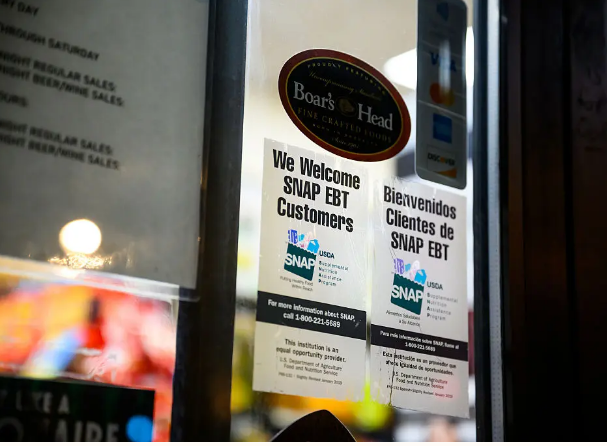
Nearly 42 million Americans who rely on the Supplemental Nutrition Assistance Program (SNAP) are caught in growing uncertainty as delayed payments stretch into a second month amid the ongoing U.S. government shutdown. The disruption, caused by a lack of available funds, has turned SNAP into a central issue in the political standoff between President Donald Trump and congressional Democrats.

Senator Elizabeth Warren accused Trump of using “hungry children as a bargaining chip,” echoing comments from California Governor Gavin Newsom, who said last month the president was “endangering people’s lives.” Concerns intensified this week after Trump posted on Truth Social that SNAP benefits would not resume “until the radical left Democrats open up government.” The post appeared to contradict a federal court order requiring the administration to resume partial payments.

Two federal judges have ruled that the U.S. Department of Agriculture (USDA) must use contingency funds to pay out benefits during the shutdown. Massachusetts Judge Indira Talwani called the suspension unlawful, while Rhode Island Judge Jack McConnell ordered the administration to use emergency funds “now” to ensure families receive aid.

The White House quickly clarified Trump’s statement, saying it would comply with the court order. Press secretary Karoline Leavitt explained that the president “does not want to have to tap into this fund in the future,” but confirmed that the administration is following judicial directives.

According to USDA data, SNAP distributed $99.8 billion in benefits in 2024, supporting nearly 42 million people nationwide. The average recipient received about $187 a month. This year, however, the administration plans to release only half the usual amount, using $4.65 billion from the USDA’s $6 billion contingency fund.

New eligibility restrictions have also been introduced under Trump’s “Big, Beautiful Bill,” signed into law on July 4. Those no longer eligible include certain groups of noncitizens, refugees, and parolees who previously qualified after a five-year waiting period.

State agencies are now scrambling to manage the partial disbursements. North Carolina officials told residents they could see benefits as early as next week if funds arrive on time. “If federal funding is provided this week as expected, the North Carolina Department of Health and Human Services expects all partial benefits to be loaded onto EBT cards by next week,” the agency said.

USDA Secretary Brooke Rollins warned of widespread delays, citing the need for revised eligibility systems and state notifications. “If the government opens, families get their full benefit much more quickly,” she said.

Cities and nonprofit organizations are now challenging the administration in court, demanding full payment of SNAP benefits. In an emergency filing, a coalition including Albuquerque, Baltimore, Columbus, and Providence argued that withholding full benefits is “arbitrary and capricious.” The case, represented by advocacy group Democracy Forward, will be heard on Thursday as millions wait for food assistance that remains tied up in Washington’s political deadlock.


Business

Fraudsters are increasingly using AI-generated images and videos to trick people into handing over sensitive personal and financial information, according to FraudSMART, the financial crime awareness initiative operated by the Banking and Payments Federation Ireland (BPFI). The organisation has reported a rise in online adverts promoting fake, State-backed investment schemes. These scams often use fabricated images of well-known politicians and business figures to make the offers appear legitimate and encourage users to click on registration links. Niamh Davenport, head of financial crime at BPFI, said scammers are deliberately exploiting recent media coverage of a planned State-backed savings and investment scheme to give their frauds a sense of credibility. “They often claim the scheme is open to everyone, but that places are limited and being ‘snapped up’ fast, in order to pressure people to act quickly,” she said. “They typically promise guaranteed returns or a guaranteed monthly income.” FraudSMART said that while anyone can be targeted, people in their early 50s are particularly vulnerable to investment scams. This age group is often focused on retirement planning, making them more receptive to financial offers that appear secure or high-yield. According to the organisation, most scams follow a similar pattern. Victims are first directed to click a registration link and complete a short online form providing their contact details. They are then contacted by someone posing as a financial adviser, who urges them to make an immediate “security deposit” to secure participation in the scheme. Once a payment is made, the money is quickly moved through multiple accounts, often overseas, making recovery extremely difficult. Davenport warned that scammers are becoming more sophisticated in their use of technology, particularly AI tools that allow them to create realistic but entirely fake promotional content. These materials are designed to mimic legitimate financial advertisements and build trust with potential victims. Recent figures from An Garda Síochána show investment fraud rose by 20% last year, with losses exceeding €20 million. The scale of individual scams varies widely, ranging from smaller crypto-related frauds involving a few hundred euro to large-scale investment schemes where victims lose tens of thousands. FraudSMART is urging the public to remain cautious when encountering online investment advertisements, especially those promising guaranteed returns or requiring urgent action. It also advises consumers to avoid sharing personal information with unverified sources and to be wary of pressure tactics designed to rush financial decisions. Authorities continue to warn that fraudsters are adapting quickly, using advanced digital tools to target victims across multiple platforms.

Trending

Business

Fraudsters are increasingly using AI-generated images and videos to trick people into handing over sensitive personal and financial information, according to FraudSMART, the financial crime awareness initiative operated by the Banking and Payments Federation Ireland (BPFI). The organisation has reported a rise in online adverts promoting fake, State-backed investment schemes. These scams often use fabricated images of well-known politicians and business figures to make the offers appear legitimate and encourage users to click on registration links. Niamh Davenport, head of financial crime at BPFI, said scammers are deliberately exploiting recent media coverage of a planned State-backed savings and investment scheme to give their frauds a sense of credibility. “They often claim the scheme is open to everyone, but that places are limited and being ‘snapped up’ fast, in order to pressure people to act quickly,” she said. “They typically promise guaranteed returns or a guaranteed monthly income.” FraudSMART said that while anyone can be targeted, people in their early 50s are particularly vulnerable to investment scams. This age group is often focused on retirement planning, making them more receptive to financial offers that appear secure or high-yield. According to the organisation, most scams follow a similar pattern. Victims are first directed to click a registration link and complete a short online form providing their contact details. They are then contacted by someone posing as a financial adviser, who urges them to make an immediate “security deposit” to secure participation in the scheme. Once a payment is made, the money is quickly moved through multiple accounts, often overseas, making recovery extremely difficult. Davenport warned that scammers are becoming more sophisticated in their use of technology, particularly AI tools that allow them to create realistic but entirely fake promotional content. These materials are designed to mimic legitimate financial advertisements and build trust with potential victims. Recent figures from An Garda Síochána show investment fraud rose by 20% last year, with losses exceeding €20 million. The scale of individual scams varies widely, ranging from smaller crypto-related frauds involving a few hundred euro to large-scale investment schemes where victims lose tens of thousands. FraudSMART is urging the public to remain cautious when encountering online investment advertisements, especially those promising guaranteed returns or requiring urgent action. It also advises consumers to avoid sharing personal information with unverified sources and to be wary of pressure tactics designed to rush financial decisions. Authorities continue to warn that fraudsters are adapting quickly, using advanced digital tools to target victims across multiple platforms.

You May Also Like

Politics

WASHINGTON — The Pentagon announced on Sunday that the United States will send a Terminal High Altitude Area Defense (THAAD) battery to Israel, alongside...

Health

NEW YORK — Teen smoking in the United States has reached an all-time low in 2024, with significant declines in overall youth tobacco use,...

Politics

WASHINGTON — As the countdown to the November 5 presidential election continues, former President Donald Trump is urging his supporters to aim for a...

Politics

In September, NASA announced that summer 2024 was the hottest on record. Just days later, the U.S. faced the dual impact of Hurricanes Helene...