

















Connect with us

Hi, what are you looking for?

Politics

Grassroots Efforts Intensify for Kamala Harris in Key Pennsylvania Race

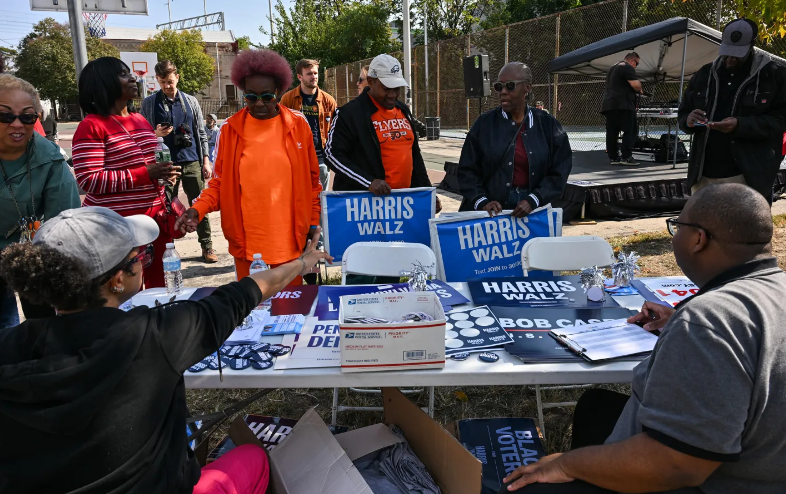
As the 2024 presidential campaign heats up, grassroots volunteers like Elana Hunter are stepping up their efforts to mobilize voters in southwest Philadelphia for Vice President Kamala Harris. On a recent Sunday morning, Hunter, a 52-year-old HR consultant, left her teenage children and ailing mother to canvass her neighborhood. Despite encountering numerous closed doors, she remained undeterred. “My daughter has fewer rights than me. What the hell was I doing sitting on the sidelines?” Hunter remarked, determined to set an example for her children.

Teaming up with Ikethia Daniels, a canvasser from Georgia, Hunter spent hours knocking on doors and distributing campaign literature. Finally, her persistence paid off when a woman answered, expressing her support for Harris but confusion about Pennsylvania’s early voting rules. Hunter took the opportunity to guide her through the voting process, leaving her feeling empowered and more informed.

Hunter’s efforts are part of a broader initiative called Women Wednesdays for Harris, a weekly online meeting that emerged in response to Harris’s candidacy following President Joe Biden’s announcement to step down from the Democratic ticket in July. These calls, organized partly by the grassroots group Indivisible Action, aim to equip individuals with practical tools to engage in political activism, especially for those who may not have much time to spare.

With the election looming, Democrats are relying on dedicated volunteers like Hunter to strengthen their ground game in Pennsylvania, which is viewed as a pivotal state in the upcoming election. While former President Donald Trump has handed control of the Republican National Committee to his daughter-in-law and is partially relying on new, less-tested groups like Elon Musk’s America PAC for support, the Harris campaign is emphasizing traditional grassroots strategies that have historically propelled political campaigns.

During a canvassing kickoff event in Bucks County, Pennsylvania Governor Josh Shapiro underscored the importance of grassroots mobilization, stating, “What we have is an army of people going out to knock on doors, make calls, throw up lawn signs, and give permission.” He expressed confidence in the Harris campaign’s ground game, asserting that they have a better strategy and leadership.

Following Shapiro’s remarks, Democratic congressional candidate Ashley Ehasz set off to canvass her district, where she encountered Christine Kahler, a two-time Trump voter who is now undecided. Kahler, who works at an afterschool program, voiced her concerns about the perception of a female president, saying, “I don’t know how other countries are going to deal with us.” However, she also expressed her frustration with Trump, noting that she is “88% sure” she will vote for Harris.

As election day approaches, the ground efforts led by dedicated volunteers and local leaders could prove crucial in swaying undecided voters in Pennsylvania, a state both parties recognize as vital to their electoral strategies.


Business

Fraudsters are increasingly using AI-generated images and videos to trick people into handing over sensitive personal and financial information, according to FraudSMART, the financial crime awareness initiative operated by the Banking and Payments Federation Ireland (BPFI). The organisation has reported a rise in online adverts promoting fake, State-backed investment schemes. These scams often use fabricated images of well-known politicians and business figures to make the offers appear legitimate and encourage users to click on registration links. Niamh Davenport, head of financial crime at BPFI, said scammers are deliberately exploiting recent media coverage of a planned State-backed savings and investment scheme to give their frauds a sense of credibility. “They often claim the scheme is open to everyone, but that places are limited and being ‘snapped up’ fast, in order to pressure people to act quickly,” she said. “They typically promise guaranteed returns or a guaranteed monthly income.” FraudSMART said that while anyone can be targeted, people in their early 50s are particularly vulnerable to investment scams. This age group is often focused on retirement planning, making them more receptive to financial offers that appear secure or high-yield. According to the organisation, most scams follow a similar pattern. Victims are first directed to click a registration link and complete a short online form providing their contact details. They are then contacted by someone posing as a financial adviser, who urges them to make an immediate “security deposit” to secure participation in the scheme. Once a payment is made, the money is quickly moved through multiple accounts, often overseas, making recovery extremely difficult. Davenport warned that scammers are becoming more sophisticated in their use of technology, particularly AI tools that allow them to create realistic but entirely fake promotional content. These materials are designed to mimic legitimate financial advertisements and build trust with potential victims. Recent figures from An Garda Síochána show investment fraud rose by 20% last year, with losses exceeding €20 million. The scale of individual scams varies widely, ranging from smaller crypto-related frauds involving a few hundred euro to large-scale investment schemes where victims lose tens of thousands. FraudSMART is urging the public to remain cautious when encountering online investment advertisements, especially those promising guaranteed returns or requiring urgent action. It also advises consumers to avoid sharing personal information with unverified sources and to be wary of pressure tactics designed to rush financial decisions. Authorities continue to warn that fraudsters are adapting quickly, using advanced digital tools to target victims across multiple platforms.

Trending

Business

Fraudsters are increasingly using AI-generated images and videos to trick people into handing over sensitive personal and financial information, according to FraudSMART, the financial crime awareness initiative operated by the Banking and Payments Federation Ireland (BPFI). The organisation has reported a rise in online adverts promoting fake, State-backed investment schemes. These scams often use fabricated images of well-known politicians and business figures to make the offers appear legitimate and encourage users to click on registration links. Niamh Davenport, head of financial crime at BPFI, said scammers are deliberately exploiting recent media coverage of a planned State-backed savings and investment scheme to give their frauds a sense of credibility. “They often claim the scheme is open to everyone, but that places are limited and being ‘snapped up’ fast, in order to pressure people to act quickly,” she said. “They typically promise guaranteed returns or a guaranteed monthly income.” FraudSMART said that while anyone can be targeted, people in their early 50s are particularly vulnerable to investment scams. This age group is often focused on retirement planning, making them more receptive to financial offers that appear secure or high-yield. According to the organisation, most scams follow a similar pattern. Victims are first directed to click a registration link and complete a short online form providing their contact details. They are then contacted by someone posing as a financial adviser, who urges them to make an immediate “security deposit” to secure participation in the scheme. Once a payment is made, the money is quickly moved through multiple accounts, often overseas, making recovery extremely difficult. Davenport warned that scammers are becoming more sophisticated in their use of technology, particularly AI tools that allow them to create realistic but entirely fake promotional content. These materials are designed to mimic legitimate financial advertisements and build trust with potential victims. Recent figures from An Garda Síochána show investment fraud rose by 20% last year, with losses exceeding €20 million. The scale of individual scams varies widely, ranging from smaller crypto-related frauds involving a few hundred euro to large-scale investment schemes where victims lose tens of thousands. FraudSMART is urging the public to remain cautious when encountering online investment advertisements, especially those promising guaranteed returns or requiring urgent action. It also advises consumers to avoid sharing personal information with unverified sources and to be wary of pressure tactics designed to rush financial decisions. Authorities continue to warn that fraudsters are adapting quickly, using advanced digital tools to target victims across multiple platforms.

You May Also Like

Politics

WASHINGTON — The Pentagon announced on Sunday that the United States will send a Terminal High Altitude Area Defense (THAAD) battery to Israel, alongside...

Health

NEW YORK — Teen smoking in the United States has reached an all-time low in 2024, with significant declines in overall youth tobacco use,...

Politics

WASHINGTON — As the countdown to the November 5 presidential election continues, former President Donald Trump is urging his supporters to aim for a...

Politics

In September, NASA announced that summer 2024 was the hottest on record. Just days later, the U.S. faced the dual impact of Hurricanes Helene...