











Connect with us

Hi, what are you looking for?

Politics

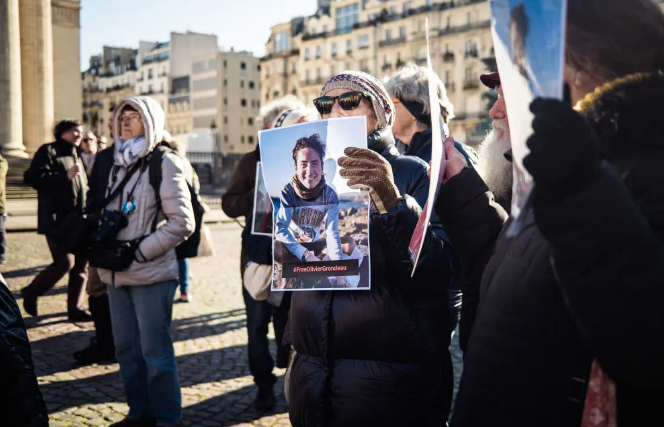
French Citizen Freed After Over 880 Days in Iranian Prison

A French national detained in Iran for more than 880 days has been released, French officials confirmed on Thursday. The development comes as France and other European nations continue negotiations with Tehran over its advancing nuclear program.

Olivier Grondeau’s release coincided with Nowruz, the Persian New Year, a period when Iran has historically granted pardons or released prisoners. French President Emmanuel Macron announced the news but provided no immediate details on the conditions surrounding his release.

Jean-Noël Barrot, France’s Minister for Europe and Foreign Affairs, shared an image of Grondeau aboard a private jet, smiling as he returned home.

“We will tirelessly continue our efforts to ensure that all our compatriots still held hostage, including Cécile Kohler and Jacques Paris, are in turn released,” Barrot stated.

Iran Silent on Release Amid Political Tensions

Iranian authorities have not officially acknowledged Grondeau’s release. Tehran has often detained foreign nationals on espionage charges, later using them as leverage in diplomatic negotiations.

Earlier this week, Iranian Foreign Ministry spokesperson Esmail Baghaei suggested that France had detained an Iranian woman supportive of Palestinian causes, but details remained unclear. Analysts speculate that Grondeau’s release may have been part of a broader negotiation.

Arrest and Detention

Grondeau’s detention occurred in the aftermath of the 2022 protests following the death of Mahsa Amini, a 22-year-old woman who died in Iranian custody after being detained for allegedly violating the country’s strict hijab laws. The protests triggered a government crackdown and widespread arrests, including those of several Western nationals.

Grondeau, a backpacker and world traveler, was arrested under unclear circumstances and later sentenced to five years in prison on espionage charges—accusations that he, his family, and the French government denied. He was held in Tehran’s notorious Evin Prison, known for detaining political prisoners and foreign nationals.

Surviving Harsh Conditions

After going public with his detention in January, Grondeau described harsh prison conditions, including prolonged solitary confinement, 24-hour lighting in cells, and repeated blindfolding when moved. He recounted being subjected to intense interrogations.

“Most of the questions were, ‘Did you take part in a demonstration? List all of the Iranians you met during your trip. Why did you come to Iran?’” he said in a January phone call aired by French broadcaster France 2.

Despite avoiding physical abuse, Grondeau suggested that the psychological toll of imprisonment was immense. “If you look for bruises on my body, you won’t find any, because they are not that stupid,” he remarked.

Political and Diplomatic Implications

Grondeau’s release follows increasing diplomatic efforts by European nations to secure the freedom of their citizens held in Iran. France continues to press for the release of other detained nationals, including Kohler and Paris.

The timing of his freedom aligns with global efforts to address Iran’s nuclear program and regional tensions, particularly regarding Tehran’s support for Yemen’s Houthi rebels. Meanwhile, U.S. President Donald Trump has also sought to initiate direct talks with Iran’s Supreme Leader Ayatollah Ali Khamenei.

While the circumstances of Grondeau’s release remain undisclosed, the move signals ongoing negotiations between Iran and Western nations over detained citizens, economic sanctions, and regional security concerns.


Business

Fraudsters are increasingly using AI-generated images and videos to trick people into handing over sensitive personal and financial information, according to FraudSMART, the financial crime awareness initiative operated by the Banking and Payments Federation Ireland (BPFI). The organisation has reported a rise in online adverts promoting fake, State-backed investment schemes. These scams often use fabricated images of well-known politicians and business figures to make the offers appear legitimate and encourage users to click on registration links. Niamh Davenport, head of financial crime at BPFI, said scammers are deliberately exploiting recent media coverage of a planned State-backed savings and investment scheme to give their frauds a sense of credibility. “They often claim the scheme is open to everyone, but that places are limited and being ‘snapped up’ fast, in order to pressure people to act quickly,” she said. “They typically promise guaranteed returns or a guaranteed monthly income.” FraudSMART said that while anyone can be targeted, people in their early 50s are particularly vulnerable to investment scams. This age group is often focused on retirement planning, making them more receptive to financial offers that appear secure or high-yield. According to the organisation, most scams follow a similar pattern. Victims are first directed to click a registration link and complete a short online form providing their contact details. They are then contacted by someone posing as a financial adviser, who urges them to make an immediate “security deposit” to secure participation in the scheme. Once a payment is made, the money is quickly moved through multiple accounts, often overseas, making recovery extremely difficult. Davenport warned that scammers are becoming more sophisticated in their use of technology, particularly AI tools that allow them to create realistic but entirely fake promotional content. These materials are designed to mimic legitimate financial advertisements and build trust with potential victims. Recent figures from An Garda Síochána show investment fraud rose by 20% last year, with losses exceeding €20 million. The scale of individual scams varies widely, ranging from smaller crypto-related frauds involving a few hundred euro to large-scale investment schemes where victims lose tens of thousands. FraudSMART is urging the public to remain cautious when encountering online investment advertisements, especially those promising guaranteed returns or requiring urgent action. It also advises consumers to avoid sharing personal information with unverified sources and to be wary of pressure tactics designed to rush financial decisions. Authorities continue to warn that fraudsters are adapting quickly, using advanced digital tools to target victims across multiple platforms.

Trending

Business

Fraudsters are increasingly using AI-generated images and videos to trick people into handing over sensitive personal and financial information, according to FraudSMART, the financial crime awareness initiative operated by the Banking and Payments Federation Ireland (BPFI). The organisation has reported a rise in online adverts promoting fake, State-backed investment schemes. These scams often use fabricated images of well-known politicians and business figures to make the offers appear legitimate and encourage users to click on registration links. Niamh Davenport, head of financial crime at BPFI, said scammers are deliberately exploiting recent media coverage of a planned State-backed savings and investment scheme to give their frauds a sense of credibility. “They often claim the scheme is open to everyone, but that places are limited and being ‘snapped up’ fast, in order to pressure people to act quickly,” she said. “They typically promise guaranteed returns or a guaranteed monthly income.” FraudSMART said that while anyone can be targeted, people in their early 50s are particularly vulnerable to investment scams. This age group is often focused on retirement planning, making them more receptive to financial offers that appear secure or high-yield. According to the organisation, most scams follow a similar pattern. Victims are first directed to click a registration link and complete a short online form providing their contact details. They are then contacted by someone posing as a financial adviser, who urges them to make an immediate “security deposit” to secure participation in the scheme. Once a payment is made, the money is quickly moved through multiple accounts, often overseas, making recovery extremely difficult. Davenport warned that scammers are becoming more sophisticated in their use of technology, particularly AI tools that allow them to create realistic but entirely fake promotional content. These materials are designed to mimic legitimate financial advertisements and build trust with potential victims. Recent figures from An Garda Síochána show investment fraud rose by 20% last year, with losses exceeding €20 million. The scale of individual scams varies widely, ranging from smaller crypto-related frauds involving a few hundred euro to large-scale investment schemes where victims lose tens of thousands. FraudSMART is urging the public to remain cautious when encountering online investment advertisements, especially those promising guaranteed returns or requiring urgent action. It also advises consumers to avoid sharing personal information with unverified sources and to be wary of pressure tactics designed to rush financial decisions. Authorities continue to warn that fraudsters are adapting quickly, using advanced digital tools to target victims across multiple platforms.

You May Also Like

Politics

WASHINGTON — The Pentagon announced on Sunday that the United States will send a Terminal High Altitude Area Defense (THAAD) battery to Israel, alongside...

Health

NEW YORK — Teen smoking in the United States has reached an all-time low in 2024, with significant declines in overall youth tobacco use,...

Politics

WASHINGTON — As the countdown to the November 5 presidential election continues, former President Donald Trump is urging his supporters to aim for a...

Politics

In September, NASA announced that summer 2024 was the hottest on record. Just days later, the U.S. faced the dual impact of Hurricanes Helene...