

















Connect with us

Hi, what are you looking for?

Politics

Columbia University Protest Sparks Arrests Amid Escalating Campus Tensions

Columbia University is once again at the center of a national debate over campus protests, after over 70 individuals were arrested during a pro-Palestinian demonstration at Butler Library on Wednesday.

The protest began around 3:15 p.m. on May 7, when approximately 100 demonstrators entered Reading Room 301 of the university’s main library. Protesters unfurled a banner reading “Liberated Zone” and renamed the space after Basel Al-Araj, a Palestinian activist. Many wore keffiyehs and face coverings, chanting “Free Palestine” and writing messages on desks, according to footage shared on social media and student newspaper The Columbia Daily Spectator.

The demonstration was organized by a coalition of student groups under the banner Columbia University Apartheid Divest, which has called on the university to sever financial ties with companies linked to Israel. A statement shared via Substack reiterated the group’s aim to disrupt what they describe as Columbia’s “profits and legitimacy” in connection to “imperialist violence.”

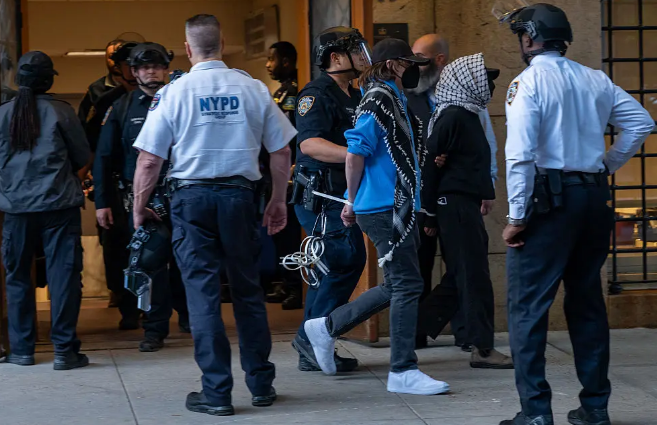
University officials responded swiftly. In a statement, Acting President Claire Shipman said Columbia requested assistance from the NYPD after protestors attempted to force their way into the library, posing safety concerns. She reported that two university security officers were injured during the standoff.

The NYPD did not enter the premises until shortly after 7 p.m., hours after the protest began. Officers, including members of the department’s Strategic Response Group, cleared the library and detained dozens of individuals. While the Spectator reported around 75 arrests, the NYPD has not confirmed a final number.

City and state officials weighed in quickly. New York City Mayor Eric Adams defended the right to peaceful protest but condemned “lawlessness,” warning non-student participants to leave the campus or face arrest. Governor Kathy Hochul echoed that sentiment, emphasizing that violence or property destruction would not be tolerated.

Secretary of State Marco Rubio, representing the Trump Administration, stated that federal authorities are reviewing the visa status of foreign students involved in the protest. The administration has pursued deportation cases against several individuals tied to last year’s campus demonstrations.

Columbia has faced intense scrutiny since its role in igniting pro-Palestinian student activism across U.S. campuses in 2024. That movement began with an encampment at Columbia’s Morningside campus and escalated to a takeover of Hamilton Hall. In response to pressure from federal officials, including the Trump Administration, Columbia has since implemented sweeping protest restrictions and imposed sanctions on student activists.

The latest confrontation underscores the continued volatility surrounding student activism, free speech, and university governance in a politically charged environment.


Business

Fraudsters are increasingly using AI-generated images and videos to trick people into handing over sensitive personal and financial information, according to FraudSMART, the financial crime awareness initiative operated by the Banking and Payments Federation Ireland (BPFI). The organisation has reported a rise in online adverts promoting fake, State-backed investment schemes. These scams often use fabricated images of well-known politicians and business figures to make the offers appear legitimate and encourage users to click on registration links. Niamh Davenport, head of financial crime at BPFI, said scammers are deliberately exploiting recent media coverage of a planned State-backed savings and investment scheme to give their frauds a sense of credibility. “They often claim the scheme is open to everyone, but that places are limited and being ‘snapped up’ fast, in order to pressure people to act quickly,” she said. “They typically promise guaranteed returns or a guaranteed monthly income.” FraudSMART said that while anyone can be targeted, people in their early 50s are particularly vulnerable to investment scams. This age group is often focused on retirement planning, making them more receptive to financial offers that appear secure or high-yield. According to the organisation, most scams follow a similar pattern. Victims are first directed to click a registration link and complete a short online form providing their contact details. They are then contacted by someone posing as a financial adviser, who urges them to make an immediate “security deposit” to secure participation in the scheme. Once a payment is made, the money is quickly moved through multiple accounts, often overseas, making recovery extremely difficult. Davenport warned that scammers are becoming more sophisticated in their use of technology, particularly AI tools that allow them to create realistic but entirely fake promotional content. These materials are designed to mimic legitimate financial advertisements and build trust with potential victims. Recent figures from An Garda Síochána show investment fraud rose by 20% last year, with losses exceeding €20 million. The scale of individual scams varies widely, ranging from smaller crypto-related frauds involving a few hundred euro to large-scale investment schemes where victims lose tens of thousands. FraudSMART is urging the public to remain cautious when encountering online investment advertisements, especially those promising guaranteed returns or requiring urgent action. It also advises consumers to avoid sharing personal information with unverified sources and to be wary of pressure tactics designed to rush financial decisions. Authorities continue to warn that fraudsters are adapting quickly, using advanced digital tools to target victims across multiple platforms.

Trending

Business

Fraudsters are increasingly using AI-generated images and videos to trick people into handing over sensitive personal and financial information, according to FraudSMART, the financial crime awareness initiative operated by the Banking and Payments Federation Ireland (BPFI). The organisation has reported a rise in online adverts promoting fake, State-backed investment schemes. These scams often use fabricated images of well-known politicians and business figures to make the offers appear legitimate and encourage users to click on registration links. Niamh Davenport, head of financial crime at BPFI, said scammers are deliberately exploiting recent media coverage of a planned State-backed savings and investment scheme to give their frauds a sense of credibility. “They often claim the scheme is open to everyone, but that places are limited and being ‘snapped up’ fast, in order to pressure people to act quickly,” she said. “They typically promise guaranteed returns or a guaranteed monthly income.” FraudSMART said that while anyone can be targeted, people in their early 50s are particularly vulnerable to investment scams. This age group is often focused on retirement planning, making them more receptive to financial offers that appear secure or high-yield. According to the organisation, most scams follow a similar pattern. Victims are first directed to click a registration link and complete a short online form providing their contact details. They are then contacted by someone posing as a financial adviser, who urges them to make an immediate “security deposit” to secure participation in the scheme. Once a payment is made, the money is quickly moved through multiple accounts, often overseas, making recovery extremely difficult. Davenport warned that scammers are becoming more sophisticated in their use of technology, particularly AI tools that allow them to create realistic but entirely fake promotional content. These materials are designed to mimic legitimate financial advertisements and build trust with potential victims. Recent figures from An Garda Síochána show investment fraud rose by 20% last year, with losses exceeding €20 million. The scale of individual scams varies widely, ranging from smaller crypto-related frauds involving a few hundred euro to large-scale investment schemes where victims lose tens of thousands. FraudSMART is urging the public to remain cautious when encountering online investment advertisements, especially those promising guaranteed returns or requiring urgent action. It also advises consumers to avoid sharing personal information with unverified sources and to be wary of pressure tactics designed to rush financial decisions. Authorities continue to warn that fraudsters are adapting quickly, using advanced digital tools to target victims across multiple platforms.

You May Also Like

Politics

WASHINGTON — The Pentagon announced on Sunday that the United States will send a Terminal High Altitude Area Defense (THAAD) battery to Israel, alongside...

Health

NEW YORK — Teen smoking in the United States has reached an all-time low in 2024, with significant declines in overall youth tobacco use,...

Politics

WASHINGTON — As the countdown to the November 5 presidential election continues, former President Donald Trump is urging his supporters to aim for a...

Politics

In September, NASA announced that summer 2024 was the hottest on record. Just days later, the U.S. faced the dual impact of Hurricanes Helene...