















Connect with us

Hi, what are you looking for?

News

Turkey Farmers Prepare for Thanksgiving Surge

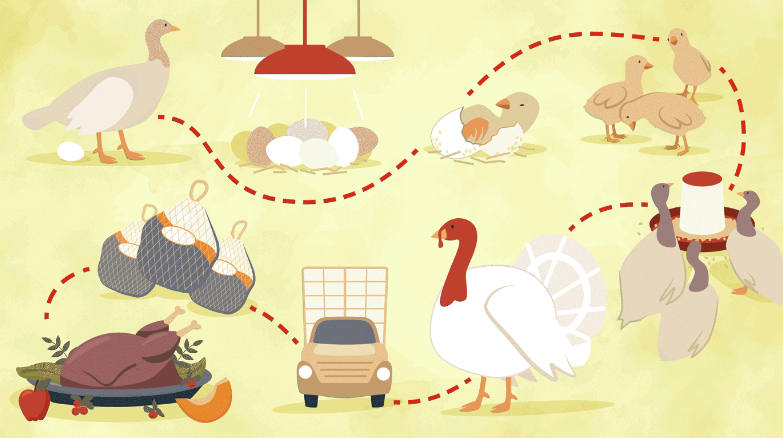
Thanksgiving, the busiest time of year for turkey farmers, marks the culmination of a complex, multi-year process to ensure that families across the U.S. can enjoy their holiday meal. From egg-laying hens to the dinner table, the journey of a turkey involves careful planning and coordination across several stages, including breeding, farming, and processing.

According to Michael Swanson, chief agricultural economist at Wells Fargo, Thanksgiving represents the “Super Bowl” of the turkey industry. “When you have your turkey on Thanksgiving, you’re looking at the end of a multi-year process with lots of people thinking, planning out, and worrying to make that wonderful turkey dinner work,” Swanson said.

The process begins on turkey breeder farms, where hens lay between 80 and 100 eggs over a 25-week cycle. These eggs are sent to a hatchery where they are incubated for about 28 days. Once hatched, the young turkeys, or poults, are transported to other farms to grow. At about one day old, the poults are placed in heated, climate-controlled barns for the first few weeks of their lives. These barns are kept at temperatures around 94°F to mimic the warmth provided by their mother hens. As the birds mature, the temperature is gradually reduced.

Erica Sawatzke, a Minnesota turkey farmer, raises around 120,000 hens annually. Her birds reach maturity at about 13 weeks, while the industry average is 14 weeks. During this time, the turkeys are fed a mix of corn and soybean meal, which helps them gain the necessary weight for market. However, their growth can be threatened by outbreaks of bird flu, which can force farmers to cull entire flocks. Fortunately, the most recent outbreaks have occurred early enough in the year that farmers have been able to adjust and recover.

Once the turkeys reach their market weight, they are transported to processing plants, where timing is crucial. Matt Goodson, CEO of Plainville Farms, explained that birds must be unloaded quickly to minimize stress. At the plant, the turkeys undergo a series of steps, including stunning, defeathering, and evisceration, before being inspected by the USDA. The birds are then chilled and packaged according to customer specifications.

Frozen turkeys are stored for months in blast freezers, while fresh turkeys require more delicate handling. These fresh birds are processed in the weeks leading up to Thanksgiving to ensure they reach stores within 48 hours of processing.

The demand for turkeys during the Thanksgiving season is immense. According to the National Turkey Federation, more than 2,500 turkey farms across the country supply fresh and frozen birds to retailers. This year, the average price of a 10-pound turkey is $27, down 6% from last year.

As turkey farmers prepare for the holiday rush, their efforts ensure that millions of families can enjoy their Thanksgiving feast.


Business

Fraudsters are increasingly using AI-generated images and videos to trick people into handing over sensitive personal and financial information, according to FraudSMART, the financial crime awareness initiative operated by the Banking and Payments Federation Ireland (BPFI). The organisation has reported a rise in online adverts promoting fake, State-backed investment schemes. These scams often use fabricated images of well-known politicians and business figures to make the offers appear legitimate and encourage users to click on registration links. Niamh Davenport, head of financial crime at BPFI, said scammers are deliberately exploiting recent media coverage of a planned State-backed savings and investment scheme to give their frauds a sense of credibility. “They often claim the scheme is open to everyone, but that places are limited and being ‘snapped up’ fast, in order to pressure people to act quickly,” she said. “They typically promise guaranteed returns or a guaranteed monthly income.” FraudSMART said that while anyone can be targeted, people in their early 50s are particularly vulnerable to investment scams. This age group is often focused on retirement planning, making them more receptive to financial offers that appear secure or high-yield. According to the organisation, most scams follow a similar pattern. Victims are first directed to click a registration link and complete a short online form providing their contact details. They are then contacted by someone posing as a financial adviser, who urges them to make an immediate “security deposit” to secure participation in the scheme. Once a payment is made, the money is quickly moved through multiple accounts, often overseas, making recovery extremely difficult. Davenport warned that scammers are becoming more sophisticated in their use of technology, particularly AI tools that allow them to create realistic but entirely fake promotional content. These materials are designed to mimic legitimate financial advertisements and build trust with potential victims. Recent figures from An Garda Síochána show investment fraud rose by 20% last year, with losses exceeding €20 million. The scale of individual scams varies widely, ranging from smaller crypto-related frauds involving a few hundred euro to large-scale investment schemes where victims lose tens of thousands. FraudSMART is urging the public to remain cautious when encountering online investment advertisements, especially those promising guaranteed returns or requiring urgent action. It also advises consumers to avoid sharing personal information with unverified sources and to be wary of pressure tactics designed to rush financial decisions. Authorities continue to warn that fraudsters are adapting quickly, using advanced digital tools to target victims across multiple platforms.

Trending

Business

Fraudsters are increasingly using AI-generated images and videos to trick people into handing over sensitive personal and financial information, according to FraudSMART, the financial crime awareness initiative operated by the Banking and Payments Federation Ireland (BPFI). The organisation has reported a rise in online adverts promoting fake, State-backed investment schemes. These scams often use fabricated images of well-known politicians and business figures to make the offers appear legitimate and encourage users to click on registration links. Niamh Davenport, head of financial crime at BPFI, said scammers are deliberately exploiting recent media coverage of a planned State-backed savings and investment scheme to give their frauds a sense of credibility. “They often claim the scheme is open to everyone, but that places are limited and being ‘snapped up’ fast, in order to pressure people to act quickly,” she said. “They typically promise guaranteed returns or a guaranteed monthly income.” FraudSMART said that while anyone can be targeted, people in their early 50s are particularly vulnerable to investment scams. This age group is often focused on retirement planning, making them more receptive to financial offers that appear secure or high-yield. According to the organisation, most scams follow a similar pattern. Victims are first directed to click a registration link and complete a short online form providing their contact details. They are then contacted by someone posing as a financial adviser, who urges them to make an immediate “security deposit” to secure participation in the scheme. Once a payment is made, the money is quickly moved through multiple accounts, often overseas, making recovery extremely difficult. Davenport warned that scammers are becoming more sophisticated in their use of technology, particularly AI tools that allow them to create realistic but entirely fake promotional content. These materials are designed to mimic legitimate financial advertisements and build trust with potential victims. Recent figures from An Garda Síochána show investment fraud rose by 20% last year, with losses exceeding €20 million. The scale of individual scams varies widely, ranging from smaller crypto-related frauds involving a few hundred euro to large-scale investment schemes where victims lose tens of thousands. FraudSMART is urging the public to remain cautious when encountering online investment advertisements, especially those promising guaranteed returns or requiring urgent action. It also advises consumers to avoid sharing personal information with unverified sources and to be wary of pressure tactics designed to rush financial decisions. Authorities continue to warn that fraudsters are adapting quickly, using advanced digital tools to target victims across multiple platforms.

You May Also Like

Politics

WASHINGTON — The Pentagon announced on Sunday that the United States will send a Terminal High Altitude Area Defense (THAAD) battery to Israel, alongside...

Health

NEW YORK — Teen smoking in the United States has reached an all-time low in 2024, with significant declines in overall youth tobacco use,...

Politics

WASHINGTON — As the countdown to the November 5 presidential election continues, former President Donald Trump is urging his supporters to aim for a...

Politics

In September, NASA announced that summer 2024 was the hottest on record. Just days later, the U.S. faced the dual impact of Hurricanes Helene...