











Connect with us

Hi, what are you looking for?

News

Ireland West Airport Marks 40 Years of Growth and Connectivity

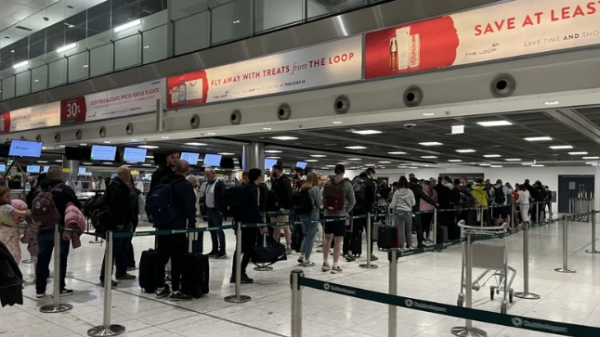
What began as a bold vision by Monsignor James Horan in the early 1980s has grown into one of Ireland’s busiest regional airports. Ireland West Airport, near Charlestown, Co Mayo, is now approaching its 40th anniversary, having welcomed a record 946,000 passengers in 2025.

The airport’s origins can be traced back to 1981, when Monsignor Horan, then Parish Priest of Knock, began work on what many considered an improbable project on a “foggy, boggy hill.” His vision was clear: “An airport is something like a road. You build a road to give a service to a community. And you build an airport to give service to a community,” he told RTÉ in 1986.

Horan, who had previously overseen the construction of the Knock Basilica and facilitated the visit of Pope John Paul II in 1979, brought a reputation for turning ambitious plans into reality. Early projections suggested the airport would serve 250,000 passengers annually. Last year, numbers were nearly four times that, reflecting decades of steady growth.

Terry Reilly, former editor of The Western People, chronicled the airport’s development in his 2006 book, On a Wing and a Prayer. He described Horan as a “doer,” whose fundraising and determination helped overcome obstacles in both finance and planning. Political support also played a role, with then Taoiseach Charles Haughey providing permission and initial funding. The first commercial flights departed in late 1985, primarily for pilgrims traveling to Rome, and the airport officially opened months later with Haughey performing the ceremonial launch.

The early years were challenging. Aer Lingus showed limited interest, and the airport struggled to attract sufficient traffic. Ryanair’s arrival in the 1990s proved transformative, connecting the west of Ireland with Britain and continental Europe and providing vital weekend travel for workers returning home. This partnership has driven expansion and diversified the airport’s destinations, particularly to Spain.

Today, the airport is operated by the Connacht Airport Development Company, with local authorities holding a stake in its development. Its 2025 figures show 732,000 passengers traveled to and from Britain, while the remainder used flights to Europe. Chairman Arthur French described the year’s record numbers as “a testament to the continued strong support for the airport.”

Looking ahead, plans for a Strategic Development Zone (SDZ) around the airport aim to create over 95,000 square metres of commercial, business, and aviation-related space, including conference and hotel facilities. The project has been designated of “strategic national importance” and could drive further economic development in the west, northwest, and midlands.

As Ireland West Airport nears its 40th anniversary, the airport continues to build on Monsignor Horan’s original vision. “Those who carried the torch lit by Monsignor Horan have seen his dream through,” Reilly said, highlighting the airport’s enduring role as a gateway to Ireland and a lifeline for the region’s connectivity.


Business

Fraudsters are increasingly using AI-generated images and videos to trick people into handing over sensitive personal and financial information, according to FraudSMART, the financial crime awareness initiative operated by the Banking and Payments Federation Ireland (BPFI). The organisation has reported a rise in online adverts promoting fake, State-backed investment schemes. These scams often use fabricated images of well-known politicians and business figures to make the offers appear legitimate and encourage users to click on registration links. Niamh Davenport, head of financial crime at BPFI, said scammers are deliberately exploiting recent media coverage of a planned State-backed savings and investment scheme to give their frauds a sense of credibility. “They often claim the scheme is open to everyone, but that places are limited and being ‘snapped up’ fast, in order to pressure people to act quickly,” she said. “They typically promise guaranteed returns or a guaranteed monthly income.” FraudSMART said that while anyone can be targeted, people in their early 50s are particularly vulnerable to investment scams. This age group is often focused on retirement planning, making them more receptive to financial offers that appear secure or high-yield. According to the organisation, most scams follow a similar pattern. Victims are first directed to click a registration link and complete a short online form providing their contact details. They are then contacted by someone posing as a financial adviser, who urges them to make an immediate “security deposit” to secure participation in the scheme. Once a payment is made, the money is quickly moved through multiple accounts, often overseas, making recovery extremely difficult. Davenport warned that scammers are becoming more sophisticated in their use of technology, particularly AI tools that allow them to create realistic but entirely fake promotional content. These materials are designed to mimic legitimate financial advertisements and build trust with potential victims. Recent figures from An Garda Síochána show investment fraud rose by 20% last year, with losses exceeding €20 million. The scale of individual scams varies widely, ranging from smaller crypto-related frauds involving a few hundred euro to large-scale investment schemes where victims lose tens of thousands. FraudSMART is urging the public to remain cautious when encountering online investment advertisements, especially those promising guaranteed returns or requiring urgent action. It also advises consumers to avoid sharing personal information with unverified sources and to be wary of pressure tactics designed to rush financial decisions. Authorities continue to warn that fraudsters are adapting quickly, using advanced digital tools to target victims across multiple platforms.

Trending

Business

Fraudsters are increasingly using AI-generated images and videos to trick people into handing over sensitive personal and financial information, according to FraudSMART, the financial crime awareness initiative operated by the Banking and Payments Federation Ireland (BPFI). The organisation has reported a rise in online adverts promoting fake, State-backed investment schemes. These scams often use fabricated images of well-known politicians and business figures to make the offers appear legitimate and encourage users to click on registration links. Niamh Davenport, head of financial crime at BPFI, said scammers are deliberately exploiting recent media coverage of a planned State-backed savings and investment scheme to give their frauds a sense of credibility. “They often claim the scheme is open to everyone, but that places are limited and being ‘snapped up’ fast, in order to pressure people to act quickly,” she said. “They typically promise guaranteed returns or a guaranteed monthly income.” FraudSMART said that while anyone can be targeted, people in their early 50s are particularly vulnerable to investment scams. This age group is often focused on retirement planning, making them more receptive to financial offers that appear secure or high-yield. According to the organisation, most scams follow a similar pattern. Victims are first directed to click a registration link and complete a short online form providing their contact details. They are then contacted by someone posing as a financial adviser, who urges them to make an immediate “security deposit” to secure participation in the scheme. Once a payment is made, the money is quickly moved through multiple accounts, often overseas, making recovery extremely difficult. Davenport warned that scammers are becoming more sophisticated in their use of technology, particularly AI tools that allow them to create realistic but entirely fake promotional content. These materials are designed to mimic legitimate financial advertisements and build trust with potential victims. Recent figures from An Garda Síochána show investment fraud rose by 20% last year, with losses exceeding €20 million. The scale of individual scams varies widely, ranging from smaller crypto-related frauds involving a few hundred euro to large-scale investment schemes where victims lose tens of thousands. FraudSMART is urging the public to remain cautious when encountering online investment advertisements, especially those promising guaranteed returns or requiring urgent action. It also advises consumers to avoid sharing personal information with unverified sources and to be wary of pressure tactics designed to rush financial decisions. Authorities continue to warn that fraudsters are adapting quickly, using advanced digital tools to target victims across multiple platforms.

You May Also Like

Politics

WASHINGTON — The Pentagon announced on Sunday that the United States will send a Terminal High Altitude Area Defense (THAAD) battery to Israel, alongside...

Health

NEW YORK — Teen smoking in the United States has reached an all-time low in 2024, with significant declines in overall youth tobacco use,...

Politics

WASHINGTON — As the countdown to the November 5 presidential election continues, former President Donald Trump is urging his supporters to aim for a...

Politics

In September, NASA announced that summer 2024 was the hottest on record. Just days later, the U.S. faced the dual impact of Hurricanes Helene...