














Connect with us

Hi, what are you looking for?

News

Iran and US Engage in Talks Amid Rising Tensions and Military Posturing

Iran’s top security officials say progress is being made toward negotiations with the United States, even as the Islamic republic’s military warns Washington against any potential strikes. The developments come as US forces, led by the aircraft carrier USS Abraham Lincoln, are positioned off Iran’s coast following President Donald Trump’s warnings of intervention after Tehran’s deadly crackdown on anti-government protests.

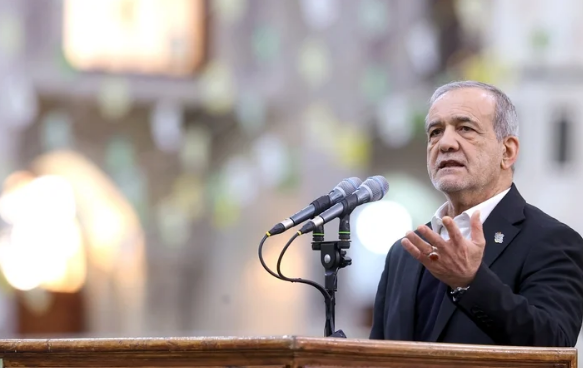
Ali Larijani, head of Iran’s Supreme National Security Council, described negotiations as moving forward despite media speculation about escalating tensions. Larijani’s comments came a day after he reportedly met with Russian President Vladimir Putin in Moscow. Iranian President Masoud Pezeshkian emphasized that broader conflict would harm both nations. In a call with Egyptian President Abdel Fattah al-Sisi, he said: “The Islamic Republic of Iran has never sought, and in no way seeks, war and it is firmly convinced that a war would be in the interest of neither Iran, nor the United States, nor the region.”

President Trump confirmed that dialogue with Tehran is ongoing, stating on Fox News, “(Iran is) talking to us, and we’ll see if we can do something, otherwise we’ll see what happens. We have a big fleet heading out there. They are negotiating.”

Qatar has also sought to ease tensions. Sheikh Mohammed bin Abdulrahman Al Thani, Qatar’s premier and foreign minister, met Larijani in Tehran to discuss regional de-escalation measures.

Despite these talks, both sides remain on alert. Iran’s army chief Amir Hatami warned that US or Israeli attacks would be met with swift retaliation. “If the enemy makes a mistake, without a doubt it will endanger its own security, the security of the region, and the security of the Zionist regime,” he said, adding that Iran’s missile and nuclear capabilities “cannot be eliminated.”

Tensions are compounded by recent US sanctions and military maneuvers. CENTCOM announced that Iran’s Revolutionary Guard Corps (IRGC) will conduct a two-day live-fire naval exercise in the Strait of Hormuz, a vital route for global energy shipments. CENTCOM cautioned Iran against unsafe actions near US forces, drawing criticism from Foreign Minister Abbas Araghchi, who called it an attempt to dictate Iran’s military exercises.

The EU recently followed the US in designating the IRGC as a terrorist organization, prompting Iran to declare the armies of European countries as terrorist groups, according to Parliament Speaker Mohammad Bagher Ghalibaf.

Meanwhile, domestic unrest continues to challenge Iran’s government. Nationwide protests over rising living costs and political grievances erupted in late December and intensified in early January. Official figures put the death toll at 3,117, while the US-based Human Rights Activists News Agency reports more than 6,700 fatalities. Pezeshkian urged authorities to address public grievances and “serve the people,” while citizens at the Turkey-Iran border described fleeing the country to escape violence.

The situation underscores a delicate balance between diplomacy and military posturing, with both Washington and Tehran signaling willingness to negotiate while preparing for potential conflict.


Business

Fraudsters are increasingly using AI-generated images and videos to trick people into handing over sensitive personal and financial information, according to FraudSMART, the financial crime awareness initiative operated by the Banking and Payments Federation Ireland (BPFI). The organisation has reported a rise in online adverts promoting fake, State-backed investment schemes. These scams often use fabricated images of well-known politicians and business figures to make the offers appear legitimate and encourage users to click on registration links. Niamh Davenport, head of financial crime at BPFI, said scammers are deliberately exploiting recent media coverage of a planned State-backed savings and investment scheme to give their frauds a sense of credibility. “They often claim the scheme is open to everyone, but that places are limited and being ‘snapped up’ fast, in order to pressure people to act quickly,” she said. “They typically promise guaranteed returns or a guaranteed monthly income.” FraudSMART said that while anyone can be targeted, people in their early 50s are particularly vulnerable to investment scams. This age group is often focused on retirement planning, making them more receptive to financial offers that appear secure or high-yield. According to the organisation, most scams follow a similar pattern. Victims are first directed to click a registration link and complete a short online form providing their contact details. They are then contacted by someone posing as a financial adviser, who urges them to make an immediate “security deposit” to secure participation in the scheme. Once a payment is made, the money is quickly moved through multiple accounts, often overseas, making recovery extremely difficult. Davenport warned that scammers are becoming more sophisticated in their use of technology, particularly AI tools that allow them to create realistic but entirely fake promotional content. These materials are designed to mimic legitimate financial advertisements and build trust with potential victims. Recent figures from An Garda Síochána show investment fraud rose by 20% last year, with losses exceeding €20 million. The scale of individual scams varies widely, ranging from smaller crypto-related frauds involving a few hundred euro to large-scale investment schemes where victims lose tens of thousands. FraudSMART is urging the public to remain cautious when encountering online investment advertisements, especially those promising guaranteed returns or requiring urgent action. It also advises consumers to avoid sharing personal information with unverified sources and to be wary of pressure tactics designed to rush financial decisions. Authorities continue to warn that fraudsters are adapting quickly, using advanced digital tools to target victims across multiple platforms.

Trending

Business

Fraudsters are increasingly using AI-generated images and videos to trick people into handing over sensitive personal and financial information, according to FraudSMART, the financial crime awareness initiative operated by the Banking and Payments Federation Ireland (BPFI). The organisation has reported a rise in online adverts promoting fake, State-backed investment schemes. These scams often use fabricated images of well-known politicians and business figures to make the offers appear legitimate and encourage users to click on registration links. Niamh Davenport, head of financial crime at BPFI, said scammers are deliberately exploiting recent media coverage of a planned State-backed savings and investment scheme to give their frauds a sense of credibility. “They often claim the scheme is open to everyone, but that places are limited and being ‘snapped up’ fast, in order to pressure people to act quickly,” she said. “They typically promise guaranteed returns or a guaranteed monthly income.” FraudSMART said that while anyone can be targeted, people in their early 50s are particularly vulnerable to investment scams. This age group is often focused on retirement planning, making them more receptive to financial offers that appear secure or high-yield. According to the organisation, most scams follow a similar pattern. Victims are first directed to click a registration link and complete a short online form providing their contact details. They are then contacted by someone posing as a financial adviser, who urges them to make an immediate “security deposit” to secure participation in the scheme. Once a payment is made, the money is quickly moved through multiple accounts, often overseas, making recovery extremely difficult. Davenport warned that scammers are becoming more sophisticated in their use of technology, particularly AI tools that allow them to create realistic but entirely fake promotional content. These materials are designed to mimic legitimate financial advertisements and build trust with potential victims. Recent figures from An Garda Síochána show investment fraud rose by 20% last year, with losses exceeding €20 million. The scale of individual scams varies widely, ranging from smaller crypto-related frauds involving a few hundred euro to large-scale investment schemes where victims lose tens of thousands. FraudSMART is urging the public to remain cautious when encountering online investment advertisements, especially those promising guaranteed returns or requiring urgent action. It also advises consumers to avoid sharing personal information with unverified sources and to be wary of pressure tactics designed to rush financial decisions. Authorities continue to warn that fraudsters are adapting quickly, using advanced digital tools to target victims across multiple platforms.

You May Also Like

Politics

WASHINGTON — The Pentagon announced on Sunday that the United States will send a Terminal High Altitude Area Defense (THAAD) battery to Israel, alongside...

Health

NEW YORK — Teen smoking in the United States has reached an all-time low in 2024, with significant declines in overall youth tobacco use,...

Politics

WASHINGTON — As the countdown to the November 5 presidential election continues, former President Donald Trump is urging his supporters to aim for a...

Politics

In September, NASA announced that summer 2024 was the hottest on record. Just days later, the U.S. faced the dual impact of Hurricanes Helene...