














Connect with us

Hi, what are you looking for?

News

At Least 12 Medical Workers Killed in Lebanon as US-Iran Tensions Escalate

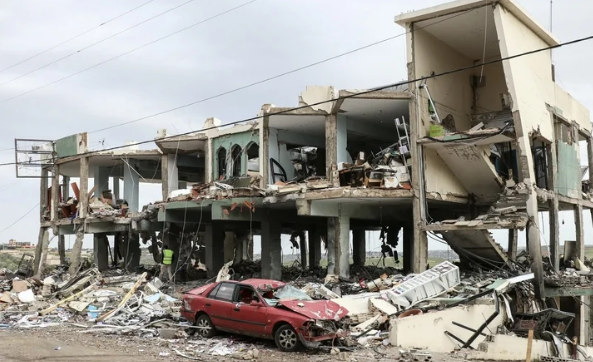
At least 12 medical personnel were killed in an Israeli strike on a healthcare centre in Borj Qalaouiya, southern Lebanon, health authorities said, bringing the total number of paramedics killed since the latest conflict erupted to 26. Earlier Saturday, a separate Israeli attack on the Lebanese city of Sidon claimed four lives, according to the country’s state news agency NNA.

Mehieddine al-Teryaki, surveying the destruction in Sidon, said his uncle and three family members were among the dead. “What they did is a massacre,” he told reporters.

The Lebanese health ministry reported that Israeli attacks have killed at least 773 people in the country since 2 March, including 98 children, according to the World Health Organization.

Amid the violence, French President Emmanuel Macron said the Lebanese government is ready for direct talks with Israel and offered to host negotiations in Paris, stressing that all measures must be taken to prevent Lebanon from descending into chaos.

Tensions are also escalating in the Gulf as US President Donald Trump threatened to target Iran’s Kharg Island oil facilities if Tehran continues attacks on vessels passing through the Strait of Hormuz, a critical waterway for global energy supplies. In a social media post, Trump said the US had “totally obliterated” military targets on the island, while stressing that the strikes did not hit oil infrastructure.

Trump added that any interference with free passage through the strait could lead to renewed attacks on Iran’s oil network. US Central Command confirmed that more than 90 Iranian military targets were struck in a precision operation on Kharg Island. The president urged allies to send warships to the Gulf to ensure the Strait of Hormuz remains “open and safe.”

Iran has not backed down. Supreme Leader Mojtaba Khamenei, who succeeded his father after his assassination, has stated that the strait should remain closed as a bargaining tool. Iran’s armed forces warned that any attack on the country’s oil and energy facilities would prompt strikes on oil installations linked to the US. Fars news agency reported that explosions were heard across Kharg Island, affecting air defense systems, a naval base, and airport facilities, though oil infrastructure remained intact.

The conflict is affecting global markets. Oil prices have fluctuated sharply amid fears of supply disruption. While Iran continues exporting crude, several Gulf producers have halted shipments citing security concerns.

The broader regional conflict has caused widespread casualties. Reports indicate that at least 2,000 people have died in the past two weeks across Iran, Lebanon, and the Gulf, with millions displaced. The US military has also suffered losses, including six crew members aboard a refueling aircraft that crashed in western Iraq.

The situation remains volatile, with ongoing Israeli, Iranian, and US military operations, raising fears of further escalation and regional instability.

Business

Fraudsters are increasingly using AI-generated images and videos to trick people into handing over sensitive personal and financial information, according to FraudSMART, the financial crime awareness initiative operated by the Banking and Payments Federation Ireland (BPFI). The organisation has reported a rise in online adverts promoting fake, State-backed investment schemes. These scams often use fabricated images of well-known politicians and business figures to make the offers appear legitimate and encourage users to click on registration links. Niamh Davenport, head of financial crime at BPFI, said scammers are deliberately exploiting recent media coverage of a planned State-backed savings and investment scheme to give their frauds a sense of credibility. “They often claim the scheme is open to everyone, but that places are limited and being ‘snapped up’ fast, in order to pressure people to act quickly,” she said. “They typically promise guaranteed returns or a guaranteed monthly income.” FraudSMART said that while anyone can be targeted, people in their early 50s are particularly vulnerable to investment scams. This age group is often focused on retirement planning, making them more receptive to financial offers that appear secure or high-yield. According to the organisation, most scams follow a similar pattern. Victims are first directed to click a registration link and complete a short online form providing their contact details. They are then contacted by someone posing as a financial adviser, who urges them to make an immediate “security deposit” to secure participation in the scheme. Once a payment is made, the money is quickly moved through multiple accounts, often overseas, making recovery extremely difficult. Davenport warned that scammers are becoming more sophisticated in their use of technology, particularly AI tools that allow them to create realistic but entirely fake promotional content. These materials are designed to mimic legitimate financial advertisements and build trust with potential victims. Recent figures from An Garda Síochána show investment fraud rose by 20% last year, with losses exceeding €20 million. The scale of individual scams varies widely, ranging from smaller crypto-related frauds involving a few hundred euro to large-scale investment schemes where victims lose tens of thousands. FraudSMART is urging the public to remain cautious when encountering online investment advertisements, especially those promising guaranteed returns or requiring urgent action. It also advises consumers to avoid sharing personal information with unverified sources and to be wary of pressure tactics designed to rush financial decisions. Authorities continue to warn that fraudsters are adapting quickly, using advanced digital tools to target victims across multiple platforms.

Trending

Business

Fraudsters are increasingly using AI-generated images and videos to trick people into handing over sensitive personal and financial information, according to FraudSMART, the financial crime awareness initiative operated by the Banking and Payments Federation Ireland (BPFI). The organisation has reported a rise in online adverts promoting fake, State-backed investment schemes. These scams often use fabricated images of well-known politicians and business figures to make the offers appear legitimate and encourage users to click on registration links. Niamh Davenport, head of financial crime at BPFI, said scammers are deliberately exploiting recent media coverage of a planned State-backed savings and investment scheme to give their frauds a sense of credibility. “They often claim the scheme is open to everyone, but that places are limited and being ‘snapped up’ fast, in order to pressure people to act quickly,” she said. “They typically promise guaranteed returns or a guaranteed monthly income.” FraudSMART said that while anyone can be targeted, people in their early 50s are particularly vulnerable to investment scams. This age group is often focused on retirement planning, making them more receptive to financial offers that appear secure or high-yield. According to the organisation, most scams follow a similar pattern. Victims are first directed to click a registration link and complete a short online form providing their contact details. They are then contacted by someone posing as a financial adviser, who urges them to make an immediate “security deposit” to secure participation in the scheme. Once a payment is made, the money is quickly moved through multiple accounts, often overseas, making recovery extremely difficult. Davenport warned that scammers are becoming more sophisticated in their use of technology, particularly AI tools that allow them to create realistic but entirely fake promotional content. These materials are designed to mimic legitimate financial advertisements and build trust with potential victims. Recent figures from An Garda Síochána show investment fraud rose by 20% last year, with losses exceeding €20 million. The scale of individual scams varies widely, ranging from smaller crypto-related frauds involving a few hundred euro to large-scale investment schemes where victims lose tens of thousands. FraudSMART is urging the public to remain cautious when encountering online investment advertisements, especially those promising guaranteed returns or requiring urgent action. It also advises consumers to avoid sharing personal information with unverified sources and to be wary of pressure tactics designed to rush financial decisions. Authorities continue to warn that fraudsters are adapting quickly, using advanced digital tools to target victims across multiple platforms.

You May Also Like

Politics

WASHINGTON — The Pentagon announced on Sunday that the United States will send a Terminal High Altitude Area Defense (THAAD) battery to Israel, alongside...

Health

NEW YORK — Teen smoking in the United States has reached an all-time low in 2024, with significant declines in overall youth tobacco use,...

Politics

WASHINGTON — As the countdown to the November 5 presidential election continues, former President Donald Trump is urging his supporters to aim for a...

Politics

In September, NASA announced that summer 2024 was the hottest on record. Just days later, the U.S. faced the dual impact of Hurricanes Helene...