














Connect with us

Hi, what are you looking for?

Health

Texas Measles Outbreak Grows to 146 Cases, Claims Life of Unvaccinated Child

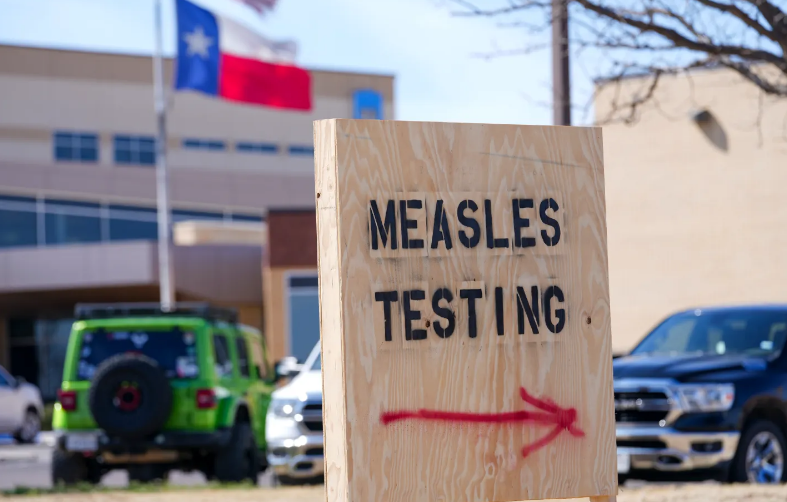
The number of measles cases in Texas has surged to 146, marking the state’s largest outbreak in nearly three decades, health officials confirmed on Friday. The outbreak, which has spread across nine counties, claimed the life of an unvaccinated school-aged child earlier this week—the first U.S. measles death since 2015.

According to the Texas Department of State Health Services (DSHS), the outbreak has grown by 22 cases since Tuesday, with nearly 100 cases concentrated in Gaines County. At least 20 patients have been hospitalized. The child who died Tuesday night was treated at Covenant Children’s Hospital in Lubbock, though officials confirmed the patient was not a Lubbock County resident.

Federal Response and Vaccine Debate

U.S. Health and Human Services Secretary Robert F. Kennedy Jr., a known vaccine skeptic, initially downplayed the outbreak earlier this week, calling it “not unusual.” However, by Friday afternoon, Kennedy took to X (formerly Twitter) to express sympathy for those affected and acknowledged the “serious impact” of the outbreak. He also assured the public that funding for Texas’ immunization program would continue and that containing the outbreak remains a “top priority.”

Rural West Texas Community Hit Hard

Health officials have traced the epicenter of the outbreak to a “close-knit, undervaccinated” Mennonite community in rural West Texas, where vaccination rates have long been a concern. Gaines County, a region with a high homeschooling population, has one of the state’s highest exemption rates for childhood vaccines—nearly 14% of school-aged children opted out of at least one required vaccine last year.

Under Texas law, parents can claim exemptions from school vaccines for reasons of conscience, including religious beliefs. However, the actual number of unvaccinated children in the area is likely much higher, as homeschooling families are not required to report immunization data.

Health Officials Warn of Rising Risk

Measles, a highly contagious respiratory virus, can linger in the air for up to two hours after an infected person leaves a space. While most children recover, complications such as pneumonia, brain swelling, blindness, and death can occur.

The Centers for Disease Control and Prevention (CDC) recommends two doses of the measles, mumps, and rubella (MMR) vaccine, which is highly effective in preventing infection. National vaccination rates have declined since the COVID-19 pandemic, leaving many communities vulnerable.

In a Friday news conference in Austin, health officials confirmed the first measles case in Travis County since 2019—an unvaccinated infant who contracted the virus while traveling overseas. The child’s family members, who were vaccinated, are isolating to prevent further spread.

Chris Van Deusen, a spokesman for Texas DSHS, reported that four other Texas cases this year—two in Houston, one in Rockwall County, and the Travis County case—were linked to international travel and not connected to the West Texas outbreak.

Calls for Vaccination Amid Rising Cases

At the Austin news conference, U.S. Rep. Lloyd Doggett (D-Texas) made a direct plea to the public.

“We’re here to say quite simply: Measles can kill, ignorance can kill, and vaccine denial definitely kills,” Doggett stated.

Meanwhile, officials in two Texas cities reported possible rubella cases this week, though health authorities have yet to confirm any additional infections.

With the outbreak showing no signs of slowing, health officials continue to urge Texans to get vaccinated—a critical step in preventing further spread of this once-eliminated disease.


Business

Fraudsters are increasingly using AI-generated images and videos to trick people into handing over sensitive personal and financial information, according to FraudSMART, the financial crime awareness initiative operated by the Banking and Payments Federation Ireland (BPFI). The organisation has reported a rise in online adverts promoting fake, State-backed investment schemes. These scams often use fabricated images of well-known politicians and business figures to make the offers appear legitimate and encourage users to click on registration links. Niamh Davenport, head of financial crime at BPFI, said scammers are deliberately exploiting recent media coverage of a planned State-backed savings and investment scheme to give their frauds a sense of credibility. “They often claim the scheme is open to everyone, but that places are limited and being ‘snapped up’ fast, in order to pressure people to act quickly,” she said. “They typically promise guaranteed returns or a guaranteed monthly income.” FraudSMART said that while anyone can be targeted, people in their early 50s are particularly vulnerable to investment scams. This age group is often focused on retirement planning, making them more receptive to financial offers that appear secure or high-yield. According to the organisation, most scams follow a similar pattern. Victims are first directed to click a registration link and complete a short online form providing their contact details. They are then contacted by someone posing as a financial adviser, who urges them to make an immediate “security deposit” to secure participation in the scheme. Once a payment is made, the money is quickly moved through multiple accounts, often overseas, making recovery extremely difficult. Davenport warned that scammers are becoming more sophisticated in their use of technology, particularly AI tools that allow them to create realistic but entirely fake promotional content. These materials are designed to mimic legitimate financial advertisements and build trust with potential victims. Recent figures from An Garda Síochána show investment fraud rose by 20% last year, with losses exceeding €20 million. The scale of individual scams varies widely, ranging from smaller crypto-related frauds involving a few hundred euro to large-scale investment schemes where victims lose tens of thousands. FraudSMART is urging the public to remain cautious when encountering online investment advertisements, especially those promising guaranteed returns or requiring urgent action. It also advises consumers to avoid sharing personal information with unverified sources and to be wary of pressure tactics designed to rush financial decisions. Authorities continue to warn that fraudsters are adapting quickly, using advanced digital tools to target victims across multiple platforms.

Trending

Business

Fraudsters are increasingly using AI-generated images and videos to trick people into handing over sensitive personal and financial information, according to FraudSMART, the financial crime awareness initiative operated by the Banking and Payments Federation Ireland (BPFI). The organisation has reported a rise in online adverts promoting fake, State-backed investment schemes. These scams often use fabricated images of well-known politicians and business figures to make the offers appear legitimate and encourage users to click on registration links. Niamh Davenport, head of financial crime at BPFI, said scammers are deliberately exploiting recent media coverage of a planned State-backed savings and investment scheme to give their frauds a sense of credibility. “They often claim the scheme is open to everyone, but that places are limited and being ‘snapped up’ fast, in order to pressure people to act quickly,” she said. “They typically promise guaranteed returns or a guaranteed monthly income.” FraudSMART said that while anyone can be targeted, people in their early 50s are particularly vulnerable to investment scams. This age group is often focused on retirement planning, making them more receptive to financial offers that appear secure or high-yield. According to the organisation, most scams follow a similar pattern. Victims are first directed to click a registration link and complete a short online form providing their contact details. They are then contacted by someone posing as a financial adviser, who urges them to make an immediate “security deposit” to secure participation in the scheme. Once a payment is made, the money is quickly moved through multiple accounts, often overseas, making recovery extremely difficult. Davenport warned that scammers are becoming more sophisticated in their use of technology, particularly AI tools that allow them to create realistic but entirely fake promotional content. These materials are designed to mimic legitimate financial advertisements and build trust with potential victims. Recent figures from An Garda Síochána show investment fraud rose by 20% last year, with losses exceeding €20 million. The scale of individual scams varies widely, ranging from smaller crypto-related frauds involving a few hundred euro to large-scale investment schemes where victims lose tens of thousands. FraudSMART is urging the public to remain cautious when encountering online investment advertisements, especially those promising guaranteed returns or requiring urgent action. It also advises consumers to avoid sharing personal information with unverified sources and to be wary of pressure tactics designed to rush financial decisions. Authorities continue to warn that fraudsters are adapting quickly, using advanced digital tools to target victims across multiple platforms.

You May Also Like

Politics

WASHINGTON — The Pentagon announced on Sunday that the United States will send a Terminal High Altitude Area Defense (THAAD) battery to Israel, alongside...

Health

NEW YORK — Teen smoking in the United States has reached an all-time low in 2024, with significant declines in overall youth tobacco use,...

Politics

WASHINGTON — As the countdown to the November 5 presidential election continues, former President Donald Trump is urging his supporters to aim for a...

Politics

In September, NASA announced that summer 2024 was the hottest on record. Just days later, the U.S. faced the dual impact of Hurricanes Helene...