


















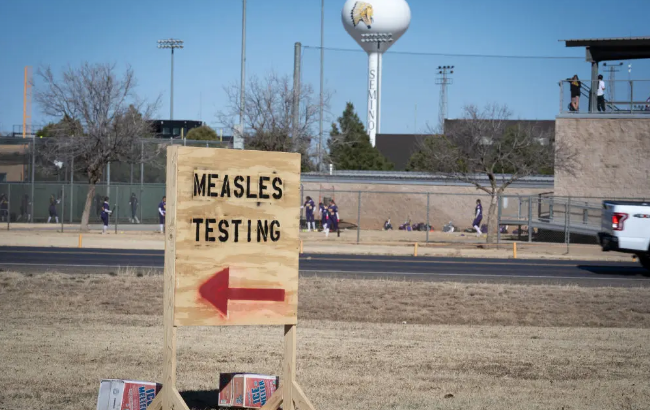
Texas health officials announced Monday that the state’s measles outbreak, which infected more than 700 people and resulted in the deaths of two children, has officially ended. The declaration comes more than 42 days after the last reported case — the period public health experts consider twice the maximum incubation time for the virus.
The outbreak, which began in late January in undervaccinated Mennonite communities in Gaines County, spread to other parts of Texas and was later linked to cases in neighboring states, including New Mexico and Kansas. According to the Texas Department of State Health Services (DSHS), the state recorded 762 confirmed measles cases this year. Among them were two unvaccinated girls who died earlier in the outbreak.
While hailing the tireless efforts of health workers — many of whom had never previously encountered a measles case — DSHS stressed that the end of the outbreak does not mean the risk is gone. “The end of this outbreak does not mean the threat of measles is over,” the agency said, urging parents to ensure their children are protected through vaccination.
Measles, a highly contagious but preventable disease, was declared eliminated in the United States in 2000 thanks to widespread use of the measles, mumps, and rubella (MMR) vaccine. However, vaccination rates have declined in recent years, fueling a resurgence of the virus. Nationally, measles cases have climbed to their highest level in more than three decades, with 1,356 confirmed infections across the country this year as of August 5, according to the Centers for Disease Control and Prevention (CDC). Of those cases, 92 percent involved people who were either unvaccinated or whose vaccination status was unknown.
The CDC has reported three measles-related deaths this year: two in Texas and one unvaccinated adult in New Mexico. Before this year, the last U.S. death from measles occurred in 2015.
Experts warn that the official Texas figures may understate the true scale of the outbreak. Dr. Paul Offit, director of the Vaccine Education Center at Children’s Hospital of Philadelphia, noted that many individuals in the Mennonite community often do not seek medical care, suggesting some infections may have gone unreported.
Offit cautioned that while the outbreak appears to have subsided, measles historically peaks in the winter months. He warned that a resurgence could occur in the coming months if vaccination rates do not improve. “This should be a warning to parents that, if they haven’t vaccinated their children, now’s the time,” he said.
Public health experts also emphasized broader concerns, pointing out that declining vaccination rates could pave the way for other preventable diseases to return. Measles, they note, is often the first to resurface due to its extreme contagiousness.
Calling the Texas outbreak “a warning shot,” Offit said the consequences were clear. “It’s unconscionable to have a child die of something that is entirely preventable,” he said. “We can’t let that happen again.”