















Connect with us

Hi, what are you looking for?

Health

Surgeons Explore the Potential of Apple Vision Pro in Operating Rooms

Twenty-four years after performing the first robotically assisted gastric bypass surgery, renowned surgeon Santiago Horgan is pioneering a new technology that he believes could revolutionize operating rooms: the Apple Vision Pro mixed-reality headset.

Over the past month, Horgan and his team at the University of California, San Diego (UCSD), have completed more than 20 minimally invasive surgeries using the headsets. Although Apple released the Vision Pro to the public in February, the product has struggled commercially. However, professionals in fields like architecture and medicine are investigating its potential to address specific challenges.

Horgan, who directs UCSD’s Center for the Future of Surgery, emphasizes the headset’s potential to enhance surgical efficiency and reduce the risk of injury. “This is the same level of revolution, but it will impact more lives because of the access to it,” he stated, comparing it to his earlier surgical breakthrough.

In laparoscopic surgery, surgeons use a small camera inserted through a tiny incision, projecting the view onto a monitor. This setup often forces doctors to divert their attention from the surgical field to the screen, complicating the delicate coordination required during procedures. “I’m usually turning around and stopping the operation to see a CT scan or looking at the monitor for the heart rate,” Horgan explained.

A 2022 study found that many surgeons experience discomfort during minimal-access surgeries, with some considering early retirement due to frequent pain. Horgan believes that the Vision Pro could allow surgeons to visualize the surgical area and essential patient data without having to look away.

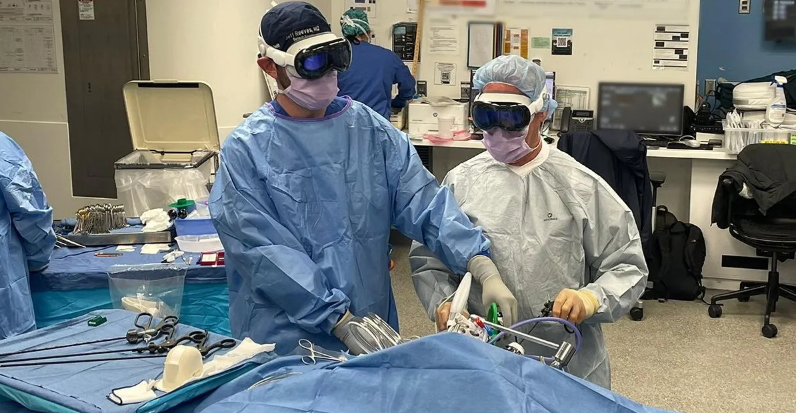
Previously, Horgan experimented with other headsets, such as Google Glass and Microsoft HoloLens, but found them lacking in resolution. However, after testing the Vision Pro prior to its launch, he was impressed. Following approval from the university’s institutional review board, Horgan led the first surgery using the device in September, successfully treating a paraesophageal hernia. “We are all blown away: It was better than we even expected,” he remarked.

Since then, the minimally invasive surgery department at UCSD has conducted over 20 procedures using the Apple Vision Pro, including surgeries for acid reflux and obesity. All surgical staff, including doctors, assistants, and nurses, wear the headsets during operations, with no patients opting out of the trial.

Christopher Longhurst, chief clinical and innovation officer at UC San Diego Health, highlighted the cost-effectiveness of the Vision Pro in a healthcare setting. Priced at $3,499, the headset is considerably cheaper than traditional operating room monitors, which can range from $20,000 to $30,000. “So $3,500 for a headset is like budget dust in the healthcare setting,” Longhurst noted, indicating that the technology could be particularly beneficial for smaller community hospitals.

However, the FDA has yet to approve the Apple Vision Pro for widespread medical use, leaving the future of its application in surgical settings uncertain.


Business

Fraudsters are increasingly using AI-generated images and videos to trick people into handing over sensitive personal and financial information, according to FraudSMART, the financial crime awareness initiative operated by the Banking and Payments Federation Ireland (BPFI). The organisation has reported a rise in online adverts promoting fake, State-backed investment schemes. These scams often use fabricated images of well-known politicians and business figures to make the offers appear legitimate and encourage users to click on registration links. Niamh Davenport, head of financial crime at BPFI, said scammers are deliberately exploiting recent media coverage of a planned State-backed savings and investment scheme to give their frauds a sense of credibility. “They often claim the scheme is open to everyone, but that places are limited and being ‘snapped up’ fast, in order to pressure people to act quickly,” she said. “They typically promise guaranteed returns or a guaranteed monthly income.” FraudSMART said that while anyone can be targeted, people in their early 50s are particularly vulnerable to investment scams. This age group is often focused on retirement planning, making them more receptive to financial offers that appear secure or high-yield. According to the organisation, most scams follow a similar pattern. Victims are first directed to click a registration link and complete a short online form providing their contact details. They are then contacted by someone posing as a financial adviser, who urges them to make an immediate “security deposit” to secure participation in the scheme. Once a payment is made, the money is quickly moved through multiple accounts, often overseas, making recovery extremely difficult. Davenport warned that scammers are becoming more sophisticated in their use of technology, particularly AI tools that allow them to create realistic but entirely fake promotional content. These materials are designed to mimic legitimate financial advertisements and build trust with potential victims. Recent figures from An Garda Síochána show investment fraud rose by 20% last year, with losses exceeding €20 million. The scale of individual scams varies widely, ranging from smaller crypto-related frauds involving a few hundred euro to large-scale investment schemes where victims lose tens of thousands. FraudSMART is urging the public to remain cautious when encountering online investment advertisements, especially those promising guaranteed returns or requiring urgent action. It also advises consumers to avoid sharing personal information with unverified sources and to be wary of pressure tactics designed to rush financial decisions. Authorities continue to warn that fraudsters are adapting quickly, using advanced digital tools to target victims across multiple platforms.

Trending

Business

Fraudsters are increasingly using AI-generated images and videos to trick people into handing over sensitive personal and financial information, according to FraudSMART, the financial crime awareness initiative operated by the Banking and Payments Federation Ireland (BPFI). The organisation has reported a rise in online adverts promoting fake, State-backed investment schemes. These scams often use fabricated images of well-known politicians and business figures to make the offers appear legitimate and encourage users to click on registration links. Niamh Davenport, head of financial crime at BPFI, said scammers are deliberately exploiting recent media coverage of a planned State-backed savings and investment scheme to give their frauds a sense of credibility. “They often claim the scheme is open to everyone, but that places are limited and being ‘snapped up’ fast, in order to pressure people to act quickly,” she said. “They typically promise guaranteed returns or a guaranteed monthly income.” FraudSMART said that while anyone can be targeted, people in their early 50s are particularly vulnerable to investment scams. This age group is often focused on retirement planning, making them more receptive to financial offers that appear secure or high-yield. According to the organisation, most scams follow a similar pattern. Victims are first directed to click a registration link and complete a short online form providing their contact details. They are then contacted by someone posing as a financial adviser, who urges them to make an immediate “security deposit” to secure participation in the scheme. Once a payment is made, the money is quickly moved through multiple accounts, often overseas, making recovery extremely difficult. Davenport warned that scammers are becoming more sophisticated in their use of technology, particularly AI tools that allow them to create realistic but entirely fake promotional content. These materials are designed to mimic legitimate financial advertisements and build trust with potential victims. Recent figures from An Garda Síochána show investment fraud rose by 20% last year, with losses exceeding €20 million. The scale of individual scams varies widely, ranging from smaller crypto-related frauds involving a few hundred euro to large-scale investment schemes where victims lose tens of thousands. FraudSMART is urging the public to remain cautious when encountering online investment advertisements, especially those promising guaranteed returns or requiring urgent action. It also advises consumers to avoid sharing personal information with unverified sources and to be wary of pressure tactics designed to rush financial decisions. Authorities continue to warn that fraudsters are adapting quickly, using advanced digital tools to target victims across multiple platforms.

You May Also Like

Politics

WASHINGTON — The Pentagon announced on Sunday that the United States will send a Terminal High Altitude Area Defense (THAAD) battery to Israel, alongside...

Health

NEW YORK — Teen smoking in the United States has reached an all-time low in 2024, with significant declines in overall youth tobacco use,...

Politics

WASHINGTON — As the countdown to the November 5 presidential election continues, former President Donald Trump is urging his supporters to aim for a...

Politics

In September, NASA announced that summer 2024 was the hottest on record. Just days later, the U.S. faced the dual impact of Hurricanes Helene...