

















Vibration plates are gaining popularity across social media platforms, with influencers claiming they can improve health, “drain the thyroid,” or replace traditional workouts. While the trend has sparked skepticism, these machines have been studied for decades and are even used by professional athletes and astronauts. Experts say the devices can provide some benefits, but claims on social media often exaggerate their effects.
“Social media often presents a loose interpretation of the data,” said Rachele Pojednic, an exercise scientist and director of education at Stanford Lifestyle Medicine. “Research does support modest benefits in specific contexts, but whole-body vibration is not a magic tool.” Brent Feland, an exercise science professor at Brigham Young University, said vibration plates can improve stretching, sprinting, and blood flow, but they are far from a substitute for regular exercise.
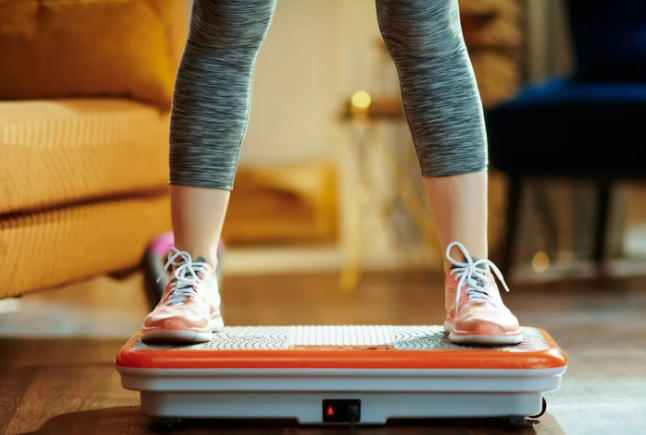
Vibration plates come in two main types. Linear plates move up and down like a tiny elevator, while oscillating plates tilt side to side like a seesaw. Both generate rapid, small movements that cause muscles to contract and release repeatedly. These contractions increase blood flow, raise body temperature, and stimulate the release of proteins called myokines, which help muscles absorb glucose. The rapid movement also adds a stronger gravitational load to bones and muscles, providing an extra stimulus for strength and stability.
Studies show that vibration plates can help improve balance, particularly for older adults, people with limited mobility, or those undergoing rehabilitation. “For people who can’t do traditional exercise, standing on a plate triggers muscle activity without the strain of large movements,” said Darryl Cochrane, an exercise and health science professor at Massey University in New Zealand. Some research also suggests potential benefits for bone density, especially in post-menopausal women and geriatric populations.
Vibration plates may provide minor improvements in athletic performance, including muscular strength, power, range of motion, and warm-up efficiency. Short sessions on the plate can activate muscles quickly, sometimes with less energy than cycling or jogging. Users often report that the vibrations feel pleasant and temporarily distract from discomfort or pain in joints.
Despite these benefits, experts warn that many social media claims are misleading. Standing on a vibration plate burns only slightly more calories than standing still, and it does not provide measurable lymphatic drainage. Pojednic emphasized that traditional exercise, like walking, remains more effective for overall fitness.
Experts recommend vibration plates mainly for two groups: people with mobility or balance challenges, and athletes seeking additional training variations. Users should start with low frequencies and short intervals, gradually increasing intensity while maintaining proper form to avoid injury. “Whole-body vibration can boost a fitness routine and make exercise more enjoyable, but it’s not a shortcut,” Feland said.