



















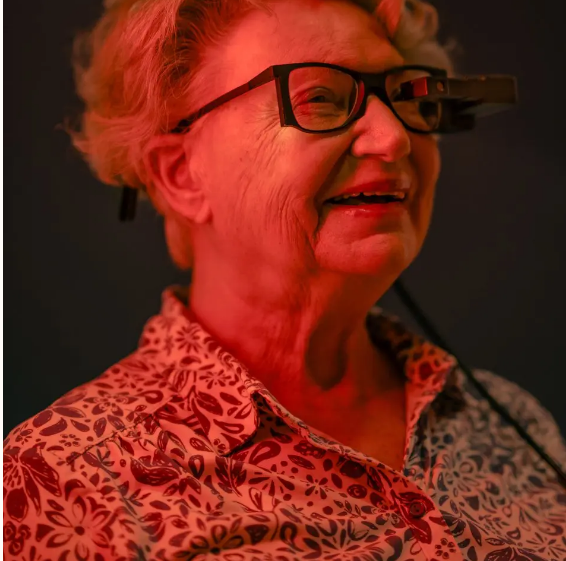
It has been years since 87-year-old Alice Charton clearly saw another person’s face. The retired schoolteacher, who lives in a suburb of Paris, began losing her central vision five years ago when a small hazy spot appeared in her sight. The blur grew into a dark blotch that made it impossible for her to recognize people, read, or move around unfamiliar streets. The cause was age-related macular degeneration (AMD), a disease affecting around 200 million people worldwide. While AMD does not typically cause total blindness, it often leaves patients severely visually impaired.
“I always worked with children, teaching them how to read,” Charton said. “It was especially devastating for me not to be able to read.”
Three years ago, however, Charton’s world changed. Thanks to an experimental treatment developed by Science Corp., a neuroscience company in San Francisco, she regained part of her vision. The company’s “Prima” procedure involves implanting a 2-millimeter computer chip with 400 electrodes directly onto the damaged area of the retina. Patients wear special glasses equipped with a miniature camera that captures images and transmits them in infrared light to the chip. This allows the signal to reach the optic nerve and the brain, partially restoring sight.
Though the device does not provide perfect vision, the improvement is life-changing. Charton can now read for about two hours a day. “This brought me hope,” she said. “It literally changed my life.”
According to study results published in the New England Journal of Medicine, 38 AMD patients who underwent the Prima procedure showed significant improvement. Nearly 80 percent of participants could read 20 additional letters on an eye chart, and 84 percent could recognize letters, numbers, and words at home.
“AMD patients in our clinical trial were able to read and write again, not just letter by letter but word by word,” said Daniel Palanker, a Stanford University professor and consultant on the project. Palanker first developed the Prima concept in 2004 and has since collaborated with Science Corp. to enhance the technology. The next-generation implant, expected to contain 10,000 pixels, could one day allow vision close to normal 20/20 acuity.
Science Corp., founded by biomedical engineer Max Hodak, is also exploring other neural technologies, including brain implants that could help paralyzed individuals control computers or communicate using only their thoughts. The company envisions chips that could one day grow into brain tissue, forming connections with neurons.
For patients like Charton, though, the breakthrough already represents something remarkable — a return to a world once lost to darkness. “Even if I can’t see faces,” she said, “I can read again. That’s everything to me.”