






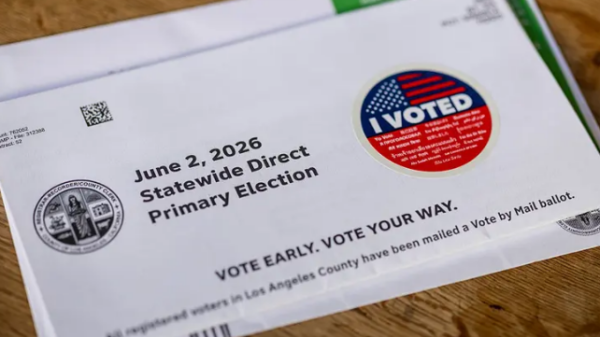











California voters will decide Tuesday whether to dismantle the state’s independent redistricting commission, potentially allowing Democrats to redraw congressional boundaries in their favor — a move that could reshape the balance of power in Washington ahead of the 2026 midterm elections.
Proposition 50, appearing on the statewide ballot, would scrap the California Citizens Redistricting Commission, which was created to remove politics from the once-a-decade mapmaking process. If passed, the measure would return the power to draw political boundaries to state lawmakers — a reversal of one of California’s most prominent political reforms.
The initiative, backed by Democratic Governor Gavin Newsom, comes as Republicans in Texas and other conservative-led states have redrawn districts to solidify their own majorities. Texas’ new map is expected to cost Democrats up to five House seats in 2026. Newsom has framed the California measure as an act of political fairness, arguing that Democrats should not “unilaterally disarm” while Republicans pursue aggressive gerrymanders elsewhere.
“If deep-red Texas can redraw the lines to protect its interests, California shouldn’t sit back and lose representation,” Newsom said during a recent campaign rally in Los Angeles.
Democrats currently control 40 of California’s 52 congressional seats. Analysts estimate that regaining control over redistricting could allow the party to carve out as many as five additional districts favorable to their candidates — enough to offset expected losses in Texas and potentially reclaim a narrow House majority from Republicans.
Critics, however, warn that Proposition 50 could undo years of bipartisan reform. The state’s redistricting commission, approved by voters in 2008, was designed to ensure fair representation and reduce political manipulation. “This would be one of the most blatant partisan power grabs in recent memory,” said Kathay Feng of Common Cause, a watchdog group that helped establish the commission.
The outcome in California could reverberate far beyond state lines. With former President Donald Trump seeking to consolidate power and advance his legislative agenda, a Democratic-controlled House could act as a check on his policies. Losing the chamber, however, would likely leave Democrats with little leverage to counter Trump’s proposals.
The measure also raises a broader question about the Democratic Party’s evolving identity. Long committed to political norms and procedural fairness, Democrats are now openly debating whether to fight back using the same hardball tactics Republicans have employed in recent years.
As one strategist put it: “For years, Democrats prided themselves on taking the high road. But when the other side keeps changing the rules, how long can you afford to keep playing by them?”
California’s voters will now decide whether “going high” still wins in modern politics — or whether, in the face of Trump-era norms, Democrats are ready to go lower.