















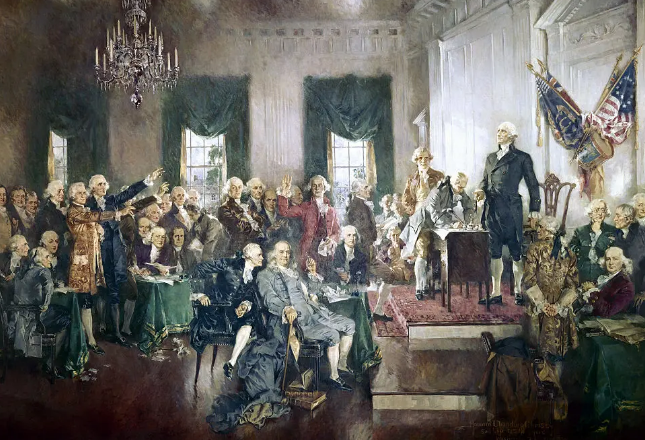
One of the earliest federal holidays enacted by Congress, Presidents’ Day honors the birthday and legacy of the first U.S. President, George Washington. Observed on the third Monday of February each year, the day is marked by patriotic parades, historical reenactments, and readings of major presidential speeches, including Washington’s Farewell Address.
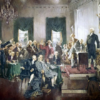
“It’s a really good opportunity to reflect on the origins of the [presidential] office and what was intended by Washington and the other framers at the Constitutional Convention,” Lindsay Chervinsky, executive director of the George Washington Presidential Library at Mount Vernon, told TIME.
The holiday is officially known as “Washington’s Birthday” under federal law, despite its common nickname. Established in 1879 by an Act of Congress introduced by Republican Sen. Stephen Wallace Dorsey of Arkansas and signed by President Rutherford B. Hayes, the holiday originally applied only to federal offices in Washington, D.C., before expanding nationwide in 1885.
Washington was born on Feb. 11, 1731, under the Julian calendar. The adoption of the Gregorian calendar in 1752 shifted his birthday to Feb. 22, 1732. The Uniform Monday Holiday Act of 1968 later moved the observance to the third Monday in February, creating three-day weekends but separating the holiday from Washington’s actual birthday.
Although Congress rejected a proposal to rename the holiday to include Abraham Lincoln, the 16th President’s birthday on Feb. 12 has led many Americans to see Presidents’ Day as honoring both leaders. Lincoln is remembered for preserving the Union and advancing the abolition of slavery.
Historical accounts suggest that Washington was not fond of birthday celebrations, with family records showing only modest observances. The Senate, however, has preserved a tradition of reading his 7,641-word Farewell Address each year, a practice dating to 1862 during the Civil War. Senators alternate parties and sign a black leather-bound book to commemorate the reading.
Presidents’ Day has also become associated with retail promotions. Beginning in the 1970s, stores began marketing sales around the long weekend, using patriotic imagery such as Mount Rushmore or the American flag. Some cultural associations, like the link to cherry pie, trace back to the legendary tale of Washington chopping down a cherry tree, although these connections are more symbolic than widespread.
The holiday also highlights the nation’s early presidents. The first seven Presidents were born before the United States existed, technically under British rule. Martin Van Buren, born in 1782 in New York, was the first President born after the Declaration of Independence and the first native-born citizen to hold the office.
Chervinsky said the observance offers a chance to reflect not only on exemplary leadership but also on the lessons learned from the nation’s challenging moments. Republican Sen. Roger Wicker of Mississippi recited the Farewell Address in 2025, describing it as “a grateful opportunity to read Washington’s words aloud and consider their enduring relevance.”