


















The nation’s two most populous states, Texas and California, are at the center of an escalating redistricting war that could reshape control of Congress ahead of the 2026 midterm elections. The clash, fueled by partisan maneuvering and pressure from President Donald Trump, has drawn in several other states and set the stage for a fierce political struggle over the balance of power in Washington.
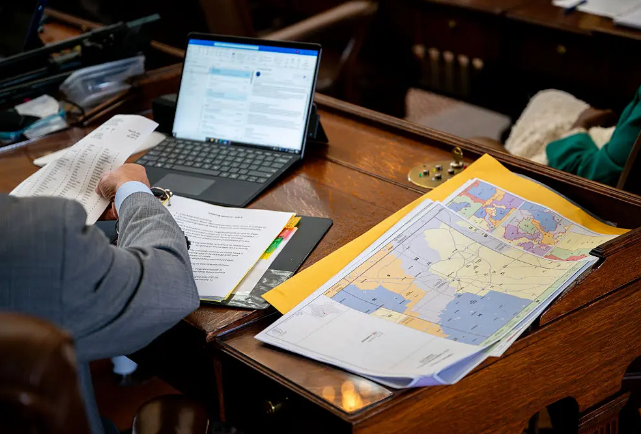
Traditionally, congressional district maps are redrawn once every decade following the national census. But in July, Republicans in Texas pushed through a rare mid-decade redistricting plan, pressed by Trump to shore up the party’s fragile House majority. Despite opposition from Texas Democrats, the state legislature approved a bill that could flip as many as five congressional seats from Democratic to Republican control. Governor Greg Abbott has pledged to sign the measure “swiftly.”
Trump has been vocal in urging other Republican-led states to follow suit. In a post on Truth Social last week, the president called on Florida, Indiana, and others to consider similar moves, predicting that Republicans could gain as many as 100 seats if they combine redistricting with efforts to restrict mail-in voting. “The CROOKED game of politics is over,” Trump wrote.
If successful, redistricting in multiple states could deliver Republicans up to a dozen additional seats in Congress, strengthening their grip on power.
Democrats, however, are not standing still. In California, Governor Gavin Newsom has spearheaded what he calls an “Election Rigging Response” campaign, aiming to counter Texas by flipping five Republican-held districts to Democratic control. Democratic leaders in Illinois, Maryland, and New York have also signaled they will pursue redistricting to offset GOP gains.
House Minority Leader Hakeem Jeffries (D-N.Y.) said Sunday that Democrats are prepared to respond strategically. “Right now, this has happened in Texas—California has responded. Let’s see what comes next,” he told CNN.
But Democrats face structural obstacles. In states such as California, independent commissions rather than state legislatures control redistricting, limiting the ability of politicians to redraw maps for partisan advantage. That could blunt Democratic efforts to fully match the aggressive Republican push.
The intensifying battle has also sparked criticism from within Republican ranks. Representative Mike Lawler (R-N.Y.) told CBS News that mid-decade redistricting undermines democracy, regardless of which party benefits. “I think gerrymandering is fundamentally wrong. It is at the heart of why Congress has been broken for so many years,” Lawler said. He plans to introduce legislation banning the practice, though he acknowledged it faces steep odds. “There’s going to be strong headwinds from both parties,” he said.
With Texas and California leading the charge, political analysts warn that other battlegrounds—including Florida, Indiana, Illinois, Maryland, and New York—are likely to become flashpoints in the coming months. The outcome of these redistricting fights could prove decisive in determining whether Democrats succeed in breaking Republican control of Congress—or whether Trump’s push for a supermajority gains momentum.