



















Connect with us

Hi, what are you looking for?

Health

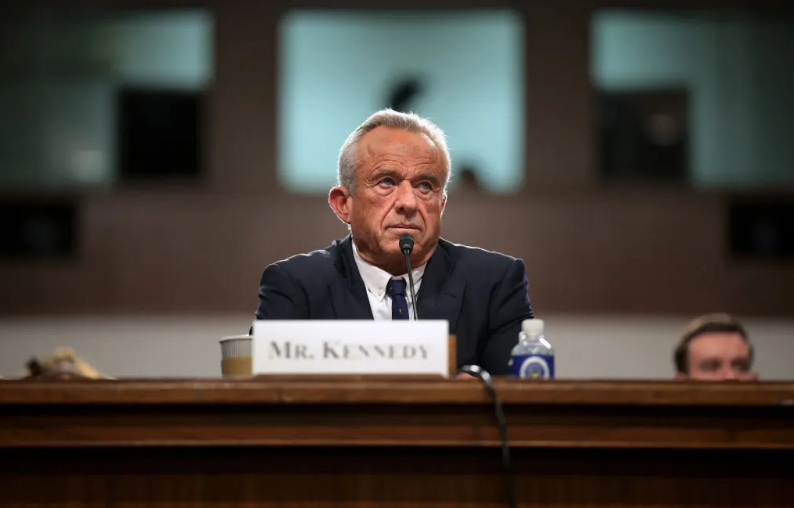
Robert F. Kennedy Jr. Grilled by Senators Over Controversial COVID-19 Views at HHS Confirmation Hearing

Robert F. Kennedy Jr., nominated by President Trump to lead the U.S. Department of Health and Human Services (HHS), faced intense scrutiny during his confirmation hearing on January 29. Democratic senators questioned him about his past statements regarding COVID-19, particularly his controversial views on race and ethnicity in relation to the virus, as well as his outspoken opposition to vaccines.

One of the most heated moments of the hearing centered on Kennedy’s 2023 comments, made while running for president, where he suggested that COVID-19 could be “ethnically targeted,” disproportionately affecting certain races. In a statement caught on video, Kennedy claimed that “COVID-19 attacks certain races disproportionately,” with “Ashkenazi Jews and Chinese” being the least affected. The remarks were condemned as anti-Semitic, leading Kennedy to clarify on social media that he had never implied the virus was intentionally engineered to spare Jews. However, the comments were raised during the hearing, where Kennedy reiterated that he did not believe the virus was “deliberately targeted.”

Experts have strongly refuted Kennedy’s claims. Research from government health agencies has shown that the disproportionate impact of COVID-19 on Black and Hispanic communities was not due to biological factors but rather social determinants such as access to healthcare, underlying health conditions, and increased exposure due to essential jobs. “The idea of biological differences by race has been disproven,” said Samantha Artiga of the Kaiser Family Foundation.

Kennedy’s anti-vaccine stance was also a focal point during the hearing. Known for his longstanding criticism of vaccines, Kennedy has described COVID-19 lockdowns, mask mandates, and vaccine policies as excessive, even comparing them to the practices of Nazi Germany. His comments comparing vaccine mandates to the Holocaust led to widespread condemnation, prompting an apology from Kennedy. At the hearing, he also questioned the appropriateness of COVID-19 vaccines for young children, despite evidence from the Centers for Disease Control and Prevention (CDC) showing that vaccines are safe and effective for children.

Dr. Gregory Poland, president of Atria Research Institute, criticized Kennedy’s reliance on flawed evidence, noting that his claims often ignore scientific consensus. “Evidence-based medicine is completely based on the scientific method, which he evidently rejects,” Poland remarked.

As a potential head of HHS, Kennedy would have significant influence over public health policy, including vaccination guidelines. This has raised concerns about his ability to lead the U.S. response to future pandemics. “The guardrails are gone,” warned Dr. Eric Burnett, assistant professor at Columbia University. “Medical experts, people who are familiar with pandemics, just won’t be there.”

Kennedy, who has vowed to dedicate resources to preventing pandemics, was also questioned about his preparedness for future health crises, such as the growing threat of bird flu. However, some experts remain wary of his ability to handle such challenges, especially given the Trump Administration’s prior actions to weaken U.S. engagement with international health organizations, such as withdrawing from the World Health Organization.

The confirmation hearing highlighted a deep divide over Kennedy’s controversial views, leaving many uncertain about his suitability to lead the nation’s health response.


Business

Fraudsters are increasingly using AI-generated images and videos to trick people into handing over sensitive personal and financial information, according to FraudSMART, the financial crime awareness initiative operated by the Banking and Payments Federation Ireland (BPFI). The organisation has reported a rise in online adverts promoting fake, State-backed investment schemes. These scams often use fabricated images of well-known politicians and business figures to make the offers appear legitimate and encourage users to click on registration links. Niamh Davenport, head of financial crime at BPFI, said scammers are deliberately exploiting recent media coverage of a planned State-backed savings and investment scheme to give their frauds a sense of credibility. “They often claim the scheme is open to everyone, but that places are limited and being ‘snapped up’ fast, in order to pressure people to act quickly,” she said. “They typically promise guaranteed returns or a guaranteed monthly income.” FraudSMART said that while anyone can be targeted, people in their early 50s are particularly vulnerable to investment scams. This age group is often focused on retirement planning, making them more receptive to financial offers that appear secure or high-yield. According to the organisation, most scams follow a similar pattern. Victims are first directed to click a registration link and complete a short online form providing their contact details. They are then contacted by someone posing as a financial adviser, who urges them to make an immediate “security deposit” to secure participation in the scheme. Once a payment is made, the money is quickly moved through multiple accounts, often overseas, making recovery extremely difficult. Davenport warned that scammers are becoming more sophisticated in their use of technology, particularly AI tools that allow them to create realistic but entirely fake promotional content. These materials are designed to mimic legitimate financial advertisements and build trust with potential victims. Recent figures from An Garda Síochána show investment fraud rose by 20% last year, with losses exceeding €20 million. The scale of individual scams varies widely, ranging from smaller crypto-related frauds involving a few hundred euro to large-scale investment schemes where victims lose tens of thousands. FraudSMART is urging the public to remain cautious when encountering online investment advertisements, especially those promising guaranteed returns or requiring urgent action. It also advises consumers to avoid sharing personal information with unverified sources and to be wary of pressure tactics designed to rush financial decisions. Authorities continue to warn that fraudsters are adapting quickly, using advanced digital tools to target victims across multiple platforms.

Trending

Business

Fraudsters are increasingly using AI-generated images and videos to trick people into handing over sensitive personal and financial information, according to FraudSMART, the financial crime awareness initiative operated by the Banking and Payments Federation Ireland (BPFI). The organisation has reported a rise in online adverts promoting fake, State-backed investment schemes. These scams often use fabricated images of well-known politicians and business figures to make the offers appear legitimate and encourage users to click on registration links. Niamh Davenport, head of financial crime at BPFI, said scammers are deliberately exploiting recent media coverage of a planned State-backed savings and investment scheme to give their frauds a sense of credibility. “They often claim the scheme is open to everyone, but that places are limited and being ‘snapped up’ fast, in order to pressure people to act quickly,” she said. “They typically promise guaranteed returns or a guaranteed monthly income.” FraudSMART said that while anyone can be targeted, people in their early 50s are particularly vulnerable to investment scams. This age group is often focused on retirement planning, making them more receptive to financial offers that appear secure or high-yield. According to the organisation, most scams follow a similar pattern. Victims are first directed to click a registration link and complete a short online form providing their contact details. They are then contacted by someone posing as a financial adviser, who urges them to make an immediate “security deposit” to secure participation in the scheme. Once a payment is made, the money is quickly moved through multiple accounts, often overseas, making recovery extremely difficult. Davenport warned that scammers are becoming more sophisticated in their use of technology, particularly AI tools that allow them to create realistic but entirely fake promotional content. These materials are designed to mimic legitimate financial advertisements and build trust with potential victims. Recent figures from An Garda Síochána show investment fraud rose by 20% last year, with losses exceeding €20 million. The scale of individual scams varies widely, ranging from smaller crypto-related frauds involving a few hundred euro to large-scale investment schemes where victims lose tens of thousands. FraudSMART is urging the public to remain cautious when encountering online investment advertisements, especially those promising guaranteed returns or requiring urgent action. It also advises consumers to avoid sharing personal information with unverified sources and to be wary of pressure tactics designed to rush financial decisions. Authorities continue to warn that fraudsters are adapting quickly, using advanced digital tools to target victims across multiple platforms.

You May Also Like

Politics

WASHINGTON — The Pentagon announced on Sunday that the United States will send a Terminal High Altitude Area Defense (THAAD) battery to Israel, alongside...

Health

NEW YORK — Teen smoking in the United States has reached an all-time low in 2024, with significant declines in overall youth tobacco use,...

Politics

WASHINGTON — As the countdown to the November 5 presidential election continues, former President Donald Trump is urging his supporters to aim for a...

Politics

In September, NASA announced that summer 2024 was the hottest on record. Just days later, the U.S. faced the dual impact of Hurricanes Helene...