


















Connect with us

Hi, what are you looking for?

Health

Apple Watch Gains FDA Clearance for Hypertension Alert Feature

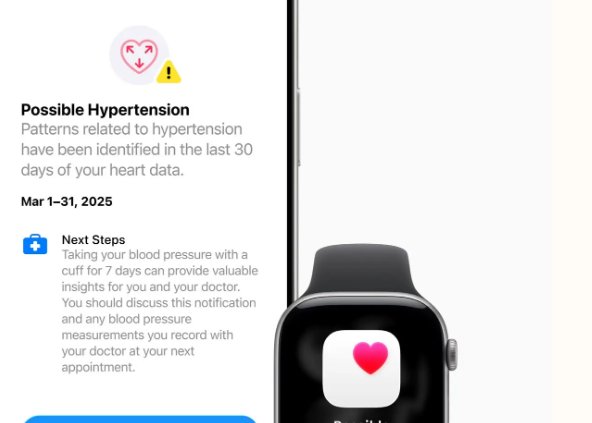
Apple Watch users will soon be able to receive alerts if they are showing signs of hypertension, following clearance of a new feature by the U.S. Food and Drug Administration (FDA) on September 11.

The tool, which will be available on Apple Watch Series 9, Apple Watch Ultra 2, and newer models in over 150 countries, does not directly diagnose high blood pressure or provide blood pressure readings. Instead, it uses the watch’s optical heart sensor to track how blood vessels contract and expand as the heart pumps. Over time, this data can reveal patterns that may indicate hypertension, prompting the device to notify the wearer and recommend consulting a doctor.

Hypertension—commonly known as high blood pressure—is one of the most widespread health issues in the U.S. According to the American Heart Association (AHA), about half of American adults are affected, but only a quarter have the condition under control. Left untreated, high blood pressure can lead to heart attacks, strokes, kidney disease, and other serious complications, with estimated costs of $131 billion annually in the U.S. alone.

The FDA’s approval follows clinical studies involving thousands of adults. In one trial, more than 2,000 participants without hypertension wore the Apple Watch for up to 12 hours a day over nearly a month. They also took daily blood pressure measurements using traditional cuffs. Results showed the Apple Watch feature was as effective as the cuff in detecting early signs of elevated blood pressure.

Medical experts have welcomed the development as a potential tool to improve awareness and early intervention. “We’ve known for a long time that high blood pressure is the major cause of heart disease, stroke, and major chronic kidney disease,” said Dr. Daniel Jones, chair of the writing committee for the upcoming 2025 AHA and American College of Cardiology (ACC) High Blood Pressure Guidelines. “Lowering blood pressure has also been shown to reduce the risk of dementia, which underscores the importance of regular monitoring—even for young adults.”

However, Jones cautioned that while wearable technology may be helpful, it is not yet considered a validated method for diagnosing or managing hypertension. The AHA and ACC continue to recommend that adults have their blood pressure measured at least once a year using a medically approved device, whether at home, a pharmacy, or a doctor’s office.

Lifestyle changes such as reducing salt intake, maintaining a healthy weight, and exercising regularly remain key to preventing and managing high blood pressure. Medications are also widely used when lifestyle adjustments are not enough.

As Apple expands its focus on health monitoring, experts say the new feature could encourage more people to engage with their cardiovascular health—but stress that it should complement, not replace, professional medical evaluation.


Business

Fraudsters are increasingly using AI-generated images and videos to trick people into handing over sensitive personal and financial information, according to FraudSMART, the financial crime awareness initiative operated by the Banking and Payments Federation Ireland (BPFI). The organisation has reported a rise in online adverts promoting fake, State-backed investment schemes. These scams often use fabricated images of well-known politicians and business figures to make the offers appear legitimate and encourage users to click on registration links. Niamh Davenport, head of financial crime at BPFI, said scammers are deliberately exploiting recent media coverage of a planned State-backed savings and investment scheme to give their frauds a sense of credibility. “They often claim the scheme is open to everyone, but that places are limited and being ‘snapped up’ fast, in order to pressure people to act quickly,” she said. “They typically promise guaranteed returns or a guaranteed monthly income.” FraudSMART said that while anyone can be targeted, people in their early 50s are particularly vulnerable to investment scams. This age group is often focused on retirement planning, making them more receptive to financial offers that appear secure or high-yield. According to the organisation, most scams follow a similar pattern. Victims are first directed to click a registration link and complete a short online form providing their contact details. They are then contacted by someone posing as a financial adviser, who urges them to make an immediate “security deposit” to secure participation in the scheme. Once a payment is made, the money is quickly moved through multiple accounts, often overseas, making recovery extremely difficult. Davenport warned that scammers are becoming more sophisticated in their use of technology, particularly AI tools that allow them to create realistic but entirely fake promotional content. These materials are designed to mimic legitimate financial advertisements and build trust with potential victims. Recent figures from An Garda Síochána show investment fraud rose by 20% last year, with losses exceeding €20 million. The scale of individual scams varies widely, ranging from smaller crypto-related frauds involving a few hundred euro to large-scale investment schemes where victims lose tens of thousands. FraudSMART is urging the public to remain cautious when encountering online investment advertisements, especially those promising guaranteed returns or requiring urgent action. It also advises consumers to avoid sharing personal information with unverified sources and to be wary of pressure tactics designed to rush financial decisions. Authorities continue to warn that fraudsters are adapting quickly, using advanced digital tools to target victims across multiple platforms.

Trending

Business

Fraudsters are increasingly using AI-generated images and videos to trick people into handing over sensitive personal and financial information, according to FraudSMART, the financial crime awareness initiative operated by the Banking and Payments Federation Ireland (BPFI). The organisation has reported a rise in online adverts promoting fake, State-backed investment schemes. These scams often use fabricated images of well-known politicians and business figures to make the offers appear legitimate and encourage users to click on registration links. Niamh Davenport, head of financial crime at BPFI, said scammers are deliberately exploiting recent media coverage of a planned State-backed savings and investment scheme to give their frauds a sense of credibility. “They often claim the scheme is open to everyone, but that places are limited and being ‘snapped up’ fast, in order to pressure people to act quickly,” she said. “They typically promise guaranteed returns or a guaranteed monthly income.” FraudSMART said that while anyone can be targeted, people in their early 50s are particularly vulnerable to investment scams. This age group is often focused on retirement planning, making them more receptive to financial offers that appear secure or high-yield. According to the organisation, most scams follow a similar pattern. Victims are first directed to click a registration link and complete a short online form providing their contact details. They are then contacted by someone posing as a financial adviser, who urges them to make an immediate “security deposit” to secure participation in the scheme. Once a payment is made, the money is quickly moved through multiple accounts, often overseas, making recovery extremely difficult. Davenport warned that scammers are becoming more sophisticated in their use of technology, particularly AI tools that allow them to create realistic but entirely fake promotional content. These materials are designed to mimic legitimate financial advertisements and build trust with potential victims. Recent figures from An Garda Síochána show investment fraud rose by 20% last year, with losses exceeding €20 million. The scale of individual scams varies widely, ranging from smaller crypto-related frauds involving a few hundred euro to large-scale investment schemes where victims lose tens of thousands. FraudSMART is urging the public to remain cautious when encountering online investment advertisements, especially those promising guaranteed returns or requiring urgent action. It also advises consumers to avoid sharing personal information with unverified sources and to be wary of pressure tactics designed to rush financial decisions. Authorities continue to warn that fraudsters are adapting quickly, using advanced digital tools to target victims across multiple platforms.

You May Also Like

Politics

WASHINGTON — The Pentagon announced on Sunday that the United States will send a Terminal High Altitude Area Defense (THAAD) battery to Israel, alongside...

Health

NEW YORK — Teen smoking in the United States has reached an all-time low in 2024, with significant declines in overall youth tobacco use,...

Politics

WASHINGTON — As the countdown to the November 5 presidential election continues, former President Donald Trump is urging his supporters to aim for a...

Politics

In September, NASA announced that summer 2024 was the hottest on record. Just days later, the U.S. faced the dual impact of Hurricanes Helene...