



















Connect with us

Hi, what are you looking for?

News

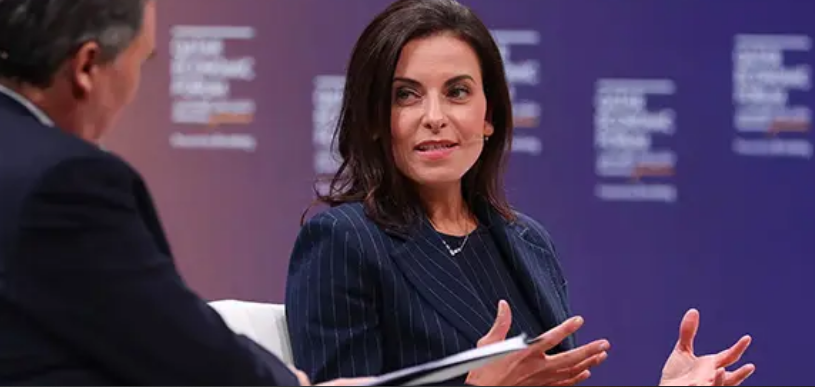
Meta Names Dina Powell McCormick to Lead AI Strategy and Capital Partnerships

Meta has appointed former Trump administration adviser Dina Powell McCormick to a newly created senior leadership role, reinforcing the tech company’s ambitions in artificial intelligence infrastructure.

The owner of Facebook, Instagram, and WhatsApp said Powell McCormick will serve as president and vice chairman, overseeing global strategy, government engagement, and capital partnerships. Her focus will be on funding and scaling Meta’s expanding AI initiatives. She will report directly to founder and CEO Mark Zuckerberg.

The announcement follows Powell McCormick’s recent departure from Meta’s board, a move that surprised investors after less than a year in the role. Zuckerberg described her experience as uniquely suited to guiding the company through its next phase of growth. “Dina’s experience at the highest levels of global finance, combined with her deep relationships around the world, makes her exceptionally well placed to help Meta navigate this next phase,” he said.

Meta has emerged as a leading investor in AI infrastructure, racing rivals including OpenAI, Microsoft, and Oracle to develop more powerful systems. The company is building multiple gigawatt-scale data centres across the United States, including a flagship site in Louisiana highlighted by former President Donald Trump and projected to cost up to $50 billion.

Zuckerberg has committed up to $600 billion in spending on infrastructure over the coming years. Meta has already begun raising tens of billions of dollars in external financing and has secured long-term energy partnerships, including nuclear power agreements, to meet the enormous electricity demands of AI. Powell McCormick will play a central role in managing these capital and energy arrangements.

She brings more than three decades of experience in global finance, including 16 years at Goldman Sachs, where she led the firm’s global sovereign investment banking business. Most recently, she was president and head of global client services at BDT & MSD Partners, where she is expected to remain on the advisory board.

Her appointment also signals Meta’s growing engagement with governments as scrutiny of AI, data centres, and energy consumption increases. Powell McCormick previously served as deputy national security adviser during Trump’s first term and held senior roles under President George W. Bush. Her husband, Dave McCormick, is a Republican senator representing Pennsylvania.

Meta’s move comes as competition in AI infrastructure intensifies. Rival projects include Elon Musk’s xAI, which recently announced a $20 billion expansion of data centre capacity near Memphis, as well as OpenAI-backed initiatives aiming to transform global computing power. Analysts say Meta’s strategy reflects its determination to combine technological innovation with financial and political influence to secure a leading position in the rapidly evolving AI sector.


Business

Fraudsters are increasingly using AI-generated images and videos to trick people into handing over sensitive personal and financial information, according to FraudSMART, the financial crime awareness initiative operated by the Banking and Payments Federation Ireland (BPFI). The organisation has reported a rise in online adverts promoting fake, State-backed investment schemes. These scams often use fabricated images of well-known politicians and business figures to make the offers appear legitimate and encourage users to click on registration links. Niamh Davenport, head of financial crime at BPFI, said scammers are deliberately exploiting recent media coverage of a planned State-backed savings and investment scheme to give their frauds a sense of credibility. “They often claim the scheme is open to everyone, but that places are limited and being ‘snapped up’ fast, in order to pressure people to act quickly,” she said. “They typically promise guaranteed returns or a guaranteed monthly income.” FraudSMART said that while anyone can be targeted, people in their early 50s are particularly vulnerable to investment scams. This age group is often focused on retirement planning, making them more receptive to financial offers that appear secure or high-yield. According to the organisation, most scams follow a similar pattern. Victims are first directed to click a registration link and complete a short online form providing their contact details. They are then contacted by someone posing as a financial adviser, who urges them to make an immediate “security deposit” to secure participation in the scheme. Once a payment is made, the money is quickly moved through multiple accounts, often overseas, making recovery extremely difficult. Davenport warned that scammers are becoming more sophisticated in their use of technology, particularly AI tools that allow them to create realistic but entirely fake promotional content. These materials are designed to mimic legitimate financial advertisements and build trust with potential victims. Recent figures from An Garda Síochána show investment fraud rose by 20% last year, with losses exceeding €20 million. The scale of individual scams varies widely, ranging from smaller crypto-related frauds involving a few hundred euro to large-scale investment schemes where victims lose tens of thousands. FraudSMART is urging the public to remain cautious when encountering online investment advertisements, especially those promising guaranteed returns or requiring urgent action. It also advises consumers to avoid sharing personal information with unverified sources and to be wary of pressure tactics designed to rush financial decisions. Authorities continue to warn that fraudsters are adapting quickly, using advanced digital tools to target victims across multiple platforms.

Trending

Business

Fraudsters are increasingly using AI-generated images and videos to trick people into handing over sensitive personal and financial information, according to FraudSMART, the financial crime awareness initiative operated by the Banking and Payments Federation Ireland (BPFI). The organisation has reported a rise in online adverts promoting fake, State-backed investment schemes. These scams often use fabricated images of well-known politicians and business figures to make the offers appear legitimate and encourage users to click on registration links. Niamh Davenport, head of financial crime at BPFI, said scammers are deliberately exploiting recent media coverage of a planned State-backed savings and investment scheme to give their frauds a sense of credibility. “They often claim the scheme is open to everyone, but that places are limited and being ‘snapped up’ fast, in order to pressure people to act quickly,” she said. “They typically promise guaranteed returns or a guaranteed monthly income.” FraudSMART said that while anyone can be targeted, people in their early 50s are particularly vulnerable to investment scams. This age group is often focused on retirement planning, making them more receptive to financial offers that appear secure or high-yield. According to the organisation, most scams follow a similar pattern. Victims are first directed to click a registration link and complete a short online form providing their contact details. They are then contacted by someone posing as a financial adviser, who urges them to make an immediate “security deposit” to secure participation in the scheme. Once a payment is made, the money is quickly moved through multiple accounts, often overseas, making recovery extremely difficult. Davenport warned that scammers are becoming more sophisticated in their use of technology, particularly AI tools that allow them to create realistic but entirely fake promotional content. These materials are designed to mimic legitimate financial advertisements and build trust with potential victims. Recent figures from An Garda Síochána show investment fraud rose by 20% last year, with losses exceeding €20 million. The scale of individual scams varies widely, ranging from smaller crypto-related frauds involving a few hundred euro to large-scale investment schemes where victims lose tens of thousands. FraudSMART is urging the public to remain cautious when encountering online investment advertisements, especially those promising guaranteed returns or requiring urgent action. It also advises consumers to avoid sharing personal information with unverified sources and to be wary of pressure tactics designed to rush financial decisions. Authorities continue to warn that fraudsters are adapting quickly, using advanced digital tools to target victims across multiple platforms.

You May Also Like

Politics

WASHINGTON — The Pentagon announced on Sunday that the United States will send a Terminal High Altitude Area Defense (THAAD) battery to Israel, alongside...

Health

NEW YORK — Teen smoking in the United States has reached an all-time low in 2024, with significant declines in overall youth tobacco use,...

Politics

WASHINGTON — As the countdown to the November 5 presidential election continues, former President Donald Trump is urging his supporters to aim for a...

Politics

In September, NASA announced that summer 2024 was the hottest on record. Just days later, the U.S. faced the dual impact of Hurricanes Helene...