
















Connect with us

Hi, what are you looking for?

Politics

A Year After Butler Shooting, Trump’s Brush With Death Defines His Second Term

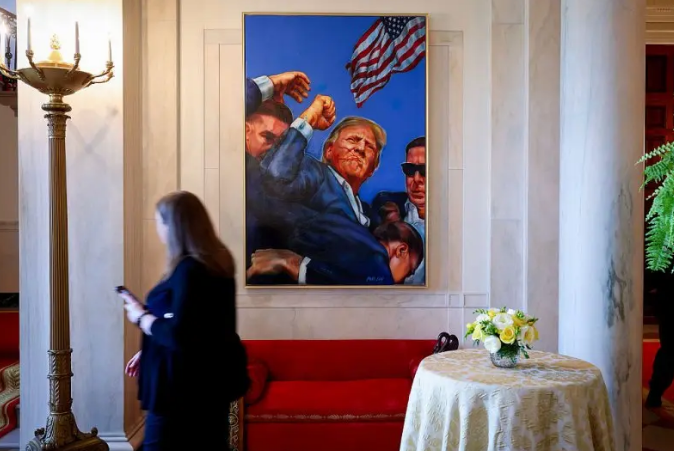
A painting now hanging in the Grand Foyer of the White House captures one of the most dramatic moments in modern American politics: Donald Trump, bloodied but defiant, raising his fist after surviving an assassination attempt in Butler, Pennsylvania. That moment, etched into the MAGA movement’s mythology, has become the symbolic cornerstone of Trump’s return to power and his approach to governance in his second term.

One year on, the failed shooting has taken on historic significance. For Trump and his allies, it represents divine intervention and personal resilience. “The MAGA movement sees this very simply and powerfully: the hand of Divine Providence interceded on the plains of Butler,” said Steve Bannon, Trump’s former chief strategist. The image of a wounded Trump, surrounded by Secret Service agents, has since been reproduced on everything from t-shirts to Christmas ornaments—revered by supporters as a moment of destiny.

The events of July 13, 2024, reshaped Trump’s campaign and presidency. A slight turn of his head spared his life, as a bullet grazed his ear rather than striking a fatal blow. He later told his family, “Holy sh-t, I got lucky.” Moments later, Trump emerged from cover and addressed the stunned crowd with a rallying cry: “Fight, fight, fight!”

The attempt on his life electrified the campaign. Within hours, influential figures like Elon Musk publicly endorsed him and contributed generously to pro-Trump political groups. Support from industry leaders and some former critics helped expand his coalition, propelling him to victory in November. “That was a horrible day,” Trump told TIME, “but I think it did change a lot of minds.”

Trump’s second term has since taken an aggressive turn. In his first six months, he has pursued sweeping changes across government, challenged powerful institutions, and taken bold foreign policy steps, including military confrontations and broad tariffs. “It’s made him more aggressive,” said Rep. Anna Paulina Luna of Florida. “It actually did define him in the presidency.”

Another attempted attack followed in September, this time while he was golfing in Florida. Trump responded by pledging to dedicate himself entirely to the campaign and, later, to governing with greater intensity. Campaign manager Susie Wiles said it marked a “difference maker” in Trump’s mindset.

Critics warn that the trauma has emboldened Trump to push a radical agenda with fewer restraints, following a political career marked by controversy, indictments, and an insurrection. But to his supporters, Trump’s resilience reaffirms his leadership. “Most people would have quit,” said Lara Trump. “He didn’t—and it paid off in spades.”

As Trump continues to reshape American institutions, many see the Butler incident not just as a turning point, but as the moment his comeback became inevitable.


Business

Fraudsters are increasingly using AI-generated images and videos to trick people into handing over sensitive personal and financial information, according to FraudSMART, the financial crime awareness initiative operated by the Banking and Payments Federation Ireland (BPFI). The organisation has reported a rise in online adverts promoting fake, State-backed investment schemes. These scams often use fabricated images of well-known politicians and business figures to make the offers appear legitimate and encourage users to click on registration links. Niamh Davenport, head of financial crime at BPFI, said scammers are deliberately exploiting recent media coverage of a planned State-backed savings and investment scheme to give their frauds a sense of credibility. “They often claim the scheme is open to everyone, but that places are limited and being ‘snapped up’ fast, in order to pressure people to act quickly,” she said. “They typically promise guaranteed returns or a guaranteed monthly income.” FraudSMART said that while anyone can be targeted, people in their early 50s are particularly vulnerable to investment scams. This age group is often focused on retirement planning, making them more receptive to financial offers that appear secure or high-yield. According to the organisation, most scams follow a similar pattern. Victims are first directed to click a registration link and complete a short online form providing their contact details. They are then contacted by someone posing as a financial adviser, who urges them to make an immediate “security deposit” to secure participation in the scheme. Once a payment is made, the money is quickly moved through multiple accounts, often overseas, making recovery extremely difficult. Davenport warned that scammers are becoming more sophisticated in their use of technology, particularly AI tools that allow them to create realistic but entirely fake promotional content. These materials are designed to mimic legitimate financial advertisements and build trust with potential victims. Recent figures from An Garda Síochána show investment fraud rose by 20% last year, with losses exceeding €20 million. The scale of individual scams varies widely, ranging from smaller crypto-related frauds involving a few hundred euro to large-scale investment schemes where victims lose tens of thousands. FraudSMART is urging the public to remain cautious when encountering online investment advertisements, especially those promising guaranteed returns or requiring urgent action. It also advises consumers to avoid sharing personal information with unverified sources and to be wary of pressure tactics designed to rush financial decisions. Authorities continue to warn that fraudsters are adapting quickly, using advanced digital tools to target victims across multiple platforms.

Trending

Business

Fraudsters are increasingly using AI-generated images and videos to trick people into handing over sensitive personal and financial information, according to FraudSMART, the financial crime awareness initiative operated by the Banking and Payments Federation Ireland (BPFI). The organisation has reported a rise in online adverts promoting fake, State-backed investment schemes. These scams often use fabricated images of well-known politicians and business figures to make the offers appear legitimate and encourage users to click on registration links. Niamh Davenport, head of financial crime at BPFI, said scammers are deliberately exploiting recent media coverage of a planned State-backed savings and investment scheme to give their frauds a sense of credibility. “They often claim the scheme is open to everyone, but that places are limited and being ‘snapped up’ fast, in order to pressure people to act quickly,” she said. “They typically promise guaranteed returns or a guaranteed monthly income.” FraudSMART said that while anyone can be targeted, people in their early 50s are particularly vulnerable to investment scams. This age group is often focused on retirement planning, making them more receptive to financial offers that appear secure or high-yield. According to the organisation, most scams follow a similar pattern. Victims are first directed to click a registration link and complete a short online form providing their contact details. They are then contacted by someone posing as a financial adviser, who urges them to make an immediate “security deposit” to secure participation in the scheme. Once a payment is made, the money is quickly moved through multiple accounts, often overseas, making recovery extremely difficult. Davenport warned that scammers are becoming more sophisticated in their use of technology, particularly AI tools that allow them to create realistic but entirely fake promotional content. These materials are designed to mimic legitimate financial advertisements and build trust with potential victims. Recent figures from An Garda Síochána show investment fraud rose by 20% last year, with losses exceeding €20 million. The scale of individual scams varies widely, ranging from smaller crypto-related frauds involving a few hundred euro to large-scale investment schemes where victims lose tens of thousands. FraudSMART is urging the public to remain cautious when encountering online investment advertisements, especially those promising guaranteed returns or requiring urgent action. It also advises consumers to avoid sharing personal information with unverified sources and to be wary of pressure tactics designed to rush financial decisions. Authorities continue to warn that fraudsters are adapting quickly, using advanced digital tools to target victims across multiple platforms.

You May Also Like

Politics

WASHINGTON — The Pentagon announced on Sunday that the United States will send a Terminal High Altitude Area Defense (THAAD) battery to Israel, alongside...

Health

NEW YORK — Teen smoking in the United States has reached an all-time low in 2024, with significant declines in overall youth tobacco use,...

Politics

WASHINGTON — As the countdown to the November 5 presidential election continues, former President Donald Trump is urging his supporters to aim for a...

Politics

In September, NASA announced that summer 2024 was the hottest on record. Just days later, the U.S. faced the dual impact of Hurricanes Helene...