



















Connect with us

Hi, what are you looking for?

Health

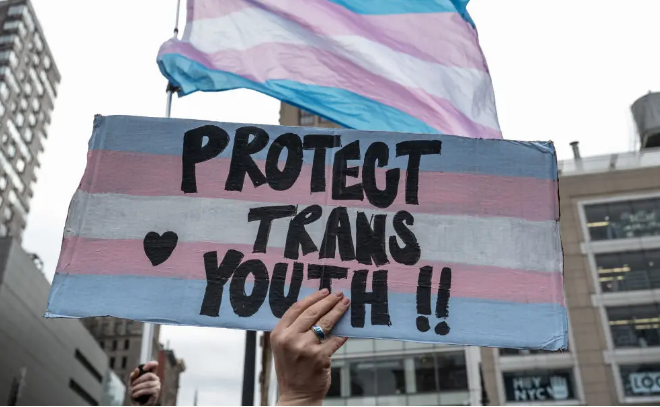
HHS Report Sparks Outrage Over Endorsement of ‘Exploratory Therapy’ for Trans Youth

A new report released by the U.S. Department of Health and Human Services (HHS) on Thursday has ignited a firestorm of criticism from LGBTQ+ advocacy groups, medical professionals, and civil rights organizations. The report recommends “exploratory therapy” — a form of psychotherapy — as an alternative to gender-affirming medical care for transgender and nonbinary youth, drawing sharp parallels to the widely discredited practice of conversion therapy.

The document, published in response to a Trump-era executive order, questions the current medical consensus around gender-affirming care and suggests that mental health therapy alone may be sufficient to treat gender dysphoria in children. It claims that research on psychotherapeutic alternatives has been stifled by what it calls a “mischaracterization” of such approaches as conversion therapy.

LGBTQ+ advocates, however, have condemned the report’s recommendations. “This is, in fact, the same harmful practice of conversion therapy, just using friendlier language,” said Casey Pick, Director of Law and Policy at The Trevor Project. “It’s a dangerous rejection of health care best practices for transgender people.”

The report follows a January executive order from former President Donald Trump titled “Protecting Children from Chemical and Surgical Mutilation.” The directive threatens to cut federal funding from hospitals and clinics that provide gender-affirming care to individuals under 19. Though the order has not yet been fully enforced, several federal agencies, including the Centers for Medicare & Medicaid Services, have signaled intent to comply.

In its language, the HHS report reflects a stark shift in tone and terminology — using terms like “sex reassignment surgery” and “pediatric medical transition” instead of “gender confirmation” or “gender-affirming care.” These changes mirror rhetoric in the executive order, which asserts that gender identity is “disconnected from biological reality.”

Medical professionals and legal experts warn that the shift in federal stance could have devastating consequences for trans youth. “Being gay or transgender is not a choice. No amount of therapy can change that,” said Shannon Minter of the National Center for Lesbian Rights.

Major medical organizations, including the American Medical Association and the American Academy of Pediatrics, continue to support gender-affirming care as safe, effective, and often life-saving. Conversely, conversion therapy has been widely discredited and linked to increased rates of depression, anxiety, and suicidal ideation.

The policy change arrives amid an ongoing legal battle over LGBTQ+ rights. The Supreme Court is expected to weigh in on two pivotal cases this year: Chiles v. Salazar, which challenges Colorado’s ban on conversion therapy, and U.S. v. Skrmetti, which addresses state bans on gender-affirming care for minors.

Advocates fear a “double blow” if the Court upholds bans on essential care while also striking down protections against conversion therapy. “These cases raise the stakes for trans youth across the country,” said Minter.

According to UCLA’s Williams Institute, more than 300,000 transgender youth aged 13 to 17 live in the U.S. As of this year, 26 states have enacted laws limiting or banning access to gender-affirming care. Meanwhile, the ACLU reports over 500 anti-LGBTQ+ bills introduced across state legislatures in the 2025 session.

“This is about our patients,” said Dr. Morissa Ladinsky, a Stanford pediatrician. “They deserve evidence-based, life-affirming care — not politically motivated ideology.”


Business

Fraudsters are increasingly using AI-generated images and videos to trick people into handing over sensitive personal and financial information, according to FraudSMART, the financial crime awareness initiative operated by the Banking and Payments Federation Ireland (BPFI). The organisation has reported a rise in online adverts promoting fake, State-backed investment schemes. These scams often use fabricated images of well-known politicians and business figures to make the offers appear legitimate and encourage users to click on registration links. Niamh Davenport, head of financial crime at BPFI, said scammers are deliberately exploiting recent media coverage of a planned State-backed savings and investment scheme to give their frauds a sense of credibility. “They often claim the scheme is open to everyone, but that places are limited and being ‘snapped up’ fast, in order to pressure people to act quickly,” she said. “They typically promise guaranteed returns or a guaranteed monthly income.” FraudSMART said that while anyone can be targeted, people in their early 50s are particularly vulnerable to investment scams. This age group is often focused on retirement planning, making them more receptive to financial offers that appear secure or high-yield. According to the organisation, most scams follow a similar pattern. Victims are first directed to click a registration link and complete a short online form providing their contact details. They are then contacted by someone posing as a financial adviser, who urges them to make an immediate “security deposit” to secure participation in the scheme. Once a payment is made, the money is quickly moved through multiple accounts, often overseas, making recovery extremely difficult. Davenport warned that scammers are becoming more sophisticated in their use of technology, particularly AI tools that allow them to create realistic but entirely fake promotional content. These materials are designed to mimic legitimate financial advertisements and build trust with potential victims. Recent figures from An Garda Síochána show investment fraud rose by 20% last year, with losses exceeding €20 million. The scale of individual scams varies widely, ranging from smaller crypto-related frauds involving a few hundred euro to large-scale investment schemes where victims lose tens of thousands. FraudSMART is urging the public to remain cautious when encountering online investment advertisements, especially those promising guaranteed returns or requiring urgent action. It also advises consumers to avoid sharing personal information with unverified sources and to be wary of pressure tactics designed to rush financial decisions. Authorities continue to warn that fraudsters are adapting quickly, using advanced digital tools to target victims across multiple platforms.

Trending

Business

Fraudsters are increasingly using AI-generated images and videos to trick people into handing over sensitive personal and financial information, according to FraudSMART, the financial crime awareness initiative operated by the Banking and Payments Federation Ireland (BPFI). The organisation has reported a rise in online adverts promoting fake, State-backed investment schemes. These scams often use fabricated images of well-known politicians and business figures to make the offers appear legitimate and encourage users to click on registration links. Niamh Davenport, head of financial crime at BPFI, said scammers are deliberately exploiting recent media coverage of a planned State-backed savings and investment scheme to give their frauds a sense of credibility. “They often claim the scheme is open to everyone, but that places are limited and being ‘snapped up’ fast, in order to pressure people to act quickly,” she said. “They typically promise guaranteed returns or a guaranteed monthly income.” FraudSMART said that while anyone can be targeted, people in their early 50s are particularly vulnerable to investment scams. This age group is often focused on retirement planning, making them more receptive to financial offers that appear secure or high-yield. According to the organisation, most scams follow a similar pattern. Victims are first directed to click a registration link and complete a short online form providing their contact details. They are then contacted by someone posing as a financial adviser, who urges them to make an immediate “security deposit” to secure participation in the scheme. Once a payment is made, the money is quickly moved through multiple accounts, often overseas, making recovery extremely difficult. Davenport warned that scammers are becoming more sophisticated in their use of technology, particularly AI tools that allow them to create realistic but entirely fake promotional content. These materials are designed to mimic legitimate financial advertisements and build trust with potential victims. Recent figures from An Garda Síochána show investment fraud rose by 20% last year, with losses exceeding €20 million. The scale of individual scams varies widely, ranging from smaller crypto-related frauds involving a few hundred euro to large-scale investment schemes where victims lose tens of thousands. FraudSMART is urging the public to remain cautious when encountering online investment advertisements, especially those promising guaranteed returns or requiring urgent action. It also advises consumers to avoid sharing personal information with unverified sources and to be wary of pressure tactics designed to rush financial decisions. Authorities continue to warn that fraudsters are adapting quickly, using advanced digital tools to target victims across multiple platforms.

You May Also Like

Politics

WASHINGTON — The Pentagon announced on Sunday that the United States will send a Terminal High Altitude Area Defense (THAAD) battery to Israel, alongside...

Health

NEW YORK — Teen smoking in the United States has reached an all-time low in 2024, with significant declines in overall youth tobacco use,...

Politics

WASHINGTON — As the countdown to the November 5 presidential election continues, former President Donald Trump is urging his supporters to aim for a...

Politics

In September, NASA announced that summer 2024 was the hottest on record. Just days later, the U.S. faced the dual impact of Hurricanes Helene...