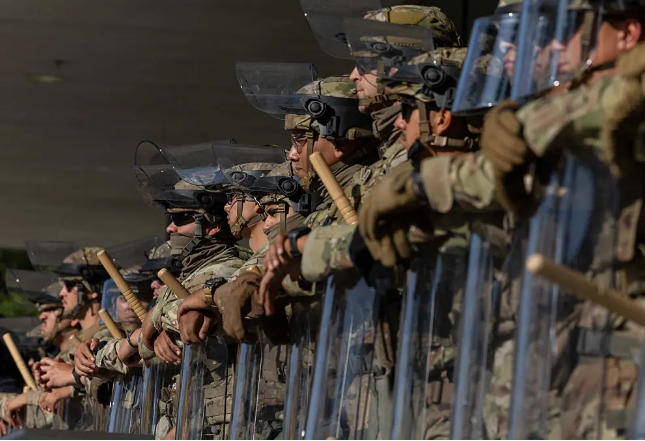
U.S. President Donald Trump has suggested he may invoke the 19th-century Insurrection Act to expand his authority to deploy the military within the United States, as opposition mounts to his use of National Guard troops in cities such as Chicago, Los Angeles and Portland.
The move comes after several governors, city officials, and courts blocked or challenged the federal deployment of Guard units, calling the actions unconstitutional and unnecessary. Trump, however, has argued that the Insurrection Act gives him the power to bypass local objections.
“We have an Insurrection Act for a reason,” Trump told reporters in the Oval Office on Monday. “It’s a way to get around pushback from officials, and I would invoke it if it were necessary — but so far it hasn’t been.” He said he would consider doing so in circumstances where “people were being killed and courts were holding us up, or mayors or governors were holding us up.”
Speaking alongside Canadian Prime Minister Mark Carney a day later, Trump again hinted at using the law, particularly in Chicago. “Chicago is a great city where there’s a lot of crime, and if the governor can’t do the job, we’ll do that job,” he said.
The remarks follow lawsuits filed by Chicago and Illinois officials, who have described Trump’s deployment of hundreds of Guard troops as “patently unlawful.” Federal judges have twice blocked similar actions in Portland, while another court ruled that sending troops to Los Angeles earlier this year violated the 1878 Posse Comitatus Act, which prohibits the use of the military for domestic law enforcement.
The Insurrection Act of 1807 allows the President to deploy the military to enforce federal law or suppress insurrection under certain conditions. However, legal experts note that the statute’s language is vague and subject to interpretation. “The current conditions just don’t rise to the level of past instances,” said Chris Mirasola, a law professor at the University of Houston. He cited historical precedents, including the 1992 Los Angeles riots and the 1957 integration crisis in Little Rock, where the law was invoked amid widespread violence and obstruction.
If Trump were to invoke the act, he would first need to issue a proclamation ordering demonstrators to disperse, followed by an executive order authorising military intervention. Mirasola said such a move would almost certainly trigger legal challenges questioning whether the conditions outlined in the law had been met.
Legal scholars and state officials have warned that invoking the act could infringe on states’ rights and strain federal-state relations. Rachel Van Cleave, professor at McGeorge School of Law, said deploying federal troops over state objections represents “an actual physical intrusion on a state’s sovereignty.”
As tensions escalate, critics argue that Trump’s stance risks politicising the military and undermining constitutional protections designed to limit federal intervention in domestic affairs.