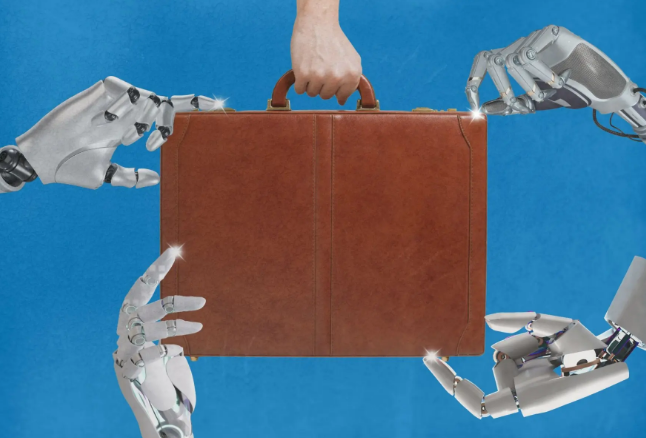
The United States is on the cusp of a transformative industrial revolution, powered not by steam or steel, but by artificial intelligence. While the technology promises historic gains in productivity and efficiency, economists and policy advocates warn of serious risks if the transition leaves American workers behind.
AI is rapidly automating jobs once considered safe from disruption, including legal research, medical diagnostics, accounting, marketing, and even software development. Positions that once paid $100,000 or more are increasingly being replaced—or redefined—by sophisticated algorithms.
The potential consequences are profound. With nearly 70% of U.S. GDP driven by consumer spending, experts caution that removing millions of workers from the economy without a clear plan could slow growth and deepen inequality.
“More profit, fewer customers. More automation, less inclusion. That’s a dangerous imbalance,” said John Hope Bryant, founder of Operation HOPE, a nonprofit focused on economic empowerment. “We need to ensure that this revolution creates more opportunity, not less.”
To help shape a more inclusive AI economy, Operation HOPE has partnered with Georgia State University to launch the AI Literacy Pipeline to Prosperity Project (AILP3). The pilot program has already trained 50 Atlanta-based youth in AI fundamentals, aiming to show that a future driven by smart tools can include all Americans—not just a tech elite.
Bryant and other advocates believe the new economy won’t necessarily require a four-year degree, but it will demand digital fluency and adaptability. Jobs like AI-assisted logistics operators, health aides using diagnostic tools, and financial coaches supported by machine learning could become the new middle-class backbone—if the right education and access are in place.
That’s where public-private partnerships and targeted investment are critical. Proposals include tying Community Reinvestment Act funds to AI training, incentivizing companies to hire reskilled workers from underrepresented communities, and supporting startups focused on “AI for good.”
“Inclusion isn’t just the right thing to do—it’s a smart economic strategy,” said Bryant. “Empowering just 30% more Americans to participate fully in the AI economy could unlock 2–3% in additional annual GDP growth.”
The call is growing for digital skills to be treated as modern infrastructure—just as essential as roads or broadband. Without that shift, experts warn, the country risks another tech boom that benefits the few while sidelining the many.
“The American Dream isn’t dead,” Bryant said. “But it needs a reboot. AI can help us run it again—smarter, fairer, and more inclusive than before.”