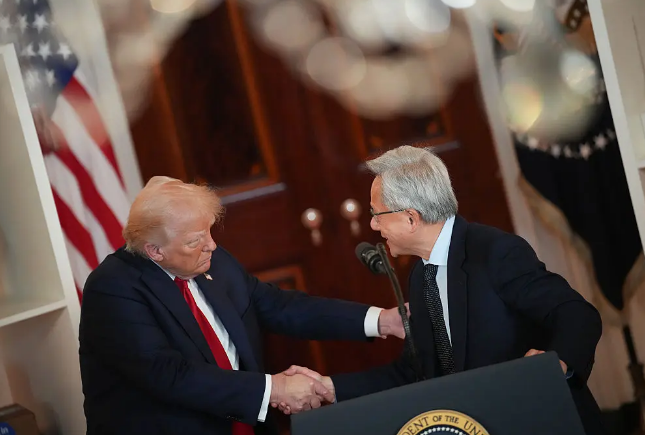
President Donald Trump announced Monday that his administration has reached an agreement allowing U.S. semiconductor giants Nvidia and Advanced Micro Devices (AMD) to resume sales of certain high-end processors to China in exchange for a share of the revenue going to the U.S. government.
Under the deal, both companies will be permitted to export slowed-down versions of their advanced processors—the Nvidia H20 and AMD MI308—in return for paying 15% of proceeds from Chinese sales to Washington. Trump said he initially sought a 20% cut but settled on 15% after negotiations with Nvidia Chief Executive Jensen Huang.
The agreement marks a significant shift in U.S. policy, which since 2022 has restricted China’s access to advanced chips over fears they could boost Beijing’s military capabilities. Earlier this year, the Trump administration tightened controls further, requiring licenses for H20 exports and halting $2.5 billion in shipments in April.
Following months of lobbying by Nvidia, including a pledge to invest $500 billion in U.S.-based server manufacturing, the White House agreed to ease restrictions. The Commerce Department began issuing export licenses for the chips last week.
Trump stressed the arrangement applies only to downgraded models and not to Nvidia’s latest and most powerful processors, such as the Blackwell series. “The Blackwell is super-duper advanced. I wouldn’t make a deal with that,” he told reporters.
While Nvidia expressed hope that the decision will help U.S. firms compete globally, Chinese authorities have reportedly advised domestic companies to avoid using the H20 for national security-related projects. Some firms are considering shifting purchases to domestic alternatives, though analysts say American chips, even in reduced-performance versions, remain highly competitive.
The agreement has sparked criticism in Washington. Representative John Moolenaar (R-Mich.) warned that tying national security to commercial terms “signals to China and our allies that American principles are negotiable for the right fee.” Representative Raja Krishnamoorthi (D-Ill.) said the deal risks sending a message that export restrictions can be bypassed for payment.
Industry analysts are split on the deal’s impact. Some see it as a pragmatic move to maintain U.S. influence in the global chip market. Others, like Beacon Policy Advisors’ Owen Tedford, worry it sets a “slippery slope” by appearing to sell export licenses to companies large enough to negotiate.
Treasury Secretary Scott Bessent has previously acknowledged that chip export controls are a bargaining tool in wider U.S.–China trade talks. The two countries recently extended their trade truce by 90 days as negotiations continue.
The White House says implementation details are still being finalized by the Commerce Department, and the arrangement could be expanded to include other technology companies.