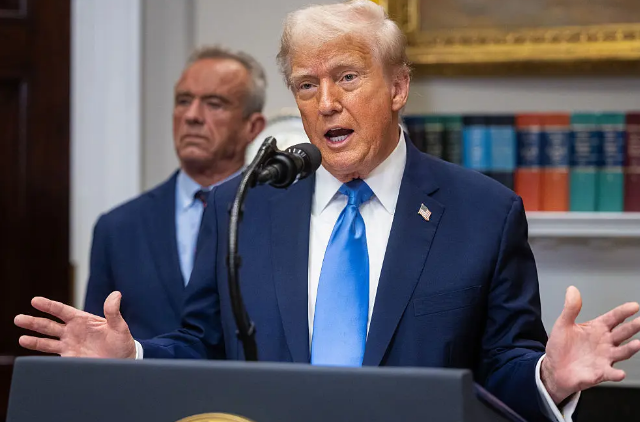
President Donald Trump has ignited fresh controversy after urging pregnant women not to take acetaminophen, claiming the widely used pain reliever carries a “very increased risk of autism.” His remarks on Monday, made without scientific evidence, were quickly challenged by leading health experts who stressed that acetaminophen is considered safe for use during pregnancy when taken as directed.
The American College of Obstetricians and Gynecologists and the Society for Maternal-Fetal Medicine both reiterated long-standing guidance that there is no proven causal link between acetaminophen use and autism. Doctors also warned that discouraging pregnant women from taking the medication could put them and their unborn children at risk, since untreated pain and fever can be harmful during pregnancy. Acetaminophen is the only over-the-counter medication approved for fever treatment in expectant mothers.
Trump, who has frequently drawn criticism for spreading misinformation on health and science issues, provided no supporting evidence for his assertion. His comments echo a pattern of past remarks that have placed him at odds with scientific consensus.
During the Covid-19 pandemic, Trump downplayed the threat of the virus, at one point declaring that “99%” of cases were “totally harmless.” He also promoted unproven treatments, including the use of disinfectant and ultraviolet light, prompting warnings from doctors about dangerous misuse. He championed chloroquine and hydroxychloroquine as potential Covid treatments despite federal health officials stressing their risks and lack of proven benefit.
On climate change, Trump has repeatedly dismissed scientific consensus, describing global warming as a “hoax” and a “scam.” He has claimed, incorrectly, that cold weather events undermine climate science and has attacked renewable energy, at one stage falsely suggesting that noise from wind turbines causes cancer.
Vaccines have been another recurring theme in Trump’s skepticism. Although he has occasionally praised their effectiveness, including highlighting the rapid rollout of Covid-19 vaccines during his first term, he has also entertained disproven claims linking vaccines to autism. Earlier this year, Trump suggested that groups avoiding vaccines and medications were less likely to experience autism, reviving a conspiracy theory rooted in a discredited 1998 study that was retracted and widely debunked.
Medical experts have consistently emphasized that rising autism diagnoses are linked to evolving diagnostic standards, not vaccines or common medications like acetaminophen. Despite this, Trump’s repeated remarks on autism and health interventions continue to alarm doctors who fear his words could fuel public mistrust of science-based medicine.
The President’s latest comments come amid broader scrutiny of his administration’s approach to health policy, including his appointment of several vaccine and climate change skeptics to senior positions. Public health organizations warned that misinformation at the highest levels risks undermining trust in evidence-based care at a time when accuracy is critical.