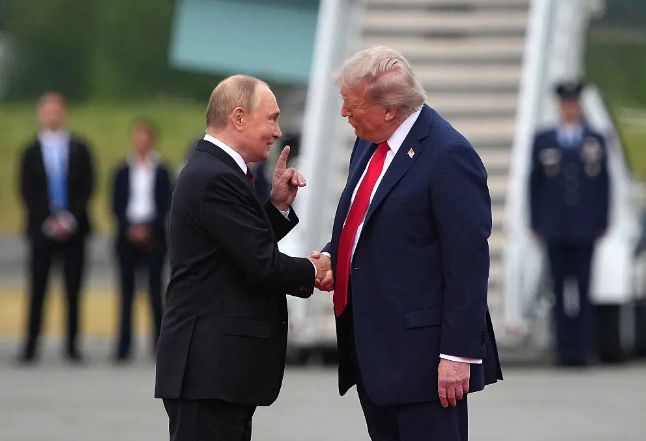
A tense round of diplomacy on Monday underscored the difficulty of advancing peace in Ukraine, as U.S. President Donald Trump urged direct talks between Russian President Vladimir Putin and Ukrainian President Volodymyr Zelensky, only to be met with defiance from Moscow.
The push came after Trump hosted Zelensky and seven European leaders at the White House in a day-long series of meetings aimed at strengthening Western unity. Late that night, Trump spoke directly with Putin, pressing the Russian leader to consider an in-person summit with his Ukrainian counterpart. But the Kremlin’s response was vague, with officials merely suggesting that future talks might involve “raising the level of representatives” rather than committing to a leader-to-leader meeting.
At the heart of Monday’s talks was a critical question: how to secure any peace agreement and who would guarantee it. European leaders signaled readiness to provide military backing for Ukraine, and Trump, in an early press conference with Zelensky, echoed that stance. “We’ll help them out with that,” Trump said, promising “very good protection, very good security” and even calling the potential guarantees “NATO-like.”
Such assurances edged closer to the binding security commitments Zelensky has long demanded. Kyiv has insisted that without firm Western guarantees, any peace deal with Russia would be meaningless, leaving Ukraine vulnerable to future aggression.
But Moscow quickly pushed back. In a statement released while Trump was still hosting European leaders, Russia’s foreign ministry warned that any attempt to station NATO or allied troops in Ukraine as part of a peace guarantee would trigger “uncontrolled escalation” with “unpredictable consequences.” The warning highlighted Russia’s consistent strategy of rejecting Western involvement in postwar security arrangements while pressing ahead with its invasion.
By the end of five hours of negotiations, Trump announced that he had “begun the arrangements for a meeting” between Putin and Zelensky, though he admitted Putin had not agreed to attend. His language on security guarantees also grew more cautious, noting only that European countries would provide assurances “in coordination with the United States.”
The shift in tone reflected the limited leverage available to Washington. Trump’s options for pressuring Moscow appeared constrained after his recent summit with Putin in Alaska, where he ruled out new sanctions or tariffs. Secretary of State Marco Rubio confirmed the stance over the weekend, saying, “I don’t think new sanctions on Russia are going to force them to accept ceasefire.”
That left Western leaders grappling with how to maintain momentum for negotiations while Russia signaled its preference to prolong the conflict. Zelensky, backed by European partners, reiterated that Ukraine would not accept peace without robust guarantees — a condition that remains deeply at odds with Moscow’s position.
As the day closed, Trump’s efforts highlighted both the urgency and the limits of U.S. diplomacy. While he succeeded in aligning more closely with European allies on the principle of protecting Ukraine, he faced a Kremlin unwilling to compromise, leaving the path toward peace as uncertain as ever.