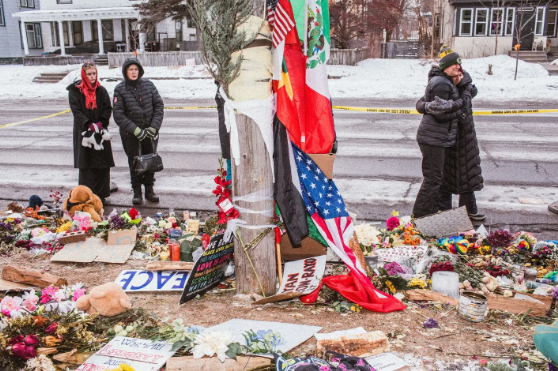
A memorial for Alex Pretti, who was shot and killed by federal agents on January 24, has grown into a sprawling display of carnations, prayer candles, poems, and messages on Nicollet Avenue in Minneapolis’ Whittier neighborhood. One note reads, “America, do not let their deaths be in vain – We the People.”
On a recent morning, Alex Hand, a 40-year-old caregiver, knelt to place lilac and maroon flowers at the site. “Alex Pretti stood up for what is right,” she said, tears forming on her cheek. Her husband, John Holman, a gallery guard at the Minneapolis Institute of Art, supported her as he recalled the day of Pretti’s death, when hundreds gathered and federal agents used tear gas and a percussion grenade to disperse the crowd. “What’s happening here is the antithesis of what Minneapolis is about,” Holman said, “but the response? I couldn’t be prouder of my city.”
The killing occurred amid Operation Metro Surge, which deployed 3,000 federal agents to Minneapolis. Over the past eight weeks, residents have organized protests, monitored school drop-offs, and provided aid to families impacted by arrests. Signal groups track ICE activity in real time, reporting vehicles and unusual movements. Lori Gesch, a 64-year-old retired grandmother, has participated in protests several days a week. “I just bought my first gas mask,” she said.
Federal authorities have announced a partial drawdown, but the operation continues. Border czar Tom Homan described the effort as “effective, but not perfect,” emphasizing that mass deportation operations remain a priority.
Local businesses have been heavily affected. Javier Perez, who runs a taco shop in southeastern Minneapolis, keeps his doors locked after two ICE visits in two months. Sales have dropped sharply, with one day recently bringing in only $82. Nearby, Ecuadorian grocery owner Luis Carlos said he fears leaving his store. “I feel like I’m in jail,” he said, describing the strain on his family and business.
Community organizers have stepped in to support affected families. Amanda Otero of TakeAction Minnesota coordinates volunteer “sanctuary school teams,” assisting over 50 families with rides, groceries, and rent payments. Daniel Hernandez and Viviana Salazar help families complete Delegations of Parental Authority (DOPA) documents, ensuring children have guardians if parents are detained.
One family, Rosalia and her son Sammy, moved to Columbia Heights to escape frequent raids. Rosalia, undocumented, designated her pastor as Sammy’s guardian in the event of detention. “I would just like for this to end,” she said, tears in her eyes. Sammy, 23, who has undergone more than 30 surgeries, expressed the mix of relief and fear these plans bring.
Hernandez, a father and business owner, has helped complete over 100 DOPAs in the past week. “The trauma is unbelievable,” he said, emphasizing the burden parents face and the steps the community is taking to protect children.
The White House estimates that ICE has detained more than 3,000 people in Minneapolis since early December, leaving many children without guardians and prompting a community-wide response in the face of fear and uncertainty.