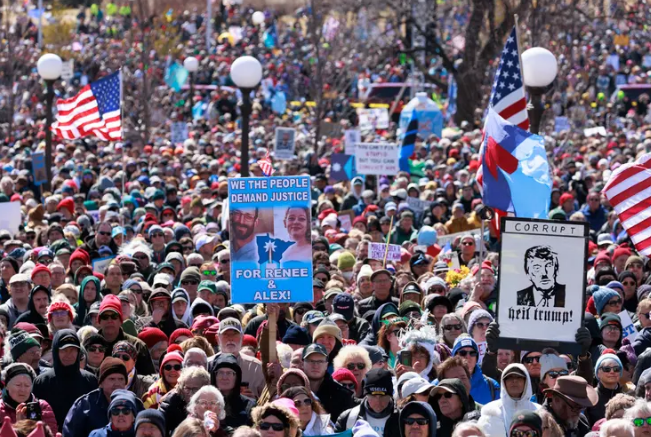
Millions of Americans took to the streets on Saturday in what organizers of the “No Kings” movement described as potentially the largest coordinated demonstration in U.S. history. From New York to California and rural towns in Kentucky, protesters rallied against President Donald Trump’s policies, including the war in Iran, immigration enforcement, and perceived authoritarian overreach. Organizers reported over 3,000 events nationwide, with participation expected to surpass the five to seven million people who joined previous protests last year.
In Minnesota, the flagship rally drew at least 50,000 people to the State Capitol in St. Paul. The event featured a lineup of high-profile speakers and performers, including Senator Bernie Sanders, Jane Fonda, and Bruce Springsteen. Springsteen performed “Streets of Minneapolis,” a song inspired by fatal federal immigration raids in the city, and addressed victims of the raids, highlighting the deaths of Renée Good and Alex Pretti. Sanders called the moment “unprecedented and dangerous,” warning that Americans must resist authoritarianism and ensure the country remains governed by its people.
New York City also saw tens of thousands of demonstrators across all five boroughs. The largest gathering took place on Seventh Avenue in Manhattan, where actor Robert De Niro, civil rights activist Rev. Al Sharpton, and New York Attorney General Letitia James spoke. De Niro urged citizens to uphold core American values, saying, “We’re going from the streets to the ballot box and because we all deserve a country with no king.”
The protests reflected a wide range of grievances. Some demonstrators criticized Congress for failing to act on immigration, the war in Iran, and stalled federal funding. Others focused on proposed voting law changes, environmental rollbacks, and threats to democratic norms. Participants spanned generations, from veterans to young adults. Natalia and Sailor, both 21, attended to represent their age group and protest Trump’s immigration policies. Immigrant demonstrator Beatrice Moritz expressed concern over the Safeguard American Voter Eligibility (SAVE) Act, arguing that it would restrict voting rights.
In Washington, D.C., protesters marched from Arlington to the National Mall, chanting “No justice, no peace. No ICE in our streets,” and carrying oversized effigies of government officials. Demonstrations in other cities included symbolic acts such as a melting ice sculpture in Austin and a memorial for children killed in a missile strike in Boston.
The protests remained largely peaceful, with only a few counter-demonstrations reported. Indivisible co-founder Ezra Levin called for a nationwide economic protest on May 1 to emphasize worker power over corporate interests. Senate Minority Leader Chuck Schumer highlighted the scale of turnout as “a very strong sign of what’s coming in November.”
The White House sought to downplay the protests, with a spokesperson describing them as events of interest mainly to reporters. Recent polling shows Trump’s approval ratings have dropped to their lowest levels since his return to the presidency, highlighting growing public discontent with his administration.