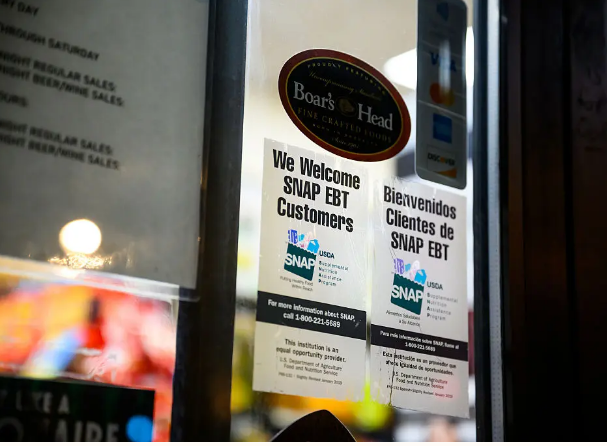
Nearly 42 million Americans who rely on the Supplemental Nutrition Assistance Program (SNAP) are caught in growing uncertainty as delayed payments stretch into a second month amid the ongoing U.S. government shutdown. The disruption, caused by a lack of available funds, has turned SNAP into a central issue in the political standoff between President Donald Trump and congressional Democrats.
Senator Elizabeth Warren accused Trump of using “hungry children as a bargaining chip,” echoing comments from California Governor Gavin Newsom, who said last month the president was “endangering people’s lives.” Concerns intensified this week after Trump posted on Truth Social that SNAP benefits would not resume “until the radical left Democrats open up government.” The post appeared to contradict a federal court order requiring the administration to resume partial payments.
Two federal judges have ruled that the U.S. Department of Agriculture (USDA) must use contingency funds to pay out benefits during the shutdown. Massachusetts Judge Indira Talwani called the suspension unlawful, while Rhode Island Judge Jack McConnell ordered the administration to use emergency funds “now” to ensure families receive aid.
The White House quickly clarified Trump’s statement, saying it would comply with the court order. Press secretary Karoline Leavitt explained that the president “does not want to have to tap into this fund in the future,” but confirmed that the administration is following judicial directives.
According to USDA data, SNAP distributed $99.8 billion in benefits in 2024, supporting nearly 42 million people nationwide. The average recipient received about $187 a month. This year, however, the administration plans to release only half the usual amount, using $4.65 billion from the USDA’s $6 billion contingency fund.
New eligibility restrictions have also been introduced under Trump’s “Big, Beautiful Bill,” signed into law on July 4. Those no longer eligible include certain groups of noncitizens, refugees, and parolees who previously qualified after a five-year waiting period.
State agencies are now scrambling to manage the partial disbursements. North Carolina officials told residents they could see benefits as early as next week if funds arrive on time. “If federal funding is provided this week as expected, the North Carolina Department of Health and Human Services expects all partial benefits to be loaded onto EBT cards by next week,” the agency said.
USDA Secretary Brooke Rollins warned of widespread delays, citing the need for revised eligibility systems and state notifications. “If the government opens, families get their full benefit much more quickly,” she said.
Cities and nonprofit organizations are now challenging the administration in court, demanding full payment of SNAP benefits. In an emergency filing, a coalition including Albuquerque, Baltimore, Columbus, and Providence argued that withholding full benefits is “arbitrary and capricious.” The case, represented by advocacy group Democracy Forward, will be heard on Thursday as millions wait for food assistance that remains tied up in Washington’s political deadlock.